
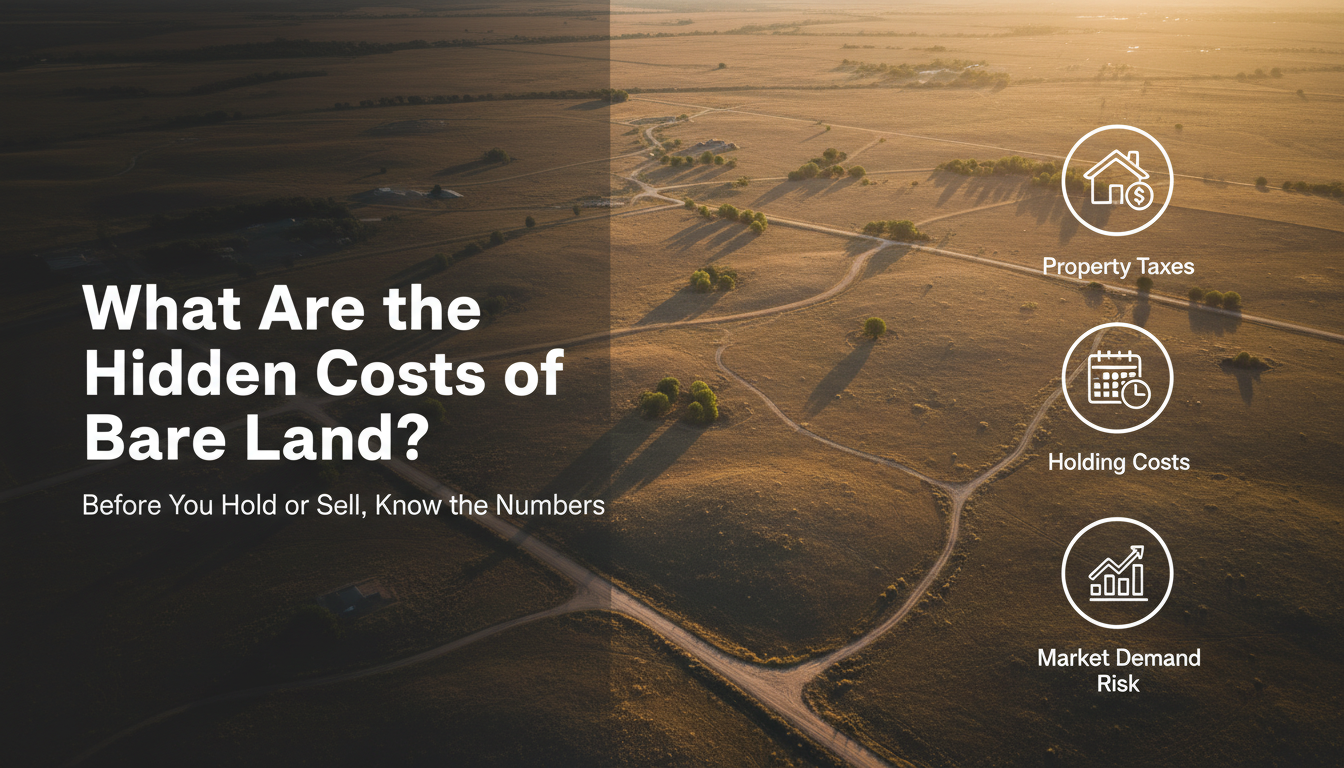
If you own bare land in Salem, Marion County, or anywhere in the Willamette Valley, you already know the obvious costs: the purchase price and the annual property tax bill. What most land owners do not realize is how many additional costs stack quietly on top of those two, year after year, whether the land ever produces a dollar of income or not.
Below is an honest, researched breakdown of what vacant land actually costs to hold in Oregon, and why so many owners end up losing money on an asset they assumed was simply “sitting there.”
Read more:Sell or Hold Oregon Bare Land? An Honest Financial Analysis (2026)
1. Property Taxes: The Cost You Already Know About
Oregon’s average effective property tax rate runs around 0.77%, with a median annual bill near $2,745 statewide, though this varies significantly by county. Rates across Oregon’s 36 counties range from a low of about 0.53% in Josephine County to a high of just over 1% in Gilliam County.
For bare land, this bill arrives every single year regardless of whether the property earns income, and it typically climbs over time as assessed values rise with local levies and school bonds. Land owners who bought a parcel a decade ago and have not looked closely at their tax statement since are often surprised at how much the number has grown.
The key point: property tax on vacant land is a fixed cost with zero offsetting revenue, unless the land is generating income or is enrolled in a special assessment program.
2. The Farm and Forestland Deferral Trap
Many Oregon land owners enroll their property in a farm use or forestland special assessment to reduce their annual tax bill. These programs, established under Oregon law in 1961, let owners defer a significant portion of property tax as long as the land is actively farmed or actively managed for timber production.
Here is the hidden cost almost nobody explains up front: this is a deferral, not a discount. If the land later loses its eligibility because it no longer meets farm income requirements, the owner changes its use, or someone develops it, the county calculates the back taxes and bills the owner for the deferred amount. In many Oregon counties, this penalty covers up to ten years of back taxes for land outside an urban growth boundary, and up to five years for land inside one.
Locally, Marion County’s own assessor guidance confirms that in an Exclusive Farm Use zone, this potential additional tax liability becomes due once the land’s use changes to something incompatible with returning it to farm use, such as residential, commercial, or industrial development.
If you inherited land enrolled in one of these programs or plan to exchange bare land for income property, calculate the potential rollback liability before making the transaction. Do not discover it after the fact.
Read more: How Do I Find Out If My Oregon Land Has Water Rights? (Step-by-Step Verification Guide)
3. Noxious Weed Control Obligations
Oregon law does not treat weed control on vacant land as optional. Under Oregon’s noxious weed statutes, any person, firm, or corporation that owns or occupies land within a weed control district must destroy or prevent designated noxious weeds from seeding on the property. County weed inspectors may enter the property, and they may carry out control or eradication work with or without charging the owner.
In practice, this means:
- Undeveloped acreage in Marion, Polk, or Yamhill County can trigger a county notice if noxious species like Scotch broom, tansy ragwort, or blackberry are allowed to spread unchecked.
- Owners who ignore the notice can face the cost of county-performed eradication, billed back to them, sometimes attached as a lien.
- This is an ongoing, recurring cost for any parcel of meaningful size, not a one-time cleanup.
4. Liability Exposure, Even Without a Structure on the Property
A common misconception says that liability risk applies only to developed property. Oregon law does not support that view. Property owners can face liability when an injured person shows that the owner knew or should have known about a hazardous condition and failed to take reasonable steps to fix it. Oregon’s comparative fault system can also allow an injured trespasser to recover damages when the trespasser’s share of fault remains lower than the landowner’s.
The attractive nuisance doctrine can increase this risk. Features such as ponds, old structures, wells, or abandoned equipment may attract children to vacant land. If a child suffers an injury because of one of these features, the landowner may face liability even when the child entered the property without permission.
Additional risks specific to undeveloped acreage include:
- Illegal dumping, which can create environmental cleanup costs and, in some cases, hold the current owner responsible for contamination even if it predates their ownership.
- Unauthorized use, such as off-roading, hunting, or camping, which raises both liability and property damage risk.
- No trespassing signage alone does not eliminate liability. Posting signs helps, but it does not fully protect an owner from a premises liability claim in Oregon.
Most standard homeowner policies do not cover raw land at all, which means many owners are carrying this risk with no insurance in place whatsoever.
Read more: How Do I Avoid Capital Gains Tax When Selling Oregon Property? (Three Legal Tools That Work)
5. Opportunity Cost: The Cost You Cannot See on Any Bill
This is the hidden cost that matters most, and the one that never shows up on a tax statement or an invoice.
Bare land, on average, appreciates more slowly than the cost of living rises. When land value grows around 2 to 3% a year while inflation runs closer to 3 to 3.5%, the land is technically losing real purchasing power every year it sits undeveloped and non-producing, even while the owner keeps paying taxes, weed control costs, and carrying insurance premiums on it.
Compare that to income producing property acquired through a 1031 exchange, which can generate 10 to 11% annual returns with monthly cash flow, and the true cost of holding bare land becomes clear. It is not just the taxes and the liability. It is the income that land could be generating instead.
How Much Is Your Bare Land Actually Costing You?
Between property taxes, potential rollback penalties, weed control obligations, liability exposure, and lost income potential, many Salem area land owners are carrying far more cost than they realize on a parcel that is not making them a dollar.
A free land evaluation can show you the real numbers: what your land is costing you annually, what its current market value is, and what it could be earning if converted into income property through a 1031 exchange.
Get My Free Land Evaluation
Frequently Asked Questions
Do I have to pay property tax on land I am not using?
Yes. Oregon property tax applies to vacant and undeveloped land the same as it does to developed property, based on assessed value, regardless of whether the land generates income.
What happens if my farm or forestland deferral gets disqualified?
The county calculates the deferred tax amount you would have owed without the special assessment and bills it as a lump sum, going back several years depending on your zoning and location relative to the urban growth boundary.
Am I liable if someone gets hurt on my vacant land in Oregon?
Potentially, yes, even if they were trespassing. Oregon’s attractive nuisance doctrine and comparative fault rules mean landowners can still face liability for injuries on undeveloped property.
Is a 1031 exchange a way to avoid these costs?
A 1031 exchange lets you move the equity in your bare land into income producing property without triggering a capital gains tax bill, which can convert a cost-generating asset into one that produces monthly cash flow instead.
503-949-5025 | al@cronemiller.com | HomesForSaleSalemOregon.net
Al Cronemiller | Oregon Land Specialist | MORE Realty | Salem, Oregon