If you own bare land, timberland, or agricultural acreage in Salem, Marion County, or anywhere in the Willamette Valley, you have probably asked yourself some version of this question. You bought the land as an investment. Prices seem to go up every year. So why does it feel like you are not actually getting ahead?
The honest answer is more nuanced than most land owners realize, and the data backs that up. Some categories of Oregon land have genuinely outpaced inflation for decades. Others have barely kept up, or have lost real value in recent years. The difference comes down to land type, location, and whether the land is producing any income at all. Here is what the research actually shows.
What Inflation Has Actually Done in Recent Decades
Before comparing land to inflation, it helps to know the real baseline. According to Bureau of Labor Statistics data, inflation in the United States has averaged close to 2.6% annually from 2000 through 2026, though the path was far from smooth. Inflation ran near zero in 2009 during the financial crisis, then spiked above 8% in 2022, the highest annual rate in four decades, before cooling back down toward more normal levels.
Over the longer run, going back more than a century, average annual inflation in the United States has hovered closer to 3%. That 3% figure is the number your land needs to beat every single year just to preserve your purchasing power, not to build wealth.
Read more: What Is Oregon’s Urban Growth Boundary? How It Affects Your Land Value
How Oregon Farmland Has Actually Performed
This is where it gets interesting, and where the story is more complicated than a simple yes or no.
According to Oregon State University Extension Service research, Oregon farmland values have generally kept pace with or exceeded inflation over the past 25-plus years, based on USDA survey data tracked from 1998 through 2025. That is a genuinely strong long-term track record for productive, income generating agricultural land.
But the details matter. In the most recent USDA reporting period, non-irrigated cropland actually declined in real, inflation-adjusted terms, even while irrigated cropland and pastureland continued to post modest gains. Growth across nearly every land category also slowed in 2024 and 2025 compared to prior years, according to the same OSU Extension analysis, partly due to higher interest rates and partly due to factors like the 2024 Oregon wildfires affecting nearby land values.
Zoom out to the county level and the picture becomes even more uneven. Oregon Capital Chronicle reporting on 2022 Census of Agriculture data found that average Willamette Valley farmland was valued above 20,000 dollars per acre, driven largely by high value crops like wine grapes and orchard fruit. Meanwhile, land in several Eastern Oregon counties averaged closer to 1,400 dollars per acre in the same period. Both are technically Oregon farmland. Their economics are almost nothing alike.
The takeaway: land tied to active, high value agricultural production in places like the Willamette Valley has a real, data supported case for beating inflation. Land that sits unused, or land in a category currently under price pressure like non-irrigated cropland, does not automatically get the same result.
Where Bare, Non-Producing Land Is Different
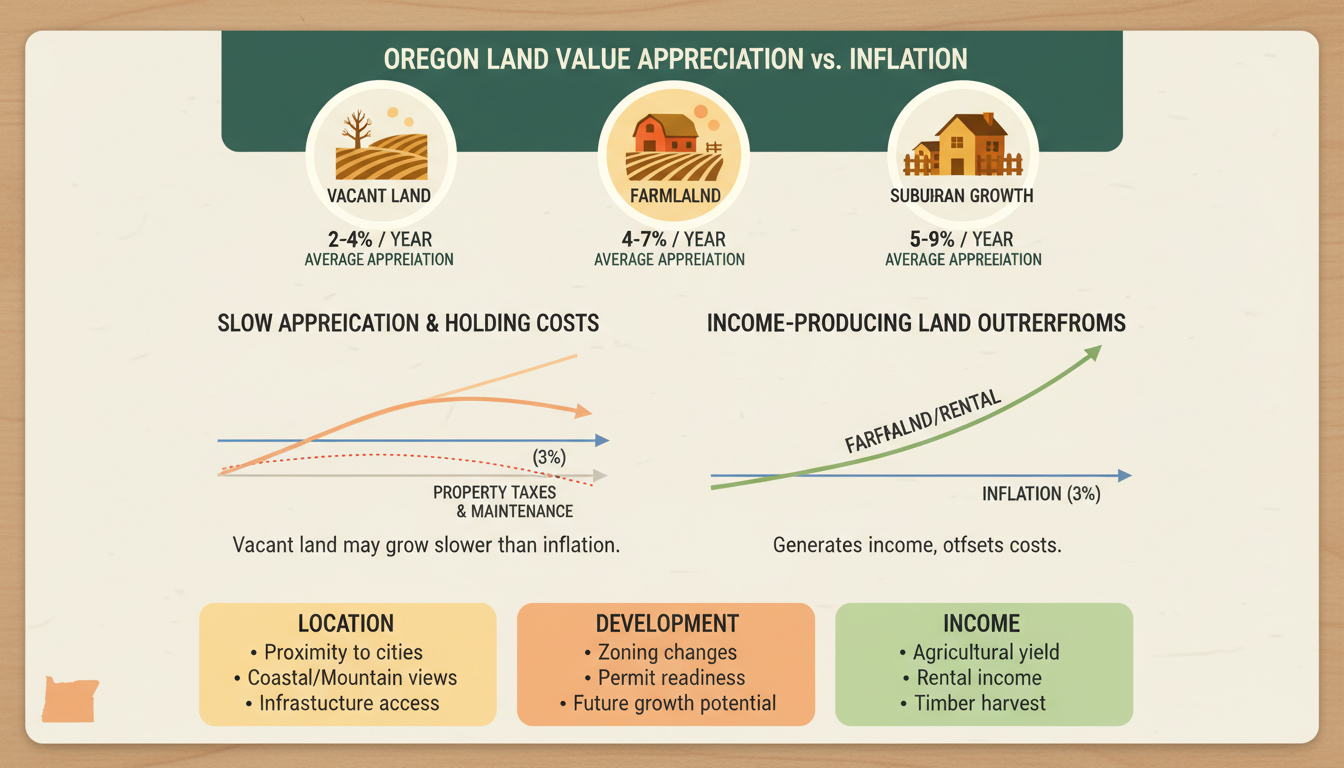
Here is the distinction most land owners never hear from a general real estate agent: national farmland, as a broad tracked asset class, has appreciated at roughly 5% to 6% annually over recent decades according to multiple agricultural lending sources. But that number reflects productive farmland with crops, irrigation, or active management behind it.
Raw, vacant, or bare land with no agricultural production and no income stream is a different animal. Federal Housing Finance Agency research on land price appreciation notes that land values are highly dependent on local factors like population growth, infrastructure investment, and shifting buyer preferences, meaning appreciation is not evenly distributed and can be essentially flat in areas without growth drivers. Industry land market data echoes this: there is no single reliable national average for raw land appreciation because raw land values are, in practice, hyper local.
This matters for Salem area land owners because two nearby parcels, one inside a growth corridor and one outside it, can have completely different appreciation stories over the same ten year period, even if both are labeled bare land on paper.
Read more: How Do I Sell Timberland in Oregon? (What Buyers Want and How to Maximize Your Return)
The Carrying Cost Problem Nobody Talks About
Even when bare land does appreciate on paper, that appreciation is not the same as real return. Every year you hold non-producing land, you are paying property taxes, and in some cases insurance or maintenance costs, with zero income coming back in the other direction.
This is the core problem with comparing land appreciation to inflation in isolation. A parcel that appreciates at 3% annually while you pay 1% of its value in property taxes every year is not actually beating inflation once carrying costs are factored in. It is treading water at best.
Income producing property changes this equation entirely. Instead of paying carrying costs on an asset that sits idle, you collect rent or lease income every month, often while the underlying property also appreciates. That combination, appreciation plus cash flow, is a fundamentally stronger position than appreciation alone, and it is the entire logic behind using a 1031 exchange to move out of bare land and into income property without triggering a capital gains tax bill in the process.
What This Means for Salem and Willamette Valley Land Owners
If you own productive, well located agricultural land in the Willamette Valley, particularly land growing high value crops, the data suggests you may genuinely be keeping pace with or beating inflation. That is a real, defensible position, and it may mean holding is the right call.
If you own bare, non-irrigated, or non-producing acreage anywhere in Marion County, Polk County, or the surrounding region, the picture is far less certain. You may be appreciating slower than inflation once carrying costs are included, and you have no income to show for the years of ownership in the meantime.
The only way to know which situation applies to you is to look at your specific parcel, its location, its current use, and its realistic income potential compared to what a 1031 exchange into income producing property could generate instead.
Read more: What Disclosures Are Required When Selling Land in Oregon? (Everything Sellers Must Know)
Frequently Asked Questions
Does all land in Oregon appreciate at the same rate?
No. Appreciation varies significantly by land type, location, and whether the land is in active agricultural production. Willamette Valley cropland and Eastern Oregon rangeland have very different value trajectories even though both are technically Oregon farmland.
Is bare land a good inflation hedge?
It can be, but it depends heavily on location and growth drivers nearby. Bare land with no income and ongoing property tax costs needs strong appreciation just to break even against inflation and carrying costs combined.
What is a safer alternative to holding bare, non-producing land?
Many Oregon land owners use a 1031 exchange to move equity out of bare land and into income producing property, which can provide both appreciation potential and monthly cash flow, without triggering capital gains tax at the time of the exchange.
How do I find out if my specific land is appreciating faster or slower than inflation?
A land specific evaluation, factoring in location, land type, and comparable local sales, is the only reliable way to know. A free land evaluation can show you how your specific parcel is trending and what your options are.
Ready to See What Your Land Is Actually Doing for You?
If you are not sure whether your bare land in Salem, Marion County, or the wider Willamette Valley is beating inflation or quietly falling behind, a free, no obligation land evaluation can give you a clear answer based on your specific property, not a national average.
503-949-5025 | al@cronemiller.com | HomesForSaleSalemOregon.net
Al Cronemiller | Oregon Land Specialist | MORE Realty | Salem, Oregon