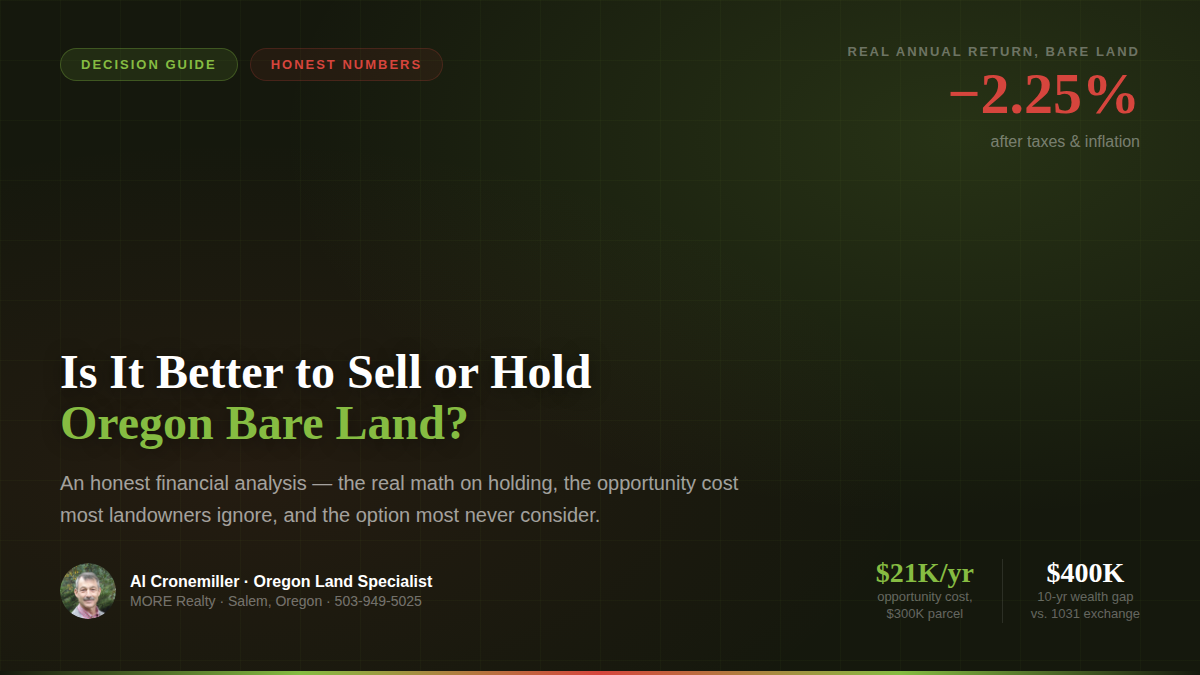
If you own bare land in Salem, Marion County, or anywhere in the Willamette Valley, you have probably asked yourself this question more than once. Land feels like a safe, simple asset to hold onto. No tenants, no repairs, no phone calls at midnight. But safe and simple are not the same thing as profitable, and the numbers tell a more complicated story than most land owners realize.
This is not a sales pitch dressed up as an article. It is a straightforward look at what the data actually shows about holding versus selling Oregon bare land, so you can make a decision based on facts rather than assumptions.
Read more: What Are the Hidden Costs of Owning Vacant Land in Oregon?
What the Data Says About Oregon Land Values Right Now
Oregon land values are not moving as uniformly as many owners assume. Recent farmland data from Oregon State University’s Extension Service shows a mixed picture depending on land type:
- Irrigated cropland in Oregon has continued climbing, now averaging around $8,000 per acre, a real gain of roughly 2.5% over the past year.
- Non-irrigated cropland has actually softened, dropping to about $3,000 per acre, a real decline of around 2.3%.
- Pastureland sits near $1,080 per acre, up a modest 0.8%.
- Forestland, which makes up nearly half of Oregon’s total land area, has averaged closer to 5% annual appreciation over the past five years, driven largely by timber and recreational demand.
Zoom out further and the trend gets more interesting. Oregon farm real estate values rose a strong 23% between 2017 and 2022, then another 6.3% between 2023 and 2024. But 2025 told a different story: for the first time since 2013, Oregon’s farm real estate value declined in inflation adjusted terms, down roughly 0.4%.
Read more: Does Land Appreciation Beat Inflation in Oregon?
The Carrying Costs Nobody Budgets For
Appreciation is only half the equation. The other half is what it costs you to simply keep the land every year, whether it produces income or not.
Property taxes. In Marion County, the effective property tax rate runs close to 0.84 to 0.88%, above the statewide Oregon average of roughly 0.77 to 0.78%. That means a land owner with a $400,000 parcel is paying somewhere in the range of $3,300 to $3,500 a year in property taxes alone, whether the land earns a dollar or not.
Insurance and maintenance. Weed abatement, fire mitigation, fencing, access roads, and liability insurance add up quietly year after year, particularly on larger rural parcels.
Wildfire exposure. This is a cost most land owners never price in until it hits them. Oregon wildfires have been shown to reduce farmland values by roughly $616 to $952 per acre based on two decades of sales data. On a 100 acre parcel, that is a potential swing of $60,000 to $95,000 in value tied to fire risk alone.
Opportunity cost. This is the biggest and least visible cost of all. Every dollar of equity sitting in bare land is a dollar not earning rental income, dividends, or interest anywhere else.
Read more: Does Land Appreciation Beat Inflation in Oregon?
The Inflation Problem
Here is the piece of the puzzle most land owners never run the numbers on.
The current annual inflation rate in the United States sits at roughly 3.5%. If your bare land is appreciating at 2 to 3% a year, which is a realistic range for most non-irrigated or forested parcels outside high demand growth corridors, your land is not actually gaining value in real terms. It is losing ground to inflation while you continue paying property taxes on it.
This is not true for every parcel. Irrigated farmland and forestland near recreational demand have outpaced inflation in recent years. But a meaningful share of Oregon’s bare land, particularly land bought purely as a long term hold with no active use, has been running at or below the rate of inflation once carrying costs are factored in.
The Tax Reality of Selling Bare Land Outright
If you sell bare land in Oregon and simply take the proceeds, the state does not go easy on you. Oregon taxes capital gains as ordinary income, with a top state rate of 9.9%, one of the highest in the country. Combine that with federal long term capital gains rates of up to 20%, plus a potential 3.8% net investment income tax for higher earners, and total combined tax exposure on a straight land sale can reach roughly 33.7% for top bracket sellers.
On a piece of land with substantial appreciation or a low original cost basis, that is a significant chunk of your equity handed over at closing, money that could otherwise be working for you in a new asset.
Read more: New Rules for Oregon Real Estate Investing
The Honest Case for Holding
To be fair, holding is not automatically the wrong move. It makes sense when:
- Your land is forestland or recreational property appreciating faster than inflation.
- You have a specific development or use plan within the next few years.
- The land carries sentimental or family significance that outweighs pure financial return.
- You are in a low tax bracket where a future sale would trigger minimal capital gains exposure.
If your land falls into one of these categories, selling or exchanging may not be the right move yet, and any honest advisor should tell you that directly.
The Honest Case for Selling or Exchanging
Selling, or more specifically exchanging into income producing property, tends to make sense when:
- Your land is non-irrigated, undeveloped, or in a category currently underperforming inflation.
- You are paying meaningful property taxes and carrying costs on land generating zero income.
- You have significant unrealized capital gains and want to avoid a large tax bill.
- You want your equity working for you through monthly cash flow instead of sitting dormant.
Land owners who move bare land into income producing property through a 1031 exchange commonly see returns in the 10 to 11% range with consistent monthly cash flow, a very different outcome than watching an acreage parcel slowly track sideways against inflation.
Sell vs. Hold: A Side by Side Comparison
| Factor | Holding Bare Land | Selling via 1031 Exchange |
|---|---|---|
| Typical annual return | 0.8% to 5%, land type dependent | 10% to 11%, income property dependent |
| Monthly cash flow | None | Yes, ongoing |
| Property tax exposure | Continues, no offsetting income | Shifts to new income property, offset by cash flow |
| Capital gains tax | Deferred until sale, then due in full | Deferred indefinitely through proper exchange structuring |
| Wildfire and carrying cost exposure | Ongoing, unmanaged | Reduced or transferred depending on new asset |
| Inflation protection | Inconsistent across land types | Stronger, tied to income growth potential |
Frequently Asked Questions
Is Oregon bare land a good investment right now?
It depends heavily on land type. Irrigated cropland and forestland have generally outpaced inflation in recent years, while non-irrigated and rural infrastructure light parcels have lagged, and in some cases declined in real terms in 2025.
How much does it cost to hold bare land in Marion County each year?
Between property taxes, at an effective rate of roughly 0.84 to 0.88%, plus insurance, maintenance, and fire mitigation, carrying costs on a mid sized parcel commonly run several thousand dollars a year with no offsetting income.
What happens if I just sell my bare land without a 1031 exchange?
You will owe capital gains tax on the appreciation, potentially up to a combined 33.7% between Oregon state tax and federal capital gains tax for higher income sellers.
Can I do a 1031 exchange on inherited land?
In most cases, yes, as long as the land is held as an investment property rather than personal use property.
How fast do I need to move once I sell?
The IRS requires you to identify replacement property within 45 days of closing your sale and complete the exchange within 180 days.
📞 503-949-5025 | ✉️ al@cronemiller.com | HomesForSaleSalemOregon.net
Al Cronemiller | Oregon Land Specialist | MORE Realty | Salem, Oregon
https://shorturl.fm/MEbhR
https://shorturl.fm/g39wg