
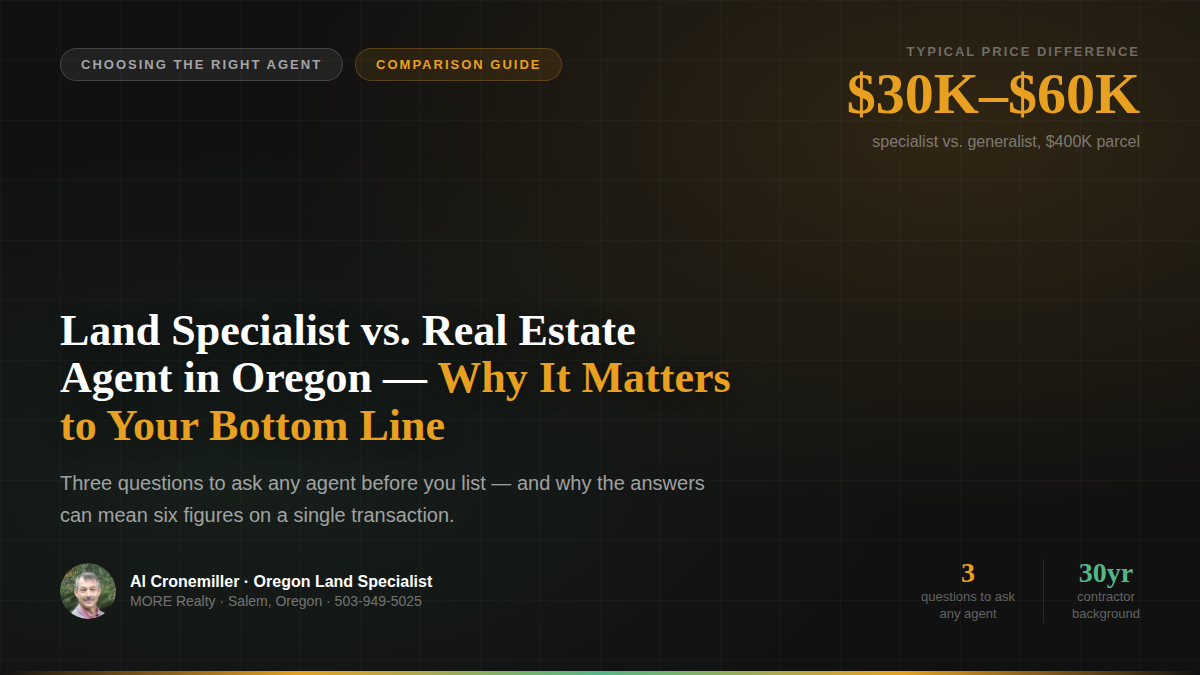
If you own bare land, timberland, or agricultural acreage in Salem, Marion County, or anywhere across the Willamette Valley, you have probably assumed that any licensed real estate agent can help you sell it or figure out what to do with it. On paper, that is true. In practice, it can cost you tens of thousands of dollars.
Here is what most Oregon land owners do not realize: the state license that qualifies someone to sell a three bedroom house in Keizer is the exact same license that qualifies them to handle 200 acres of timberland. Oregon does not require a separate license to work with land. The difference between a land specialist and a general real estate agent is not regulatory. It is experience, training, and how each one is paid to think about your property.
That difference shows up directly in your bottom line, especially if a 1031 exchange, a subdivision decision, or a long term hold strategy is on the table.
Read more: How Do I Avoid Capital Gains Tax When Selling Oregon Property? (Three Legal Tools That Work)
Oregon Licensing Rules Do Not Distinguish Land Specialists From General Agents
In Oregon, every real estate professional starts from the same entry point. To become licensed, an applicant must complete 150 hours of pre-license education through an approved school, pass the state exam administered by PSI, clear a fingerprint and background check through the Oregon State Police and FBI, and work under a sponsoring principal broker. <cite index=”10-1″>Most people complete the process in three to six months and spend roughly $735 to $1,250 total.</cite>
That 150 hour curriculum covers <cite index=”6-1″>real estate law, real estate finance, Oregon real estate practices, contracts, agency, brokerage, and property management</cite>, all of which are essential for representing buyers and sellers of homes, condos, and commercial buildings.
Notice what is missing from that list: timber valuation, water rights, soil classification, zoning and land use compliance, agricultural lease structuring, and tax deferred exchange strategy. None of that is required to get licensed in Oregon. It is only gained through additional, voluntary specialization, which is exactly where the real gap between agents shows up.
Read more: How Do I Find Out If My Oregon Land Has Water Rights? (Step-by-Step Verification Guide)
What Actually Makes Someone a Land Specialist
Because Oregon licensing does not create a separate land track, land specialization comes from three places: additional education, transaction experience, and often a background outside real estate entirely that translates directly to evaluating raw land.
Additional Education and Designations The most recognized land credential in the country is the Accredited Land Consultant designation, awarded by the REALTORS Land Institute, an affiliate of the National Association of Realtors. Earning it requires <cite index=”19-1″>104 hours of specialized classroom education</cite> covering topics most general agents never touch, including <cite index=”19-1″>timberland real estate, land development, energy and environmental asset valuation, agricultural land brokerage, and tax deferred 1031 exchanges</cite>. Candidates must also meet a minimum career transaction volume and be peer reviewed before earning the designation.
Hands On Land and Construction Experience Land valuation is not the same skill as home valuation. A home appraisal leans heavily on recent comparable sales. Land valuation depends on factors most residential agents rarely evaluate directly: timber stand quality, soil type and drainage, water rights, easements, road access, zoning designation, and realistic development feasibility. That kind of judgment typically comes from years spent physically working with land, not from a real estate course.
Transaction Focus A general agent might close two or three land deals a year among dozens of home sales. A specialist’s entire practice is built around land, which means they have seen far more of the edge cases: split parcels, boundary disputes, timber cruises, agricultural leases, and 1031 exchange deadlines under real time pressure.
Read more: Sell or Hold Oregon Bare Land? An Honest Financial Analysis (2026)
Why This Gap Matters More on a 1031 Exchange
If you are considering a 1031 exchange to move out of non-producing bare land and into income generating property, the stakes of working with a generalist versus a specialist go up significantly.
A 1031 exchange has strict IRS timing rules: you generally have 45 days to identify replacement property and 180 days total to close. An agent unfamiliar with exchange mechanics can unintentionally cause you to miss a deadline, misidentify eligible replacement property, or fail to coordinate properly with your qualified intermediary, any of which can trigger the exact capital gains tax bill you were trying to avoid.
A land specialist who works in 1031 exchanges regularly already has relationships with qualified intermediaries, understands how to source replacement property that fits your cash flow and management goals, and knows how to keep every deadline on track without last minute scrambling.
Questions to Ask Before Choosing Who Handles Your Oregon Land
- How many bare land or timberland transactions have you closed in the past two years, specifically in Salem, Marion County, or the Willamette Valley?
- Do you hold a land specific designation such as ALC, or have you completed dedicated land education?
- Have you personally coordinated a 1031 exchange from identification through closing?
- Can you evaluate timber value, water rights, and zoning constraints yourself, or would you need to outsource that analysis?
- What is your background outside of real estate that informs how you evaluate land?
If most agents give you limited answers to these questions, that does not make them unqualified to sell a house. However, your land may be one of your largest and least liquid assets, so choose an agent who builds their practice around land.
Read more: What Disclosures Are Required When Selling Land in Oregon? (Everything Sellers Must Know)
Frequently Asked Questions
Is a land specialist a different license than a real estate agent in Oregon?
No. Oregon issues one broker license for all real estate activity. Land specialization comes from additional education, designations like ALC, and transaction experience, not a separate license category.
Do I need a land specialist to sell bare land in Salem or Marion County?
Oregon law does not require you to hire a land specialist. However, a land focused professional can help you value your property accurately, identify qualified buyers or suitable exchange properties, and avoid costly mistakes during tax sensitive transactions such as a 1031 exchange.
What is an Accredited Land Consultant?
An Accredited Land Consultant, or ALC, is a designation from the REALTORS Land Institute that requires over 100 hours of land specific education and a proven transaction record, marking someone as a specialist in land brokerage rather than general residential sales.
Can a general real estate agent handle a 1031 exchange?
Yes, a licensed real estate agent can participate in a 1031 exchange. However, the agent must work within strict IRS timelines and replacement property rules. An agent who regularly handles 1031 exchanges can help coordinate the transaction, communicate with the qualified intermediary, and reduce the risk of costly mistakes.
Work With a Specialist Who Knows Salem and Willamette Valley Land
If you own bare land, timberland, or agricultural acreage in Salem, Marion County, Polk County, or the greater Willamette Valley, choose a professional who understands the local land market. A land specialist brings experience evaluating property, coordinating 1031 exchanges, assessing land opportunities, and identifying the factors that can influence your property’s value and profitability.
Get My Free Land Evaluation From a Specialist
📞 503-949-5025 | ✉️ al@cronemiller.com | HomesForSaleSalemOregon.net
Al Cronemiller | Oregon Land Specialist | MORE Realty | Salem, Oregon