
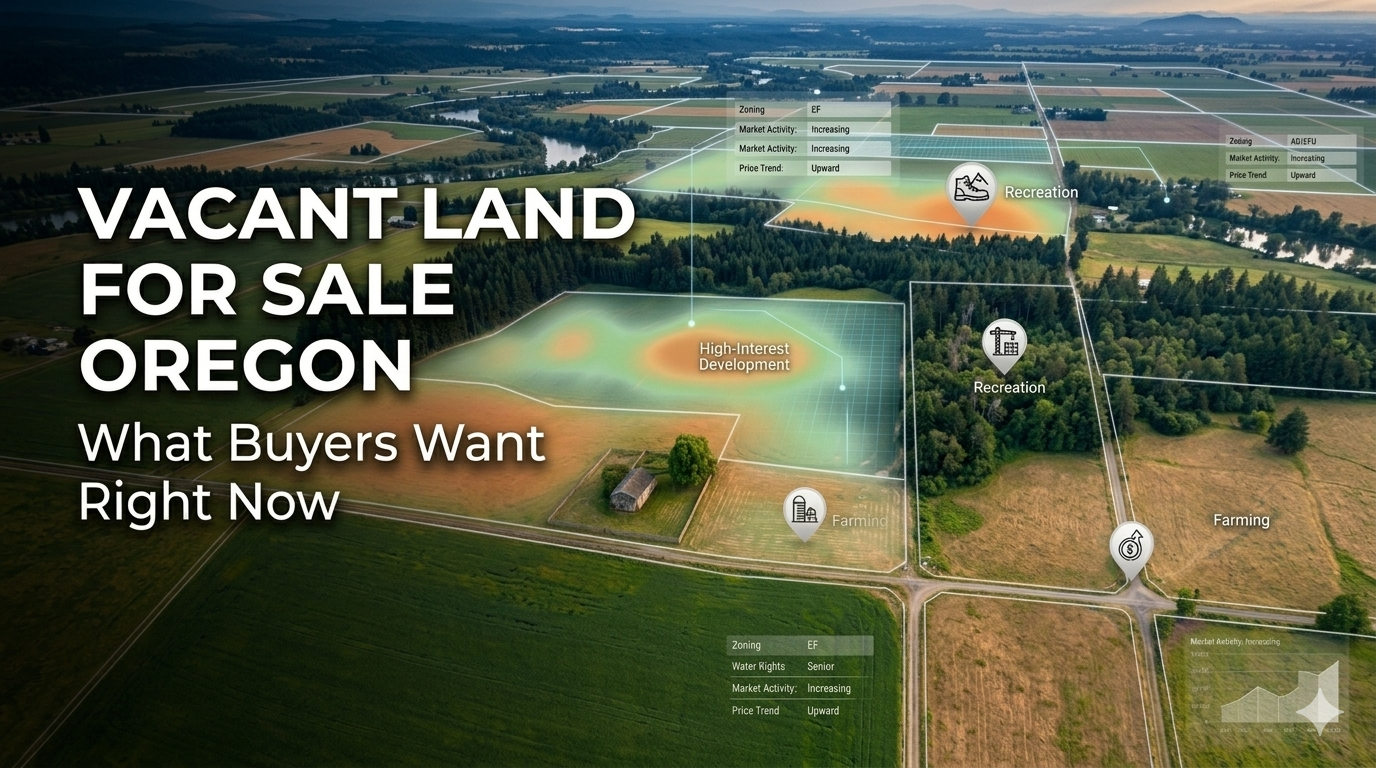
If you own bare land in Salem, Marion County, or anywhere in the Willamette Valley, the market you are selling into today looks different than it did even two years ago. Buyers are more informed, more selective, and increasingly focused on a specific set of features before they write an offer. Understanding what they actually want, rather than what you assume they want, is the difference between a parcel that sells in months and one that sits for years.
Read more: What Is Oregon’s Urban Growth Boundary? How It Affects Your Land Value
The State of the Oregon Land Market in 2026
Oregon’s land market is closely tied to its broader housing market, and 2026 has brought a more balanced environment than the frenzied years of the past. Statewide, the market has moved into a transition period, with rising inventory and slower price growth giving buyers more negotiating leverage than they had during the pandemic years. That shift matters for land sellers too. Buyers are no longer rushing to close on the first parcel they see. They are comparing options, checking access and zoning before making an offer, and negotiating harder on price and terms.
At the same time, demand has not disappeared. Smaller cities like Hood River and Corvallis are seeing stronger price gains where land availability is limited, and Oregon has continued to add tens of thousands of new residents in recent years, many citing lifestyle and quality of life as their reason for relocating. Salem sits in a strong position within that trend. The city is considered one of the fastest growing real estate markets in Oregon heading into 2026, largely because of its central location within driving distance of both the coast and the mountains.
For land owners, this means buyer interest in the Salem and Willamette Valley area remains real, but buyers are pickier about what they will pay for.
Read more: How Do I Sell Timberland in Oregon? (What Buyers Want and How to Maximize Your Return)
What Salem and Marion County Land Is Actually Selling For
Pricing data confirms just how much location and lot size affect land values in this region. Undeveloped land listed near Salem currently averages around $744,000, which works out to roughly $91,700 per acre. That is a notably higher price point than the county as a whole. Across Marion County broadly, undeveloped properties average closer to $506,000, or about $22,570 per acre. Other countywide data puts the median price per acre even lower, closer to $16,658, with the average undeveloped parcel priced around $490,000.
That spread tells an important story. Land close to Salem’s city limits commands a significant premium over land further out in the county, largely because of proximity to jobs, schools, shopping, and infrastructure. Listings near Salem frequently highlight easy commute times and proximity to city conveniences as a primary selling point, which lines up with what buyers are telling the market through their purchase decisions.
For sellers, this means two parcels of similar size and quality can sell for very different prices depending on how close they sit to Salem, how easily they can be reached, and how clearly that value is communicated in the listing.
Read more: What Disclosures Are Required When Selling Land in Oregon? (Everything Sellers Must Know)
What Today’s Oregon Land Buyers Actually Want
Based on current market behavior, four factors consistently separate land that sells quickly from land that lingers.
1. Confirmed legal access
Buyers are far more cautious about access than they used to be. Landlocked parcels are more common than many buyers expect in rural and semi-rural areas, and a driveway or dirt track alone does not guarantee legal access to a property. Serious buyers now ask for proof of a recorded easement, road maintenance agreements, or direct road frontage before they will move forward. Sellers who can hand over this documentation immediately have a real advantage.
2. Utility and buildability clarity
Buyers want to know, in plain terms, whether they can build on the land and what it will cost to get water, power, and septic in place. Listings that already include a well, septic approval, or nearby electrical service consistently draw more serious interest than parcels where a buyer has to guess.
3. Realistic, flexible acreage
The days of buyers automatically chasing the largest parcel available are fading. Remote work flexibility has shifted many buyers toward wanting land outside urban centers, but the emphasis is increasingly on usable, well-located acreage rather than sheer size. A well-positioned 2 to 20 acre parcel near Salem often generates more buyer interest than a much larger, harder to reach parcel further out.
4. Financing flexibility
Traditional bank financing for raw land remains difficult to secure, especially for smaller parcels. Seller financing has become an increasingly common solution, allowing a buyer to make payments directly to the seller under agreed terms instead of going through a bank mortgage. Offering even partial owner financing can meaningfully widen your buyer pool.
Why Marketing Timelines for Land Are Longer Than Homes
One thing every Oregon land seller should understand going in: land does not move at the same pace as houses. Vacant land marketing periods commonly stretch 12 to 24 months in Oregon, and the pool of buyers looking specifically for raw acreage is naturally smaller than the pool of buyers looking for a finished home.Overpricing early is one of the most common mistakes sellers make, since accurate pricing for land is notoriously difficult and small differences in access, terrain, and zoning can swing per acre value significantly.
This is exactly why so many land owners end up holding property far longer than they intended, paying property taxes and carrying costs on an asset that generates no income the entire time.
Read more: Sell or Hold Oregon Bare Land? An Honest Financial Analysis (2026)
Recreational, Agricultural, and Timber Buyers Have Different Priorities
Not every land buyer in the Salem area wants the same thing. Common uses for undeveloped Marion County acreage include hunting and fishing, commercial development, and homestead use, and buyers shopping for recreational or agricultural land weigh access, water rights, and soil or timber quality far more heavily than proximity to town. Agricultural demand also remains a meaningful driver of Oregon land values.
Oregon’s agriculture, food, and fiber sector accounts for a significant share of the state’s jobs and economic output, and national cropland values have continued climbing even as some inflation-adjusted farmland values softened. If your parcel has tillable ground, water rights, or merchantable timber, those details should be front and center in your listing rather than buried in the description.
Read more: How Do I Find Out If My Oregon Land Has Water Rights? (Step-by-Step Verification Guide)
What This Means If You Own Vacant Land in the Willamette Valley
Understanding what buyers want is useful whether you plan to sell outright or explore a 1031 exchange into income producing property. Land that is well positioned, properly documented, and realistically priced sells faster and closer to full value. Land that sits unpriced correctly or poorly marketed can end up costing you years of carrying costs, property taxes, and lost opportunity.
If your land has been sitting without much buyer interest, that is often a pricing or positioning problem, not a demand problem. Salem and the surrounding Willamette Valley remain active, growing markets. The buyers are out there. The question is whether your land is presented in a way that meets them where they are.
Frequently Asked Questions
How much is vacant land worth near Salem, Oregon right now?
Pricing varies significantly by proximity and access, but land close to Salem currently averages roughly $90,000 per acre, while land further out in Marion County averages closer to $17,000 to $23,000 per acre depending on the dataset used.
How long does it typically take to sell vacant land in Oregon?
Most vacant land in Oregon takes considerably longer to sell than a home, often 12 to 24 months, since the buyer pool for raw acreage is smaller and more specific than the buyer pool for finished homes.
What do land buyers care about most?
Confirmed legal access, clear utility and buildability information, realistic acreage sized to the buyer’s actual plans, and flexible financing options are consistently the top factors driving buyer decisions right now.
Is now a good time to sell bare land in the Salem area?
Buyer demand in Salem and the greater Willamette Valley remains strong due to population growth and the area’s central location, though sellers should expect a more informed, more negotiation focused buyer than in past years.
What if my land is not generating any income while it sits on the market?
This is common, and it is exactly the situation a 1031 exchange is designed to solve. Instead of waiting on a traditional sale, some land owners convert their equity into income producing property while deferring capital gains tax.
503-949-5025 | al@cronemiller.com | HomesForSaleSalemOregon.net
Al Cronemiller | Oregon Land Specialist | MORE Realty | Salem, Oregon