
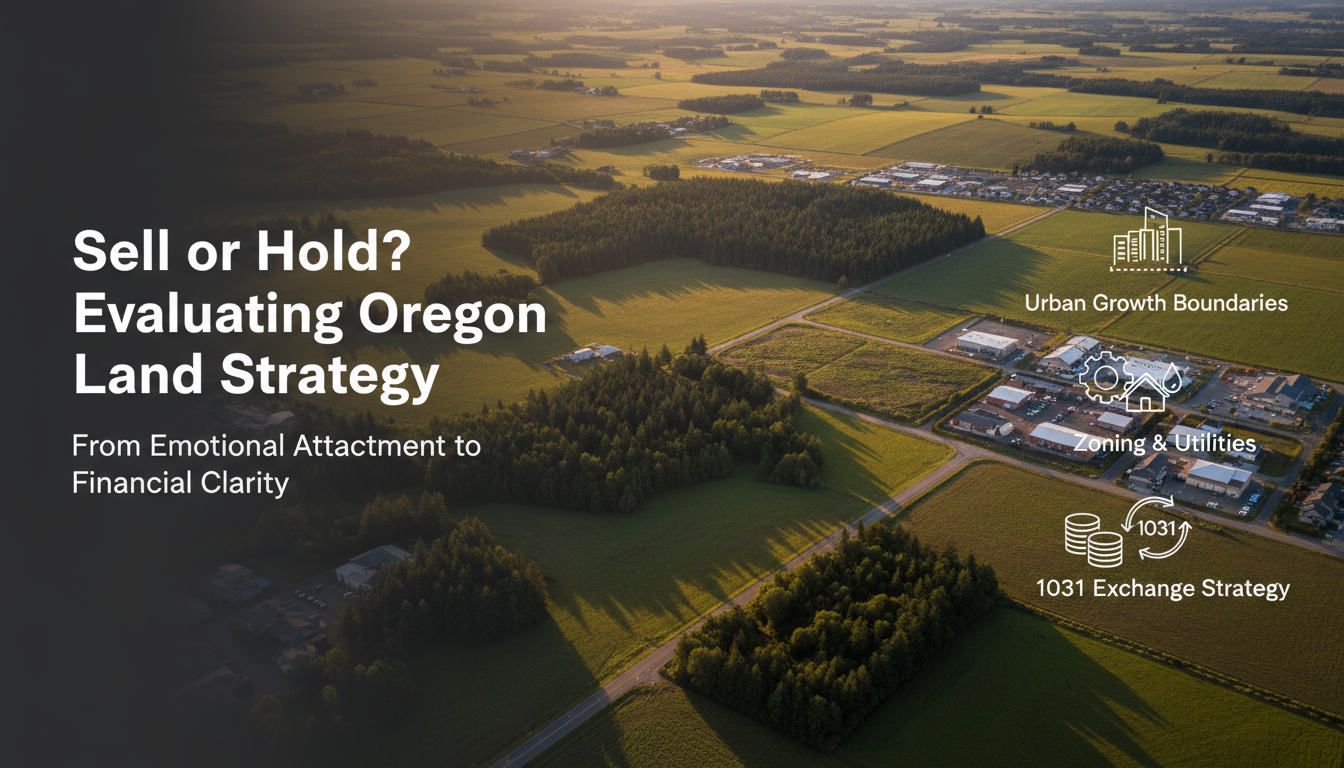
If you own bare land, farmland, or timberland anywhere in Salem, Marion County, or the greater Willamette Valley, you have probably asked yourself this question more than once. It is not a simple yes or no decision, and honestly, anyone who gives you a quick answer without looking at your actual numbers is guessing.
This guide walks through the real financial picture: what current Oregon land value data actually shows, what it costs in property taxes to hold undeveloped land, what Oregon’s farm and forest deferral programs can trigger if you are not careful, and what selling actually costs you in capital gains tax. By the end, you should have a much clearer sense of which side of the decision your land falls on.
Read more: What Is Oregon’s Urban Growth Boundary? How It Affects Your Land Value
What Oregon Land Is Actually Worth Right Now
Start with the data instead of assumptions. According to the most recent USDA and Oregon State University Extension figures, Oregon’s average per-acre farm real estate value sits at roughly $3,780, a nominal increase of about 1.6% over the prior year. That sounds like growth, and technically it is.
But here is the part most land owners never see: once that number is adjusted for inflation, Oregon farm real estate actually declined in real value for the first time since 2013. In plain terms, the dollar figure on your land went up slightly, but what that dollar figure can actually buy you went down. Your land is worth more on paper and less in practice, at the same time.
Compare that to the broader Pacific region, which includes Oregon, Washington, and California. That region averaged roughly $8,440 per acre in the most recent USDA farmland report, well above Oregon’s standalone figure. Irrigated cropland in Oregon has continued climbing, while non-irrigated cropland and pastureland have grown much more slowly or even softened. Location, water rights, and land use all matter enormously here, which is exactly why a blanket answer to “should I sell” does not work. The right answer depends on what category your specific acreage falls into.
The Hidden Cost of Holding Undeveloped Land
Every year you hold bare land in Oregon, three things are happening whether you notice them or not.
Property taxes keep coming due. Even land that produces zero income still generates an annual tax bill. If your land is not enrolled in a farm or forest special assessment program, you are very likely paying full market value property taxes on an asset that pays you nothing back.
Inflation quietly erodes your equity. As the OSU Extension data above shows, Oregon farmland’s real, inflation-adjusted value can decline even while the sticker price rises. If your land’s growth rate is not consistently outpacing inflation, you are losing purchasing power every single year you hold it, even if the tax assessor’s number looks fine.
Opportunity cost adds up. Money and equity sitting in unproductive land is money that is not earning rental income, dividends, or interest anywhere else. Over a ten or twenty year holding period, that gap compounds.
None of this means selling is automatically the right move. It means the decision needs to be made with real numbers, not gut feeling.
Read more: How Do I Sell Timberland in Oregon? (What Buyers Want and How to Maximize Your Return)
The Oregon Farm and Forest Deferral Trap Most Owners Don’t See Coming
This is the section most Oregon land owners skip past, and it is often the most expensive mistake in the entire decision.
If your land is enrolled in Oregon’s farm use or forestland special assessment program (common across Marion County and the Willamette Valley), you are paying reduced property taxes in exchange for keeping the land in qualifying farm or forest use. That is a real benefit while you hold the land. The problem shows up the moment that qualifying use changes.
Under Oregon law (ORS 308A), if farmland or forestland is disqualified from special assessment, whether through a change in use, a subdivision, a home site being built, or a sale to a buyer who will not maintain farm or forest use, the county assessor can bill you for the difference between what you actually paid and what you would have paid at full market value. That additional tax can reach back as far as five to ten years, depending on the specific program (Designated Forestland, Small Tract Forestland, or Exclusive Farm Use each have different disqualification rules).
In other words, the tax savings you enjoyed while holding the land are not necessarily gone for good. They can come back due, all at once, at exactly the moment you decide to sell, subdivide, or repurpose the property. This is one of the single most overlooked variables in the “sell or keep” decision, and it is very specific to how Oregon structures its farm and forest tax programs.
Read more: Sell or Hold Oregon Bare Land? An Honest Financial Analysis (2026)
What Selling Actually Costs You in Oregon Capital Gains Tax
If you do sell outright, Oregon does not offer a special, lower rate for capital gains the way the federal government does. Oregon treats capital gains as ordinary income, taxed at the state’s regular progressive rates, which currently range from 4.75% up to 9.9% depending on your total taxable income for the year.
Stack that on top of federal long-term capital gains rates (0%, 15%, or 20%, depending on your income bracket), and high earners may also owe the federal Net Investment Income Tax of 3.8%. For an Oregon land owner in a higher bracket, the combined state and federal tax bite on a straight sale can realistically land somewhere between 25% and just over 33% of the total gain.
On a $500,000 gain, that can mean well over $100,000 headed to state and federal tax authorities rather than into your pocket, before even factoring in any farm or forest disqualification tax discussed above.
This is exactly the gap a properly structured 1031 exchange is designed to close. By reinvesting your proceeds into qualifying replacement property instead of taking a cash payout, you defer that capital gains tax liability entirely, keeping the full value of your equity working for you in an income producing property instead of handing a large share of it to the state and federal government.
When Keeping the Land Actually Makes Sense
Selling is not always the right answer, and a good advisor should tell you that plainly. Holding onto your land may make more sense if:
- The land is irrigated cropland or sits in a high growth corridor where appreciation has genuinely outpaced inflation
- You have a specific, funded development plan with a realistic timeline
- The land carries deep family or generational significance that outweighs the pure financial calculation
- You are actively farming or managing timber and generating real income from the property today
- Selling now would trigger a disqualification tax large enough to erase most of your near term gain, and waiting or restructuring makes more financial sense
When Selling or Exchanging Makes More Sense
On the other side, an exchange or sale is usually the stronger move if:
- Your land has sat undeveloped for years with no income and no concrete plan
- Property taxes and carrying costs are outpacing any realistic appreciation
- You inherited the land and have no personal use or attachment to it
- You want predictable monthly cash flow instead of a speculative, illiquid asset
- You are comfortable reinvesting through a 1031 exchange to avoid an immediate capital gains tax hit
Frequently Asked Questions
Is Oregon farmland a good long-term investment right now?
It depends heavily on the type of land. USDA and OSU Extension data show irrigated cropland still appreciating, while non-irrigated cropland and pastureland have grown more slowly and recently underperformed inflation in real terms. Location within the Willamette Valley and water rights make a significant difference.
Will I owe back taxes if I sell farmland that has special assessment?
Possibly. If your land is enrolled in an Oregon farm use or forestland special assessment program and the sale results in disqualification, the county assessor can bill for the tax savings you received, going back up to five to ten years depending on the program. Always request a disqualification estimate before listing the property.
How much capital gains tax will I pay if I sell land in Oregon?
Oregon taxes capital gains as ordinary income at rates between 4.75% and 9.9%, combined with federal long-term capital gains rates of 0%, 15%, or 20%. Higher earners may also owe an additional 3.8% federal Net Investment Income Tax.
Can I avoid capital gains tax by exchanging my land instead of selling it?
Yes, in most cases. The IRS allows investors to reinvest proceeds from a properly structured 1031 exchange into qualifying replacement property without triggering capital gains tax at the time of the transaction, provided they follow all required timelines and rules.
Who can help me figure out whether to sell or keep my Salem area land?
A specialist with direct experience in Oregon land, local property tax rules, and 1031 exchanges can run the actual numbers for your specific property rather than giving a generic answer. That evaluation should always be free and pressure free.
Closing Section
Get a Straight Answer for Your Specific Property
Every piece of land is different, and the right decision depends on your zoning, your special assessment status, your cost basis, and your goals, not a generic rule of thumb. If you own bare land, farmland, or timberland in Salem, Marion County, Polk County, or anywhere across the Willamette Valley, I can walk through your specific numbers with you, including what a farm or forest disqualification would actually cost, what a straight sale would net you after tax, and what a 1031 exchange into income producing property could generate instead.
503-949-5025 | al@cronemiller.com | HomesForSaleSalemOregon.net
Al Cronemiller | Oregon Land Specialist | MORE Realty | Salem, Oregon