
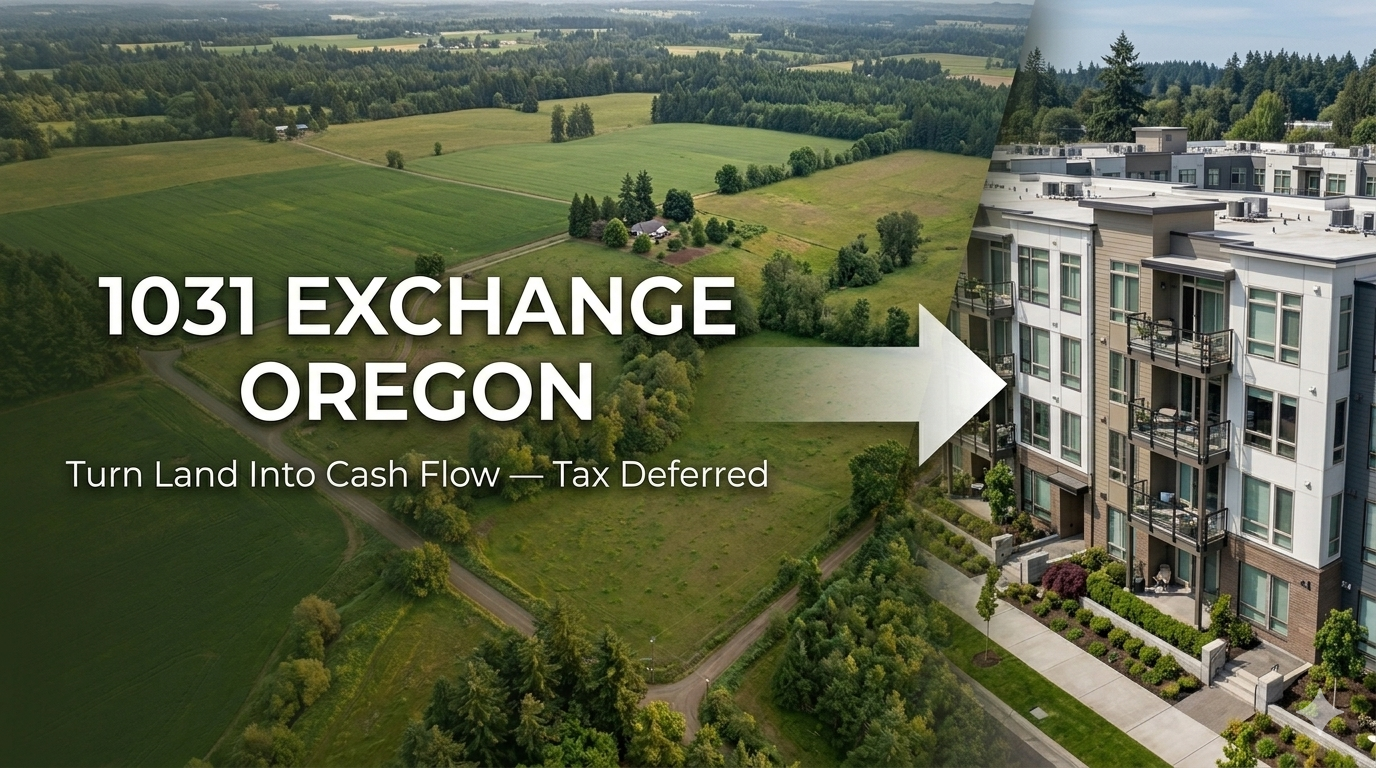
A 1031 exchange is one of the most powerful wealth-building tools available to Oregon property owners, and one of the most underutilized. Named for Section 1031 of the IRS Tax Code, this strategy allows you to sell investment real estate and defer all capital gains taxes by reinvesting the proceeds into a qualifying replacement property.
For Oregon landowners sitting on appreciated bare land, this is often the most impactful financial conversation they can have.
Read more: Sell or Hold Oregon Bare Land? An Honest Financial Analysis (2026)
What Is a 1031 Exchange?
In a 1031 exchange, you sell your “relinquished property” and reinvest the proceeds into a “replacement property” of equal or greater value. Done correctly, zero capital gains tax is owed at the time of sale, federally or at the Oregon state level.
The gain isn’t forgiven, it’s deferred. Savvy investors use repeated exchanges to compound their real estate wealth indefinitely, some never paying the deferred tax at all (passing assets to heirs with a stepped-up basis).
Key Numbers
20%: Max Federal Capital Gains Tax Rate Deferred
9.9%: Max Oregon State Capital Gains Tax Rate Deferred
$0: Tax Due at Sale with Proper 1031 Structure
What Qualifies as “Like-Kind”?
This is where most people are surprised. “Like-kind” does not mean you must replace land with land.
The term simply means both properties must be real estate held for investment or business use.
Examples include:
| Relinquished Property | Replacement Property Options |
|---|---|
| Oregon farmland | Rental home, duplex, apartment building |
| Timberland parcel | Commercial building, retail property |
| Bare land / EFU parcel | Multi-family, industrial, any investment real estate |
| Rural recreational land | Net-lease commercial, mixed-use property |
The 1031 Exchange Deadlines
Timing is one of the most important parts of a deferred 1031 exchange.
45 Day Identification Period
After transferring the relinquished property, you generally have 45 calendar days to identify potential replacement property in writing.
The commonly used Three Property Rule allows an exchanger to identify up to three potential replacement properties, regardless of their individual values. Other identification rules may apply in different circumstances.
Read more: How Do I Find Out If My Oregon Land Has Water Rights? (Step-by-Step Verification Guide)
180 Day Exchange Period
You generally must receive the replacement property by the earlier of:
- 180 days after transferring the relinquished property, or
- the due date, including extensions, of the federal tax return for the year of the transfer.
The 180 day period includes the 45 day identification period. That means you do not receive another 180 days after the identification deadline.
Because these deadlines are statutory requirements, planning the exchange before the sale closes is important.
What About Oregon Taxes?
Oregon recognizes qualifying like kind exchanges under Section 1031. The Oregon Department of Revenue provides specific reporting requirements for certain like kind exchanges, including Form OR 24 in applicable situations.
A 1031 exchange should therefore be considered as part of both the federal and Oregon tax planning process.
The amount of tax ultimately deferred depends on the specific transaction, including the property’s adjusted basis, sale price, liabilities, exchange expenses and whether the investor receives cash or other non like kind property. A tax professional should calculate the actual tax consequences before the transaction proceeds.
Read more: How Do I Avoid Capital Gains Tax When Selling Oregon Property? (Three Legal Tools That Work)
Why Consider a 1031 Exchange for Bare Land?
Bare land can be a long term investment, but it does not normally produce rental income or other recurring operating income.
If your land has appreciated substantially, selling it may create a sizable taxable gain. A 1031 exchange can potentially allow you to keep more of the investment capital working in another qualifying property rather than recognizing the full gain immediately.
For example, an investor who wants to move away from vacant land could potentially exchange into a rental property that produces income, provided the replacement property and the entire transaction meet the 1031 requirements.
The decision should not be based on tax deferral alone. The replacement property’s income potential, expenses, location, financing, management requirements and long term investment objectives also deserve careful consideration.
Start Planning Before You List the Property
One of the biggest mistakes an owner can make is waiting until after the sale is complete to think about a 1031 exchange.
In a typical deferred exchange, the qualified intermediary needs to be involved before the taxpayer receives the sale proceeds. Once the seller actually receives the proceeds, the transaction may no longer qualify for the intended deferred exchange treatment.
That is why it makes sense to discuss the exchange before closing and preferably before the property is listed.
Early planning gives you more time to understand the rules, identify potential replacement properties and coordinate the transaction with the qualified intermediary, real estate professionals and tax advisers.
1031 Exchange Support for Oregon Landowners
Selling appreciated land involves more than finding a buyer. If you are considering a 1031 exchange, the transaction needs to be coordinated from the initial sale through the acquisition of the replacement property.
My 1031 exchange support for Oregon clients can include:
- Qualified intermediary coordination
- Exchange timeline coordination
- Replacement property research
- Transaction coordination
- Support through the sale and replacement purchase
The qualified intermediary handles the exchange funds and required exchange process. Tax advice should come from your CPA, tax attorney or other qualified tax professional.
Thinking About Selling Your Oregon Land?
If you own appreciated Oregon land and are considering selling, it may be worth evaluating a 1031 exchange before putting the property on the market.
Call Al Cronemiller at 503 949 5025 to discuss your property and your next step.
A 1031 exchange has strict rules and deadlines. Before entering into an exchange, consult a qualified intermediary and your tax adviser to determine whether your specific transaction qualifies.
FAQs
Can I use a 1031 exchange to sell Oregon land?
Potentially, yes. Oregon land can qualify for a 1031 exchange when it is held for investment or productive use in a trade or business and the other requirements of Section 1031 are satisfied. The replacement property must also meet the applicable requirements.
Can bare land be exchanged for a rental property?
Yes. The properties do not have to be identical. Qualifying real property held for investment or business use can generally be exchanged for other qualifying real property. For example, qualifying bare land may potentially be exchanged for a rental property.
How long do I have to identify replacement property?
You generally have 45 calendar days after transferring the relinquished property to identify potential replacement property in writing.
How long do I have to complete a 1031 exchange?
You generally must receive the replacement property within 180 days of transferring the relinquished property, subject to the federal rule involving the due date of the tax return. The 45 day identification period falls within this 180 day period.
Does a 1031 exchange eliminate capital gains tax?
No. A 1031 exchange generally defers recognition of qualifying gain rather than eliminating the tax permanently. The tax consequences depend on what happens to the replacement property and the details of the transaction.
Do I need a qualified intermediary for a 1031 exchange?
A qualified intermediary is commonly used to facilitate a deferred 1031 exchange. The structure needs to be established before the seller receives the sale proceeds, which is why planning before closing is important.
Get My Free Timberland Evaluation
503-949-5025 | al@cronemiller.com | HomesForSaleSalemOregon.net
Al Cronemiller | Oregon Land Specialist | MORE Realty | Salem, Oregon