
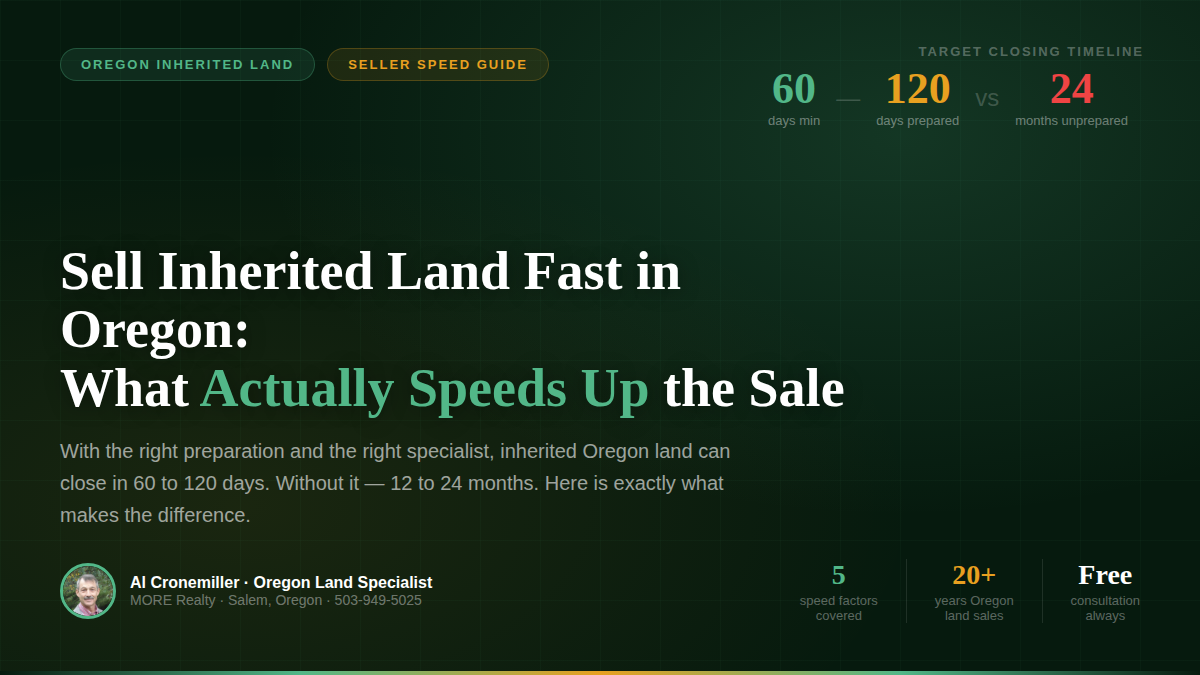
Along with the grief of losing a family member often comes a stack of paperwork, unfamiliar legal terms, and a property you may not fully understand the value of. If you are trying to sell inherited land fast in Salem, Marion County, or anywhere in the Willamette Valley, the honest answer is that speed depends less on how motivated you are and more on how quickly you clear a handful of legal and administrative hurdles first.
Here, we’ll discuss what actually controls your timeline, based on current Oregon probate law, estate tax rules, and real market data, so you know exactly where the delays come from and how to shorten them.
Read more: What Is Oregon’s Urban Growth Boundary? How It Affects Your Land Value
Do You Even Need Probate to Sell Inherited Land in Oregon?
This is the first question that determines everything else about your timeline, and most people assume the answer is yes when it might not be.
Whether inherited property needs to go through probate in Oregon depends almost entirely on how the title was held at the time of death:
- Tenancy by the entirety (married couples): Property owned this way generally passes automatically to the surviving spouse with right of survivorship, with no probate required.
- Right of survivorship deeds (unmarried co-owners): If the deed expressly states survivorship rights, the surviving co-owner’s interest transfers without probate.
- Transfer-on-death deed (TOD deed): If the original owner recorded a TOD deed, the named beneficiary can typically transfer ownership without going through probate court.
- Property held in a living trust: Land held in a trust generally passes to beneficiaries according to the trust terms, bypassing probate entirely.
- Solely owned property with no will, trust, or TOD deed: This is where probate or Oregon’s simplified small estate affidavit process usually becomes necessary.
Oregon also offers a small estate affidavit option for smaller estates, which can bypass full probate. This applies when personal property is valued at $75,000 or less and real property (including land) is valued at $200,000 or less, without subtracting any mortgage or liens from that real property figure. If your inherited land and the rest of the estate fall under those thresholds, this shortcut can save months compared to formal probate.
Read more: How Do I Sell Timberland in Oregon? (What Buyers Want and How to Maximize Your Return)
If Probate Is Required, Here Is the Realistic Timeline
If your inherited land does need to go through Oregon probate, most estates take somewhere between four and twelve months to clear, and complex estates can run longer. Oregon probate is handled through the circuit court in the county where the deceased person lived, which for many of our clients means Marion County Circuit Court in Salem.
Here is roughly how that timeline breaks down:
Months 1 to 2: A personal representative is appointed by the court, and creditors and beneficiaries are formally notified. You can begin preparing the land for sale during this window, but you cannot legally close a transaction yet.
Months 3 to 6: The personal representative is required to file a full inventory of estate assets with the court, typically within 90 days of appointment. Creditors generally have a four month window to file claims against the estate. With court permission, it is often possible to list and even accept an offer on the land during this stage.
Months 6 to 12: Outstanding creditor claims are resolved, the court approves the sale, the transaction closes, and proceeds are distributed to heirs according to the will or Oregon intestacy law if there was no will.
The single biggest driver of delay in this process is the creditor notice period, which is required by law regardless of how motivated you are to sell. There is no way to legally skip it, but there are ways to avoid adding unnecessary time on top of it.
Read more: Sell or Hold Oregon Bare Land? An Honest Financial Analysis (2026)
What Actually Speeds Up an Inherited Land Sale
Once the legal groundwork handle, the speed of your actual sale comes down to a short list of practical factors.
1. Confirm clear title before you market the land
Buyers and title companies will not close on land with unresolved ownership questions. Confirming clear title early, rather than discovering a problem mid-transaction, prevents the most common source of last minute delays.
2. Get an accurate valuation from someone who understands raw land
Vacant and inherited land does not price the same way a house does. A qualified valuation should account for zoning, access, utility availability, septic or well potential, wetlands, and comparable land sales, not just acreage and location.
3. Prepare a property information packet
Serious land buyers move faster when they do not have to chase down basic information. A packet with the recorded deed, parcel maps, zoning designation, and any known utility or access details removes friction and shortens the due diligence period.
4. Price for the market you are actually in
Oregon homes are currently going pending in roughly 44 days on average, while land and rural acreage typically take longer to sell than residential homes. Pricing realistically from day one, rather than testing a high number and adjusting later, is one of the most reliable ways to shorten total time on market.
5. Decide early whether a fast cash sale or a marketed sale fits your goals
A clean, well documented cash offer can close in a matter of days once probate clears. A marketed sale through a broker usually takes longer but can capture significantly more value, especially for land with development or income potential. Neither option is automatically correct. It depends on whether your priority is speed or maximizing what the land is actually worth.
Read more: How Do I Find Out If My Oregon Land Has Water Rights? (Step-by-Step Verification Guide)
Understanding the Tax Side Before You Sell
Taxes are often the part of this process that catches heirs off guard, so it is worth understanding the basics before you set a price or accept an offer.
Oregon estate tax
Oregon does not have a separate inheritance tax, but it does impose an estate transfer tax on estates valued above $1,000,000, with graduated rates from 10% to 16%. The estate must pay this tax rather than individual heirs. For deaths on or after January 1, 2022, the estate must generally file the estate tax return and pay the tax within 12 months of the date of death.
Stepped up basis, and why it matters more than most heirs realize
When you inherit land, the IRS generally resets its tax basis to the property’s fair market value on the date the original owner died. This is significant because it means that if you sell the land relatively soon after inheriting it, at close to that same fair market value, your taxable capital gain can be minimal or even close to zero, even if the original owner purchased the land decades ago for a fraction of what it is worth today.
When a 1031 exchange becomes relevant
If you plan to sell quickly at close to the stepped up value, capital gains tax may not be a major concern. But if the land appreciates further while you hold it, or if you are inheriting alongside siblings who want to convert the land into income producing property rather than cash out immediately, a 1031 exchange can defer capital gains tax on that future appreciation by rolling the proceeds into replacement property.
This is a common situation for families who inherit timberland or larger acreage in Marion County and Willamette Valley and are unsure whether to sell outright or reposition the asset into something that generates monthly income.
Common Complications With Inherited Land, and How to Handle Them
Multiple heirs with different priorities: It is common for one sibling to want a fast cash sale while another wants to hold the land or maximize price through marketing.
Unclear or disputed boundaries: Rural and inherited acreage sometimes has boundary lines that nobody has formally surveyed. Old fencing or informal agreements can also create boundary disputes. Resolve these issues before listing to prevent problems during due diligence.
Outstanding property taxes or liens: Unpaid property taxes or liens can delay the sale. Identify and resolve them before closing to keep the transaction on schedule.
Frequently Asked Questions
Do I have to go through probate to sell inherited land in Oregon?
Not always. It depends on how the property was titled. Land held in a trust, transferred through a transfer-on-death deed, or owned with a valid right of survivorship generally does not require probate. Solely owned property without those arrangements usually does.
How long does it take to sell inherited land in Oregon?
If probate is required, expect four to twelve months before you can legally close, depending on the estate’s complexity. Once cleared for sale, land itself often takes longer to sell than a house due to smaller buyer pools, though accurate pricing and a complete property packet can meaningfully shorten that window.
Will I owe taxes on inherited land I sell in Oregon?
You may owe taxes, but often less than you expect. The stepped up basis rule typically calculates your taxable gain from the land’s value on the date of death rather than the price the original owner paid. The estate pays Oregon estate tax on estates valued above $1,000,000, not individual heirs on their tax returns.
What is the fastest way to sell inherited land once probate is complete?
A clean, well priced cash offer from a serious buyer typically closes fastest. If maximizing value matters more than speed, a marketed sale through a broker who understands land, zoning, and access issues usually nets a higher price but takes longer.
Should I consider a 1031 exchange instead of selling my inherited land outright?
If you and any co-inheriting family members are open to converting the land into income producing property rather than taking a lump sum, a 1031 exchange can defer capital gains tax on future appreciation while turning a non-producing asset into monthly cash flow. It is worth evaluating both paths before deciding.
Get Clarity Before You List
If you have inherited bare land, timberland, or acreage anywhere in Salem, Marion County, Polk County, or the greater Willamette Valley, the fastest path forward starts with an honest conversation about where your property actually stands, legally and financially, not a listing price.
Get a Free Inherited Land Evaluation
Call me before you list and let’s build a timeline that works for your family’s situation.
📞 503-949-5025 | ✉️ al@cronemiller.com | HomesForSaleSalemOregon.net
Al Cronemiller | Oregon Land Specialist | MORE Realty | Salem, Oregon