
If you own land in Marion County, Polk County, or anywhere else in the Willamette Valley, there is a good chance your property carries an EFU designation. It shows up on the title report, the county tax record, or the zoning map, and most landowners have the same first question: what does EFU actually mean, and can I put a house on it?
This guide breaks down Oregon’s Exclusive Farm Use zoning, based on Oregon Revised Statutes Chapter 215 and the rules that Marion County and other Oregon counties use to enforce it.
Learn more: What Is Oregon’s Urban Growth Boundary? How It Affects Your Land Value
What Does EFU Zoning Mean?
EFU stands for Exclusive Farm Use. It is a zoning designation created under Oregon’s statewide land use planning system to protect agricultural land from being converted into subdivisions, residential lots, and non-farm development. All 36 Oregon counties have adopted EFU zoning in some form, which makes it one of the most widespread and consistently enforced farmland protection systems in the country.
The purpose is straightforward: keep large blocks of farmland available for actual farming and prevent rural land from slowly turning into scattered residential sprawl. In exchange for these restrictions, EFU zoned land typically qualifies for a farm use special assessment, which taxes the property based on its agricultural value rather than its market value. That can mean a significantly lower property tax bill, as long as the land is genuinely being farmed.
Oregon law defines farm use broadly under ORS 215.203. It covers raising and selling crops, breeding and selling livestock, poultry, and honeybees, dairying, and other agricultural or horticultural activities, along with preparing, storing, and marketing products grown on the land.
Read more: How Do I Sell Timberland in Oregon? (What Buyers Want and How to Maximize Your Return)
What Can You Actually Do on EFU Land?
Back in 1973, only about a dozen uses were allowed on EFU-zoned land in Oregon. Today, that list has grown to more than 60 permitted or conditional uses, defined in Oregon Administrative Rule 660-033-0120. Depending on your soil classification and county code, permitted uses can include:
- Crop production, livestock operations, and dairying
- Agricultural buildings such as barns, equipment sheds, and irrigation infrastructure
- Farm stands selling crops and products grown on the operation
- Agritourism activities and events
- Wineries and farm-related processing facilities
- Home occupations operated by a farm household
- Wetland restoration and habitat enhancement projects
- Certain solar and wind energy facilities
- Churches, cemeteries, and a handful of public and semi-public uses
Most of these uses still need to demonstrate a real connection to farm use, and many require a conditional use permit reviewed by your county planning department before you can move forward.
Can You Build a House on EFU Land in Oregon?
This is the question that brings most landowners to this page, and the honest answer is that it depends on your specific parcel. Oregon does not allow homes to be built on EFU land simply because you own the property. There are several distinct legal paths, each with its own requirements.
Read more: Land Specialist vs Real Estate Agent in Oregon: What Bare Land Owners Need to Know
1. Primary Farm Dwelling (Income-Based Approval)
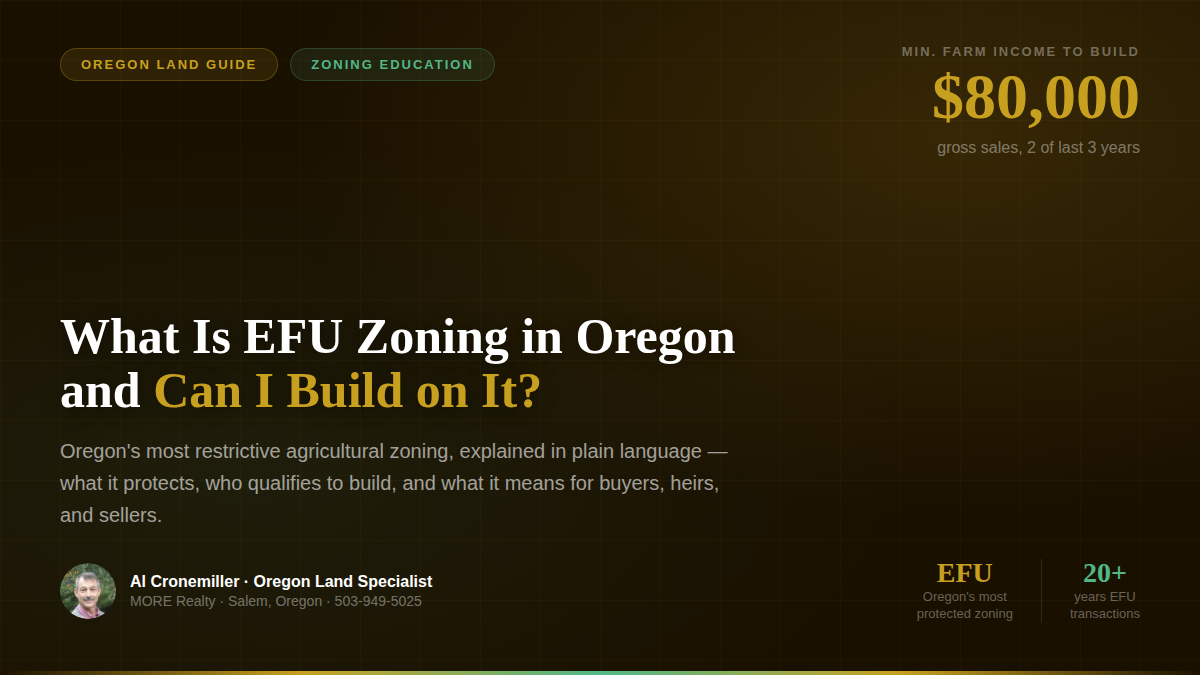
If your land is actively farmed, you may qualify for a farm dwelling under ORS 215.283. To approve it, most counties require your operation to show a minimum level of gross annual income from the sale of farm products over a set period, commonly two of the last three years or three of the last five years. The required income threshold is higher if your land is classified as high-value farmland, which covers much of the prime soil in the Willamette Valley, including large portions of Marion and Polk County.
In practice, this route is realistic for landowners running a genuine commercial farm operation, not for someone hoping to build a house and call a hobby garden a farm.
2. Lot of Record Dwellings
If your parcel was legally created before a specific cutoff date, often January 1, 1993, depending on the county, and has never had a dwelling on it, you may qualify for what is called a lot of record dwelling. This path does not require proving farm income, but it comes with its own set of siting standards, soil classification requirements, and restrictions on the size of the parcel. Marion County outlines these standards specifically in Chapter 17.136 of its zoning code.
3. Large Parcel Dwellings
Some counties, including Marion County, allow a dwelling on a large parcel, often 160 acres or more, without the same income documentation required for a standard farm dwelling. This threshold exists because a parcel of that size is generally presumed capable of supporting genuine agricultural use.
4. Accessory Farm Dwellings
If you already have an approved primary farm dwelling, you may be able to add a second, accessory dwelling to house a farm worker or a family member actively involved in the operation. These come with deed restrictions and are tied directly to ongoing farm use, not general residential use.
5. Replacement Dwellings
If your EFU parcel already has a legally established home, even one that is no longer habitable, you may be able to replace it. Marion County and most other counties allow this under specific siting and deed restriction rules rather than treating it as new construction.
What You Generally Cannot Do
You cannot subdivide EFU land into smaller residential lots. Subdivisions and planned developments are specifically prohibited in the EFU zone under Marion County code because the entire point of the zone is to keep farmland in large, usable blocks. You also cannot build a standard non-farm home simply because you like the location or the view. Non-farm dwellings on EFU land create conflicts with agricultural practices, which is exactly what this zoning is designed to prevent.
Why This Matters for Salem and Willamette Valley Landowners
A large share of the land around Salem, Keizer, and throughout Marion and Polk County sits in EFU zones because of the region’s high-value farm soils. That is good news for long-term land value and tax treatment, but it also means many landowners are sitting on acreage they assumed they could eventually build on, only to discover the zoning simply will not allow it.
This is where a lot of confusion and a lot of frustration come from. Someone inherits 40 acres outside Salem, assumes they can eventually retire on it or sell a few lots to family, and later learns that EFU zoning blocks nearly all of that. The land itself is often still valuable. It is the plan for the land that needs to change.
Read more: Can You Sell Inherited Land Before Probate in Oregon?
If You Cannot Build, What Are Your Options?
If your EFU zoned land does not qualify for a dwelling and is not actively generating farm income, it is worth stepping back and looking at the bigger financial picture. Bare, non-producing land still comes with property taxes, and it still loses ground to inflation every year it sits idle.
For landowners in exactly this position, a 1031 exchange is often the most effective solution. Instead of trying to force a dwelling approval that the zoning will not support, you can exchange the land for income-producing property and defer capital gains tax in the process. It is a way to convert land that zoning has limited into an asset that is actually working for you.
Get a Free Evaluation of Your EFU Zoned Land
Frequently Asked Questions
Is EFU zoning the same in every Oregon county?
The core framework comes from state law under ORS Chapter 215 and applies statewide, but each of Oregon’s 36 counties adopts its own zoning code with specific parcel size, income, and siting standards. Marion County’s rules, for example, are outlined in Chapter 17.136 of the county code.
Can I get EFU land rezoned so I can build?
Rezoning EFU land is difficult and uncommon. Oregon’s statewide planning goals strongly discourage converting farmland, particularly high-value farmland, to other uses. Most landowners find it far more realistic to work within EFU rules than to pursue a rezone.
Does EFU zoning lower my property taxes?
Yes, in most cases. Land that qualifies for a farm use special assessment is taxed on its agricultural value rather than market value, which typically results in a lower tax bill, as long as the required farming activity and income documentation are maintained.
What happens if I stop farming EFU land that has a special assessment?
You can be disqualified from a special assessment, which may trigger back taxes and penalties. This is one of the most common costly mistakes EFU landowners make without realizing it.
Can I sell EFU land to someone who wants to build a house?
You can sell it, but the buyer faces the same zoning restrictions you do. Any dwelling still has to qualify under one of the paths described above, regardless of who owns the parcel.
📞 503-949-5025 | ✉️ al@cronemiller.com | HomesForSaleSalemOregon.net
Al Cronemiller | Oregon Land Specialist | MORE Realty | Salem, Oregon