
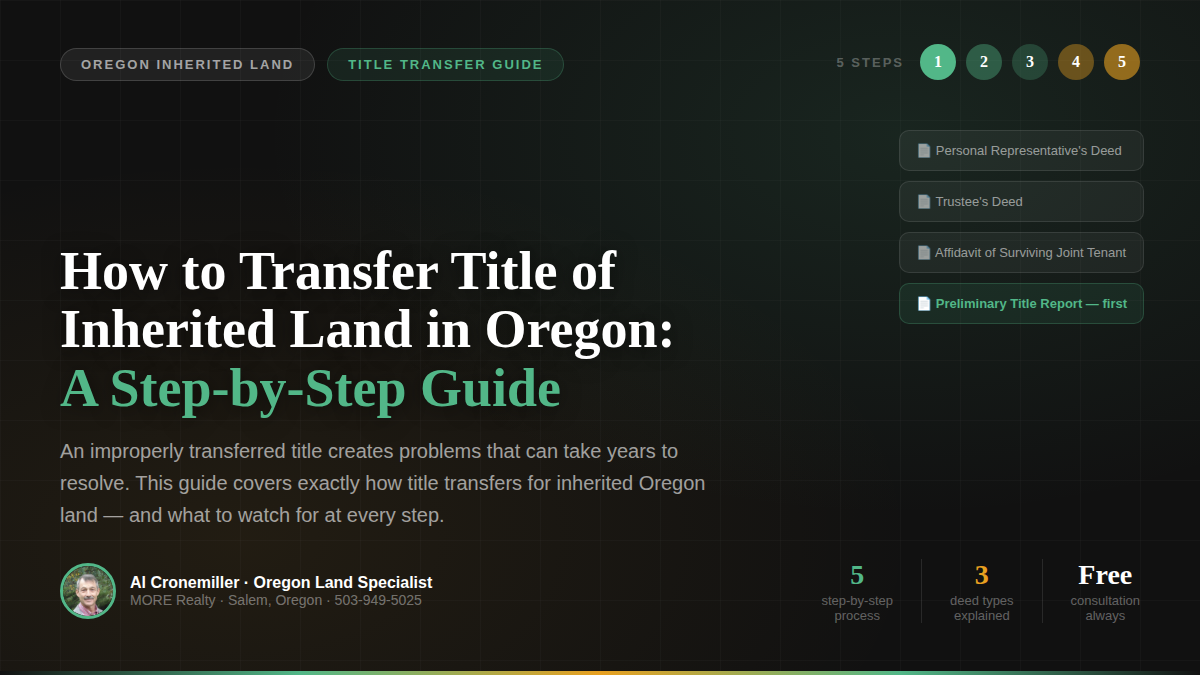
Inheriting land in Oregon is rarely simple. You are already dealing with the loss of a family member, and then another question comes up: how do you legally put the property in your name? Inheritance alone does not automatically add your name to the deed. You must complete the proper title transfer before you can sell, lease, develop, or exchange the land.
In this guide, I’ll walk you through the Oregon title transfer process step by step. You’ll learn how to check the property’s ownership, determine whether you need probate, complete the required paperwork, record the new deed, and update the county’s property records.
Read more: What Is Oregon’s Urban Growth Boundary? How It Affects Your Land Value
Step 1: Determine How the Property Was Titled
Before anything else, find out how your loved one held title to the land. This single detail determines whether you need probate at all.
Common ways Oregon land is titled, and what happens at death:
- Sole ownership, no beneficiary designation. The land must go through probate before title can transfer to heirs.
- Joint tenancy with right of survivorship. Ownership passes automatically to the surviving co-owner. No probate is require for that share, but you will still need to record an affidavit and death certificate to clear the county record.
- Tenancy by the entirety (married couples). Works the same as joint tenancy for the surviving spouse.
- Held in a revocable living trust. The trustee transfers title to beneficiaries according to the trust terms, without probate.
- Transfer on death deed (TOD deed). If your loved one recorded a TOD deed under Oregon law before their death, the named beneficiary can claim the property by recording a notarized notice of death affidavit with the county clerk.
If you are not sure which situation applies, pull a copy of the current deed from the county recorder’s office where the land is located. This tells you exactly how title hold and is the starting point for everything that follows.
Read more: How Do I Sell Timberland in Oregon? (What Buyers Want and How to Maximize Your Return)
Step 2: Confirm Whether Probate Is Required
If your loved one owned the land solely and did not place it in a trust or record a TOD deed, you will generally need to go through probate before you can transfer the title. During probate, the court validates the will, if one exists, appoints a personal representative, notifies heirs and creditors, and oversees the distribution of the property to the rightful beneficiaries.
Oregon offers two paths depending on the size of the estate.
Full Probate
Required for larger or more complex estates, or whenever there is a dispute among heirs, unclear ownership, or outstanding debts against the estate.
Small Estate Affidavit
Oregon allows a simplified process for smaller estates. To qualify, the estate generally must have a fair market value of $275,000 or less, with no more than $75,000 in personal property and no more than $200,000 in real property. If your inherited land and the rest of the estate fall under these limits, heirs can file a small estate affidavit with the probate court instead of opening a full probate case. This route is significantly faster and less expensive, and it is worth checking before assuming full probate is necessary.
Read more: How Do I Avoid Capital Gains Tax When Selling Oregon Property? (Three Legal Tools That Work)
Step 3: Complete the Probate Process (If Required)
If full probate is necessary, here is the general sequence in Oregon:
- File a petition for probate of the will, or for administration of the estate if there is no will, with the circuit court in the county where the deceased lived.
- Appointment of a personal representative, who is typically name in the will by the court.
- Inventory of estate assets, including a valuation of the land itself.
- Notice to heirs and creditors, giving interested parties the opportunity to raise claims.
- Payment of debts, taxes, and expenses from estate assets before distribution.
- Distribution of remaining property, including the land, to the rightful heirs according to the will or Oregon’s intestate succession laws if there is no will.
This process can take several months to over a year depending on the complexity of the estate, whether there are disputes, and how quickly paperwork moves through the court.
Step 4: Prepare and Record the Deed
Once probate is complete, or once you have a valid small estate affidavit, the actual transfer of title happens through a deed. For land moving out of probate, this is typically a personal representative’s deed, signed by the personal representative and recorded with the county.
A valid Oregon deed generally must include:
- The full legal description of the property, or a reference to the recorded document where that description can be found, per ORS 93.600
- The required statutory statement for conveyances under ORS 93.040
- The address where future property tax statements should be sent, per ORS 93.260
- A copy of the court order authorizing the transfer, if applicable
- The death certificate of the deceased owner
- Notarized signatures
Once the deed is complete, it must be recorded with the county clerk or county recorder in the county where the land is located. For land in Salem or Marion County, that means recording with the Marion County Clerk’s office. If your inherited land sits in Polk County or Yamhill County instead, you will record with that county’s recorder.
Read more: How Do I Find Out If My Oregon Land Has Water Rights? (Step-by-Step Verification Guide)
Step 5: Update Tax and Assessment Records
After the new deed is recorded, contact the county assessor’s office to confirm the property tax roll reflects the new owner. This matters for two reasons. First, tax statements need to go to the right address. Second, an outdated owner name on record can create friction later during a sale, refinance, or 1031 exchange, when a title company runs its search and needs the chain of ownership to match cleanly from the county records straight through to you.
Local Considerations for Salem and Marion County Land
If your inherited land sits in Salem, Marion County, or elsewhere in the Willamette Valley, a few local details are worth knowing:
- Marion County Circuit Court handles probate filings for property located in Marion County, including land in Salem, Keizer, and surrounding areas.
- Recording fees and formatting requirements can vary slightly by county, so confirm current requirements with the Marion County Clerk before submitting your deed.
- Rural acreage, timberland, and agricultural parcels often carry special assessment status (such as farm or forest deferral) that can affect taxes upon transfer. It is worth checking with the Marion County Assessor whether inheriting the land triggers a reassessment or affects any existing deferral.
What Happens After Title Is in Your Name
Once you officially transfer and record the title in your name, you gain control of the land. You can sell it, lease it, develop it, or potentially use it in a qualifying 1031 exchange without affecting anyone else’s ownership rights.
This last point matters more than most new landowners realize. A significant share of the bare land and inherited acreage across Marion County and the Willamette Valley sits idle for years after inheritance simply because the title transfer felt like the finish line. In reality, it is the starting point. With your name on the deed, you can finally assess the land’s real income potential. If holding vacant land only creates ongoing expenses, you may choose to exchange it for a qualifying income producing property that can generate regular cash flow instead of leaving you with another yearly tax bill.
Read more: Sell or Hold Oregon Bare Land? An Honest Financial Analysis (2026)
Frequently Asked Questions
Do I have to go through probate if I inherited land in Oregon?
Not always. If the land was held in joint tenancy, in a trust, or under a valid transfer on death deed, you may be able to transfer title without probate. Solely owned property without those arrangements generally requires probate or a small estate affidavit.
How long does it take to transfer title to inherited land in Oregon?
A small estate affidavit can move relatively quickly, often within a few months. Full probate typically takes several months to over a year, depending on the complexity of the estate and whether disputes arise.
What is a small estate affidavit in Oregon?
It is a simplified alternative to full probate available when the estate’s fair market value is $275,000 or less, with no more than $75,000 in personal property and no more than $200,000 in real property.
Can I sell inherited land before the title is transferred into my name?
No. You need clear, recorded title in your name, or the legal authority of an appointed personal representative, before you can legally sell or exchange inherited land.
What should I do with inherited bare land once title is transferred?
Many heirs hold onto inherited land out of uncertainty, not because it is the best financial decision. A free land evaluation can show you what the property is currently worth, what it may be losing to inflation each year, and whether a 1031 exchange into income producing property makes sense for your situation.
Ready to Find Out What Your Inherited Land Is Worth?
If you have recently inherited bare land, timberland, or agricultural acreage in Salem, Marion County, or anywhere in the Willamette Valley, and you are unsure what to do next, a free, no obligation land evaluation is a good place to start. It costs nothing to find out whether your inherited land could be earning far more than it is sitting idle.
📞 503-949-5025 | ✉️ al@cronemiller.com | HomesForSaleSalemOregon.net
Al Cronemiller | Oregon Land Specialist | MORE Realty | Salem, Oregon