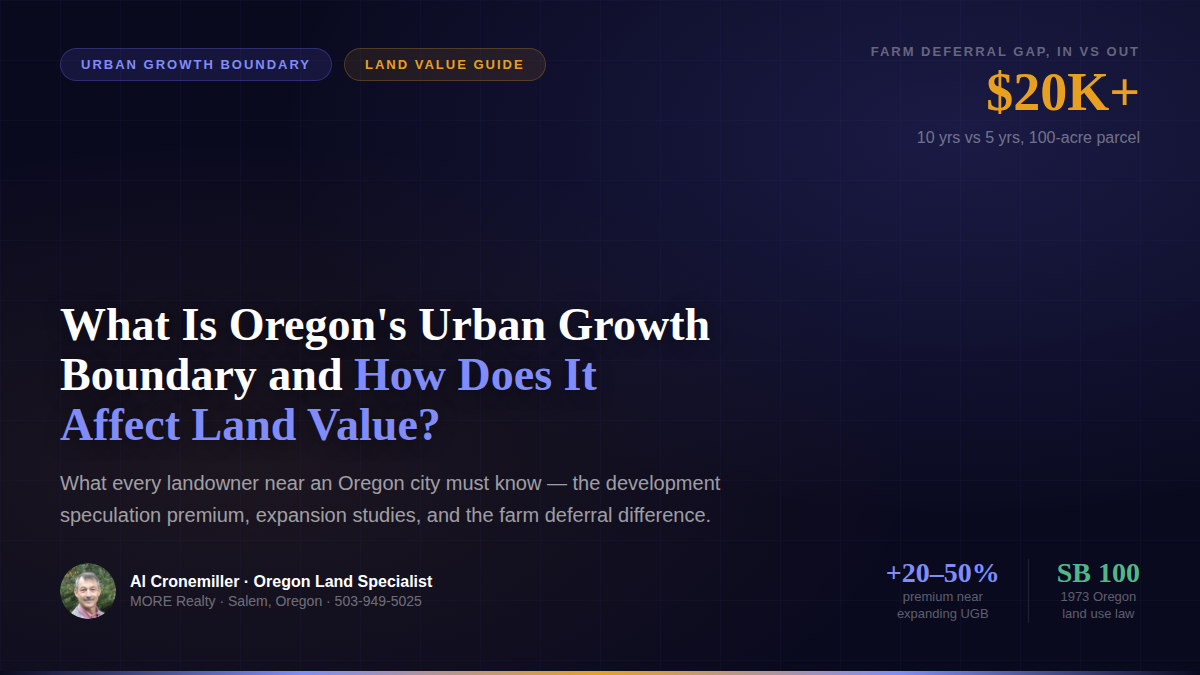
If you own bare land, farmland, or rural acreage anywhere near Salem, there is a line on a map you have probably never seen that may be doing more to shape your property’s value than the land itself. It is called the urban growth boundary, and understanding it is one of the most overlooked steps landowners skip before selling, developing, or exchanging their property.
I have spent 35 years working with land in the Willamette Valley, first in forestry and surveying, then as a general contractor, and now as a 1031 exchange specialist. I watch landowners leave real money on the table simply because they did not know which side of this boundary their property sat on. This article breaks down what the urban growth boundary is, how it works in Oregon, and what it means for your land’s value today.
Read more: What Disclosures Are Required When Selling Land in Oregon? (Everything Sellers Must Know)
What Is an Urban Growth Boundary?
An urban growth boundary, often shortened to UGB, is a legal line drawn around a city that separates land approved for urban development from land that must stay rural, agricultural, or undeveloped. Land inside the boundary can eventually be connected to city services like water, sewer, roads, and schools. Land outside the boundary generally cannot, no matter how close it sits to town.
Oregon was the first state in the country to require every city to adopt one, under the state’s land use planning law passed in 1973. Salem, Keizer, and every other city in Marion and Polk County operate under this same statewide system, managed locally in coordination with the county and reviewed regularly by the state.
The purpose behind the policy is straightforward: contain sprawl, protect farmland and forestland, and concentrate infrastructure spending where it serves the most people. The effect on individual landowners, however, is anything but simple.
Read more: Is It Better to Sell or Hold Oregon Bare Land? (An Honest Financial Analysis)
Why the Urban Growth Boundary Matters So Much for Land Value
This is the part most landowners never hear from a general real estate agent. Two parcels can sit a few hundred feet apart, look nearly identical, and be worth dramatically different amounts, purely because of which side of the boundary line they fall on.
Land inside the boundary is eligible for urban zoning, higher density development, and connection to city infrastructure. That eligibility alone can multiply its market value, sometimes by a factor of ten or more compared to nearly identical land just outside the line.
Land outside the boundary is restricted to rural or agricultural use under Oregon’s land use rules. That does not mean the land has no value. Timberland, farmland, and rural acreage can still generate strong returns. But its value is tied to farming, forestry, or long term appreciation rather than development potential, and that is a very different financial position to be in.
The practical takeaway: before you assume you know what your land is worth, or before you turn down an offer because it sounds low, find out exactly where your property sits relative to the current Salem area urban growth boundary. That single fact can change your entire strategy.
Read more: How Do I Find Out If My Oregon Land Has Water Rights? (Step-by-Step Verification Guide)
How Salem’s Urban Growth Boundary Actually Works
Salem’s urban growth boundary is not managed by the city alone. Because Salem’s boundary extends beyond the city limits, planning decisions involve coordination between the City of Salem, Marion County, Polk County, and the City of Keizer. Any changes to the boundary or the comprehensive plan affecting the surrounding area typically require input from all of these jurisdictions.
Statewide, Oregon reviews and adjusts urban growth boundaries on a regular cycle to make sure each city has enough land to accommodate future population and housing growth. Since 2016, cities and counties across Oregon have completed dozens of boundary expansions and adjustments under the state’s updated rules, and recent state legislation has pushed to make future expansions faster and easier in response to Oregon’s ongoing housing shortage.
For landowners, this means the boundary is not fixed forever. Land that sits just outside the line today could become eligible for inclusion in a future expansion, which is exactly why periodic land value reviews matter, especially for property that has been held for years or passed down through a family without much attention paid to changing zoning and planning maps.
What This Means If You Own Bare Land Near Salem
If your land is outside the urban growth boundary, here is what typically holds true:
- Your land is restricted to agricultural, forestry, or rural residential use under current zoning
- Development potential is limited unless a future boundary expansion includes your parcel
- Long term appreciation tends to run below inflation. This means the land can lose real value even while its listed price technically rises
- Property taxes and carrying costs continue every year regardless of whether the land is producing income
If Your Land Is Inside the Boundary
The situation can be very different.
- Development potential may increase your land’s value.
- More buyers may be interested in the property.
- Timing can make a big difference when selling.
Either way, a general appraisal may not tell the whole story. Local land use knowledge matters. You need to know what your property can be used for today and what opportunities may come next.
Read more: How Do I Avoid Capital Gains Tax When Selling Oregon Property? (Three Legal Tools That Work)
Frequently Asked Questions
Does land outside Salem’s urban growth boundary ever get added later?
Yes. The boundary can change as the area grows. However, expansion can take years and is never guaranteed.
Is land inside the urban growth boundary always worth more?
Generally yes, because of development and rezoning potential, but exact value depends on zoning, infrastructure access, and local demand. A proper evaluation looks at your specific parcel rather than a general rule of thumb.
Can I still make money on land outside the boundary?
Yes. You may earn from farming, timber, or other permitted uses. A 1031 exchange may also help you move into income producing property.
How do I find out if my land is inside or outside the current boundary?
Check your parcel against the current Salem area boundary map. I can also help you understand what the boundary means for your property’s value and options.
Find Out Where Your Land Really Stands
Is your property inside Salem’s urban growth boundary or outside it? Start by finding out exactly where your land stands and what it could be worth today.
📞 503-949-5025 | ✉️ al@cronemiller.com | HomesForSaleSalemOregon.net
Al Cronemiller | Oregon Land Specialist | MORE Realty | Salem, Oregon
https://shorturl.fm/WJ7OK
https://shorturl.fm/cD4cM
https://shorturl.fm/B8eSY
https://shorturl.fm/f9L0R
https://shorturl.fm/5wkRT
https://shorturl.fm/0UBf3
https://shorturl.fm/miaJl
https://shorturl.fm/WrfEy
https://shorturl.fm/hvJlu
https://shorturl.fm/q5thV