
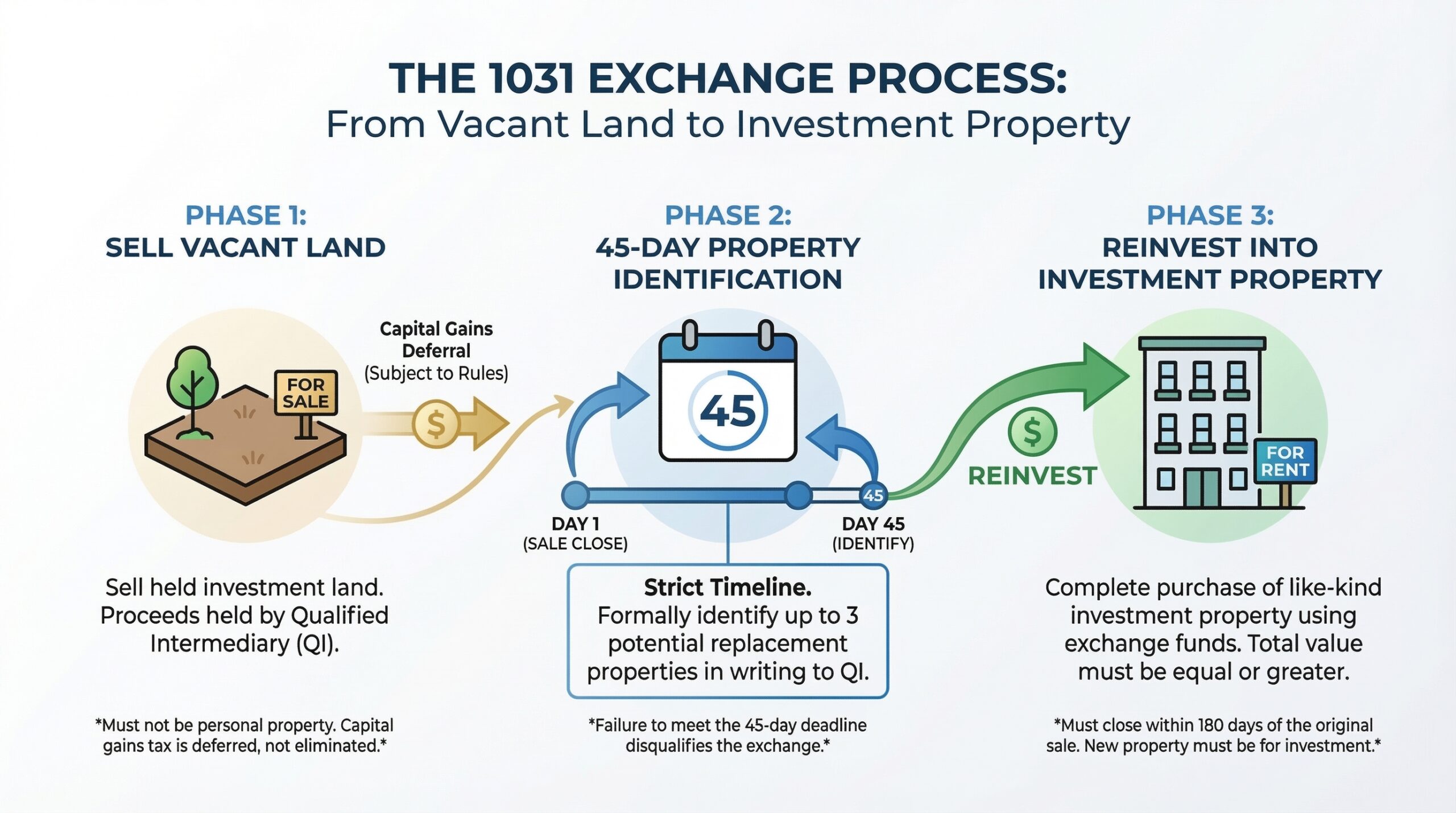
If you own vacant land in Salem, Marion County, or anywhere across the Willamette Valley, you already know the strange position it puts you in. You are paying property taxes every year on an asset that produces no income at all, while the land itself often grows in value slower than inflation erodes your purchasing power. A 1031 exchange is one of the few legal tools available to Oregon land owners that solves this problem without triggering a capital gains tax bill.
Here’s how a 1031 exchange works for bare land, the federal timelines you have to hit, and the Oregon specific rules that trip up land owners who do not plan ahead.
Read more: What Is Oregon’s Urban Growth Boundary? How It Affects Your Land Value
Does Vacant Land Qualify for a 1031 Exchange?
Yes. Vacant land is eligible for a 1031 exchange under Internal Revenue Code Section 1031, as long as it meets one core requirement: the land must be held for investment or business use, not for personal use and not primarily for resale.
This distinction matters more than most land owners realize. If you purchased land intending to develop and flip it quickly, the IRS may treat that land as inventory rather than an investment property, which disqualifies it from 1031 treatment. If you have held the land as an investment, whether for appreciation, timber value, agricultural lease income, or simply as a long term hold, it generally qualifies.
Under the like-kind rule, vacant land can be exchanged for almost any other type of investment real estate in the United States. Since the term “like-kind” refers to the nature and character of the property rather than its type, bare land can be exchanged into:
- Multi-family apartment buildings
- Commercial or retail property
- Self-storage facilities
- Office buildings
- Agricultural or timber property
- Other vacant land held for investment
This is one of the most overlooked advantages of a 1031 exchange for Oregon land owners. You are not limited to trading land for land. You can move directly from a non-producing asset into an income generating property with monthly cash flow.
Read more: How Do I Sell Timberland in Oregon? (What Buyers Want and How to Maximize Your Return)
Federal Timelines: The 45 Day and 180 Day Deadlines
Every 1031 exchange runs on two firm deadlines, and the IRS does not grant extensions except in the case of a federally declared disaster.
45 Day Identification Period: From the date your relinquished property closes, you have 45 calendar days to formally identify potential replacement properties in writing to your qualified intermediary. Most exchangers identify up to three properties of any value, though rules exist for identifying more.
180 Day Exchange Period: You then have 180 calendar days from the original closing date, not from the identification date, to complete the purchase of your replacement property. These two windows run concurrently, not back to back, so the 180 day clock starts ticking the moment your land sells.
Because both deadlines are strict, land owners who wait until after closing to start thinking about replacement property often run out of time to find something suitable. The land owners who get the best outcomes are the ones who begin evaluating replacement property options before their land ever goes under contract.
Read more: Sell or Hold Oregon Bare Land? An Honest Financial Analysis (2026)
The Role of a Qualified Intermediary
You cannot touch the sale proceeds at any point during a 1031 exchange. If the money passes through your hands, even briefly, the exchange is disqualified and the full capital gains tax becomes due.
Instead, a qualified intermediary holds the proceeds from the sale of your land and uses those funds to acquire your replacement property on your behalf. Choosing an experienced intermediary and setting up the exchange agreement before your land closes is one of the most important steps in the entire process.
Oregon Specific Rules Every Land Owner Should Know
Oregon generally conforms to federal 1031 exchange rules, but the state adds a few requirements that out of state guides often leave out.
Oregon’s Clawback Rule
Oregon is one of a small number of states with a clawback provision, codified under ORS 316.738 and ORS 317.327. If you exchange Oregon land for property outside Oregon, the state can still tax the deferred gain later if you sell that replacement property in a fully taxable transaction without completing another 1031 exchange. The obligation can remain with you for years, even if you move out of Oregon.
Annual Reporting Requirement
If you exchange Oregon property for a replacement property outside the state, you must file an annual informational return with the Oregon Department of Revenue. This return tracks your deferred gain until the reporting obligation ends.
Oregon’s State Tax Rate on Capital Gains
Oregon taxes capital gains as ordinary income, with a top marginal rate of 9.9%, one of the highest state rates in the country. This is on top of the federal long term capital gains rate, which is generally 0%, 15%, or 20% depending on income, plus a potential 3.8% Net Investment Income Tax for higher income filers. A successful 1031 exchange defers all of this, both federal and Oregon state tax, keeping your full equity working for you instead of going to a tax bill.
Read more: How Do I Find Out If My Oregon Land Has Water Rights? (Step-by-Step Verification Guide)
Common Mistakes Oregon Land Owners Make
- Waiting too long to start. Beginning replacement property research only after the 45 day clock has already started leaves very little room for error.
- Assuming a move out of state ends Oregon’s tax claim. Oregon’s clawback rule specifically exists to prevent this. Moving to another state does not erase the deferred gain tied to Oregon sourced property.
- Receiving sale proceeds directly. Any direct receipt of funds, even for a short window, disqualifies the exchange.
- Buying land intended for quick resale. If the land was purchased with a short term flip in mind rather than long term investment, it may not qualify as like-kind investment property.
- Underestimating replacement property value requirements. To defer 100% of the tax, your replacement property generally needs to be of equal or greater value, with equal or greater debt, than the property you sold. Any shortfall is considered taxable boot.
Strategy: Turning Bare Land Into Income Property
For many Salem and Willamette Valley land owners, the real opportunity in a 1031 exchange is not just the tax deferral itself. It is the shift from an asset that costs money every year to one that produces it.
Bare land typically appreciates at a modest average rate, often below the rate of inflation, meaning the real purchasing power of that equity can quietly decline year after year even as the land technically becomes “worth more” on paper. Meanwhile, that same equity, moved into a well chosen income producing property through a 1031 exchange, can generate consistent monthly cash flow and a stronger long term return.
The land owners who benefit most from this strategy are the ones who treat the exchange as a full financial decision, not just a tax move. That means evaluating current land value, realistic replacement property options, income projections, and Oregon’s specific reporting obligations together, ideally with guidance from someone who understands both Oregon land value and the mechanics of a compliant exchange.
Frequently Asked Questions
Can I do a 1031 exchange on land with no structures on it?
Yes. Raw, unimproved land qualifies for a 1031 exchange as long as it is held for investment or business purposes rather than personal use or quick resale.
Do I have to exchange land for land?
No. You can exchange vacant land for many other types of investment real estate, including apartment buildings, commercial properties and agricultural properties.
What happens if I miss the 45 day identification deadline?
The exchange fails, and the full capital gains tax becomes due on the sale, both federal and Oregon state tax.
Does Oregon’s clawback rule apply if I never plan to sell the replacement property?
Not immediately. Oregon’s clawback rule generally becomes relevant when you eventually sell an out of state replacement property in a taxable transaction without completing another 1031 exchange. If you continue exchanging or hold the property until death, the obligation may never trigger, though estate rules can also affect the outcome.
Is inherited land in Oregon eligible for a 1031 exchange?
In many cases, yes. You can potentially use inherited Oregon land in a 1031 exchange if you hold it for investment or business purposes.
Ready to Explore a 1031 Exchange for Your Oregon Land?
If you own vacant land in Salem, Marion County, Polk County, or anywhere in the Willamette Valley and want to know what it could be worth as income producing property, a free land evaluation is the natural first step. It gives you a clear picture of your options before any deadlines are running.
503-949-5025 | al@cronemiller.com | HomesForSaleSalemOregon.net
Al Cronemiller | Oregon Land Specialist | MORE Realty | Salem, Oregon