If you own bare land in Salem or anywhere in Marion County, one question probably comes up more than any other: what is this land actually worth today?
It is a harder question than it sounds. Bare land does not come with a Zestimate the way a house does. There is no roof, no square footage, no recent kitchen remodel to point to. Instead, land value is built from a mix of zoning rules, soil quality, access, timber, water rights, and location relative to Salem’s urban growth boundary. Get any one of those wrong, and your estimate can be off by tens of thousands of dollars per acre.
This guide walks through exactly how bare land is valued in Salem and Marion County, using current market data, so you can understand what your land is really worth before you sell, hold, or consider a 1031 exchange into income producing property.
Get a Free, Accurate Land Evaluation
What Bare Land Is Actually Worth in Marion County Right Now
Bare land pricing in Marion County varies dramatically depending on location, zoning, and use, and the numbers prove it. Undeveloped properties currently listed in Marion County average around $22,570 per acre while land listings across the county average closer to $32,302 per acre, with recently sold parcels landing at a median of roughly $22,222 per acre.
That is a wide range, and it is not random. A flat, tillable 20 acre parcel just outside Salem’s urban growth boundary is worth a very different amount per acre than a 200 acre timber tract in the foothills east of the city, even though both are technically “bare land.”
A few other data points worth knowing if you own land in this area:
- Marion County leads Oregon in agricultural production and includes more than 10,000 acres of, which supports strong demand for farmable acreage.
- Property taxes in Marion County average around 0.88%, which is a meaningful factor when calculating your annual carrying cost against your land’s actual return.
- Salem consistently has more land listed for sale than any other city in Marion County, which means local comparables are usually available if you know where to look.
The takeaway: there is no single “price per acre” for Salem area bare land. An accurate valuation has to account for the specific factors below.
Read more: How Do I Sell Timberland in Oregon? (What Buyers Want and How to Maximize Your Return)
The Factors That Actually Drive Bare Land Value
1. Zoning: EFU, UGB, and What They Mean for Your Value
Zoning is often the single biggest driver of land value in Marion County, and it is the factor most owners understand the least.
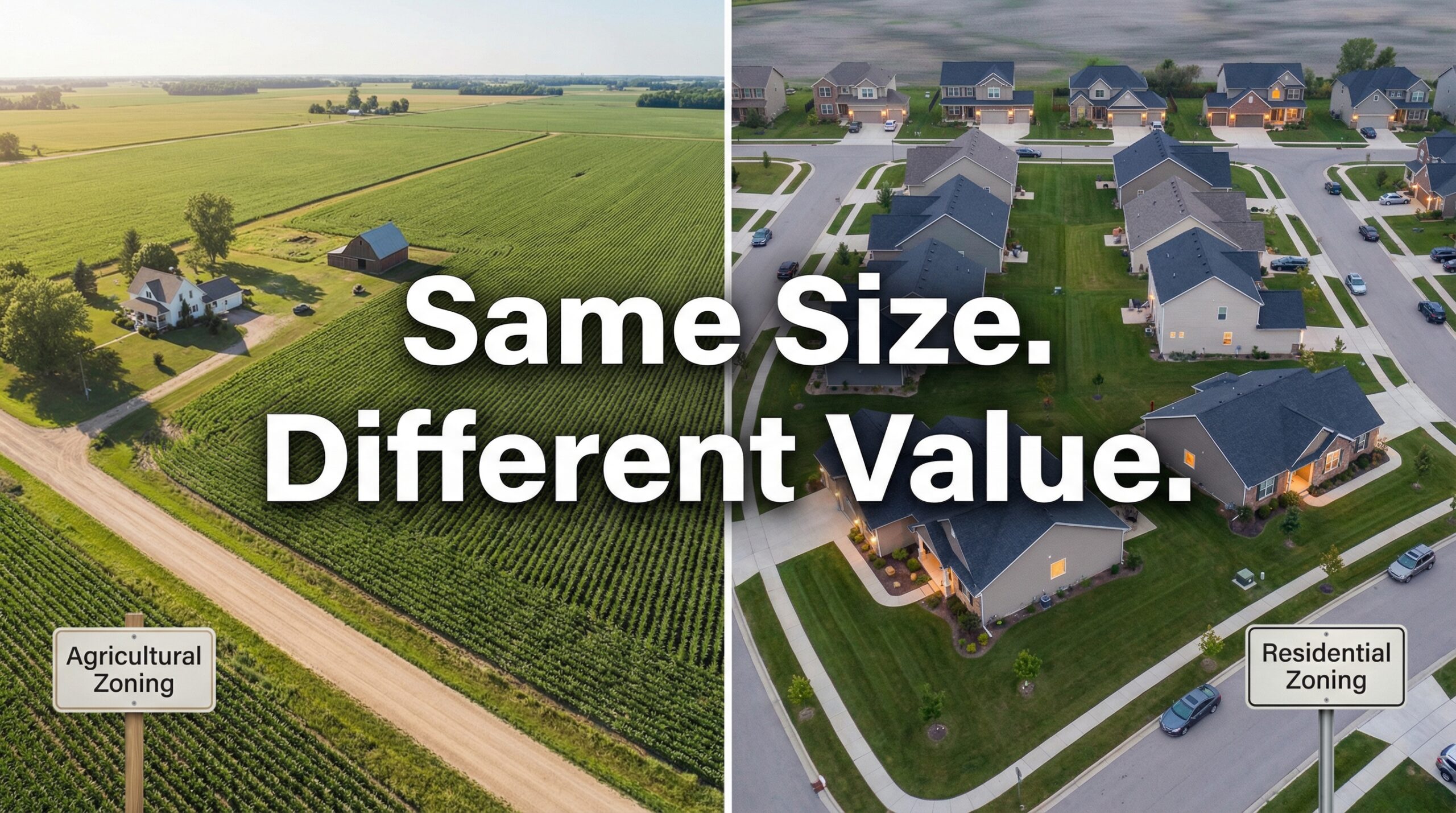
Land zoned for Exclusive Farm Use (EFU) legally limits owners to farming and farm related activities. These restrictions reduce development potential and typically keep the per acre price lower than land inside Salem’s Urban Growth Boundary (UGB). Farm and forest lands cover roughly 94 percent of privately held land in Oregon. Oregon protects these lands through zoning rules, land division restrictions, and special tax assessments. These protections support agriculture, but they also limit what buyers can legally do with the property. Those limits can reduce the land’s market value.
Land inside or adjacent to Salem’s UGB tells a different story. When land is added to the Urban Growth Boundary, local governments are required to assign appropriate urban zoning designations to it based on its intended use That reclassification is often the single biggest value jump a piece of land can experience, sometimes far outpacing any physical improvement you could make to the property itself.
What this means for you: before you or anyone else prices your land, confirm its exact zoning designation and whether it sits inside, adjacent to, or well outside the Salem or Keizer UGB. This one factor can shift your per acre value by a wide margin.
Read more: What Is Oregon’s Urban Growth Boundary? How It Affects Your Land Value
2. Access, Utilities, and Buildability
Land with paved road frontage, an existing well, septic approval, and power already run to the site consistently commands a premium over landlocked or unimproved parcels. Listings across Marion County that highlight completed septic approval, hydrology studies, or existing utility hookups routinely price well above raw, unimproved acreage of similar size and zoning.
If your land does not have these improvements yet, that is not necessarily a problem. It simply needs to be factored honestly into the valuation rather than assumed away.
3. Timber and Agricultural Value
If your property includes standing timber, that timber has its own separate value, distinct from the land itself. A professional timber cruise, an on-site inventory of timber volume and species, is the standard way to establish this. Land listings across the region regularly include timber cruise reports as a selling point precisely because buyers know raw acreage and merchantable timber are two different value components that need to be priced separately, then combined.
The same logic applies to tillable farmland. Soil class, irrigation rights, and current crop or lease income all affect what a buyer is willing to pay, separate from the land’s raw acreage.
4. Comparable Sales
Just like residential real estate, bare land value is ultimately anchored to recent comparable sales, similar acreage, zoning, and location that has actually sold, not just listed. This is where many land owners get their own valuation wrong. Listing prices and sold prices are not the same number, and Marion County’s land market moves differently across its western agricultural valley floor and its eastern forested foothills. A comparable sale from one end of the county tells you very little about value on the other end.
See What Comparable Land in Your Area Has Sold For
Common Mistakes Salem Area Land Owners Make When Valuing Their Property
Assuming inflation is on your side. Bare land does not automatically outpace inflation just because real estate historically appreciates. Many owners are surprised to learn their land’s value has grown more slowly than their cost of living, which means their actual purchasing power has been shrinking every year they hold it.
Using county assessed value as market value. Assessed value for property tax purposes and true market value are calculated differently and frequently diverge, sometimes significantly. Relying on your tax statement alone can lead to a valuation that is far off from what a buyer would actually pay.
Ignoring the UGB line. A parcel sitting just inside Salem’s Urban Growth Boundary can be worth substantially more than a nearly identical parcel just outside it. Owners who do not confirm this boundary precisely often undervalue, or overvalue, their own land.
Treating all acreage as equal. A flat, road accessible acre and a steep, landlocked acre on the same 100 acre property are not worth the same amount. Blended per acre averages can hide significant value differences within a single property.
Read more: What Disclosures Are Required When Selling Land in Oregon? (Everything Sellers Must Know)
Why an Accurate Valuation Matters Beyond the Sale Price
Getting your land’s value right is not just about knowing a number. It directly affects a strategy many Salem and Marion County land owners are not aware of: the 1031 exchange.
A 1031 exchange allows you to sell bare land and reinvest the proceeds into income producing property, without paying capital gains tax at the time of the exchange, as long as IRS rules and timelines are followed. But you cannot structure an effective exchange, or know whether it even makes sense for you, without first knowing what your land is genuinely worth in today’s Salem and Willamette Valley market.
That is the exact starting point of the process I use with every land owner I work with: an honest, locally grounded valuation first, followed by a clear look at what that value could generate as income producing property instead of sitting idle.
Start With a Free Land Evaluation
Frequently Asked Questions
What is bare land worth per acre in Marion County, Oregon?
Pricing varies widely by zoning, location, and use, with per acre values across the county ranging from roughly $16,000 to $50,000 depending on the source and property type. Land near Salem’s Urban Growth Boundary, with utilities and access already in place, typically prices well above raw EFU zoned acreage further from the city.
Does county assessed value reflect what my land is actually worth?
Not necessarily. Assessed value is calculated for property tax purposes and often differs from true market value, sometimes significantly. A market based valuation using recent comparable sales gives a far more accurate picture.
How does EFU zoning affect my land’s value?
Exclusive Farm Use zoning restricts land to farm related uses, which limits development potential and generally keeps per acre value lower than land zoned for residential or commercial use inside Salem’s Urban Growth Boundary.
Should I get a timber cruise before selling my land?
If your property has meaningful standing timber, yes. A timber cruise establishes the timber’s value separately from the land itself, which typically results in a more accurate and often higher overall valuation.
How do I know if my land is inside Salem’s Urban Growth Boundary?
This can be confirmed through Marion County or City of Salem planning records. Given how significantly UGB status affects value, it is worth verifying precisely rather than assuming based on general location.
Is a professional valuation different from what a real estate listing site shows me?
Yes. Automated listing averages reflect broad market ranges, not your specific parcel’s zoning, access, timber, or comparable sales. A proper valuation accounts for the specific factors unique to your property.
Ready to Know What Your Salem Area Land Is Really Worth?
If you own bare land, timberland, or agricultural acreage anywhere in Salem, Marion County, Polk County, or the greater Willamette Valley, an accurate valuation is the first step toward understanding your real options, whether that means holding, selling, or exploring a tax deferred 1031 exchange into income producing property.
503-949-5025 | al@cronemiller.com | HomesForSaleSalemOregon.net
Al Cronemiller | Oregon Land Specialist | MORE Realty | Salem, Oregon