
If you own bare land, timberland, or investment property anywhere in Salem, Marion County, or the Willamette Valley, this question has probably crossed your mind: how much of my profit is the government going to take when I sell?
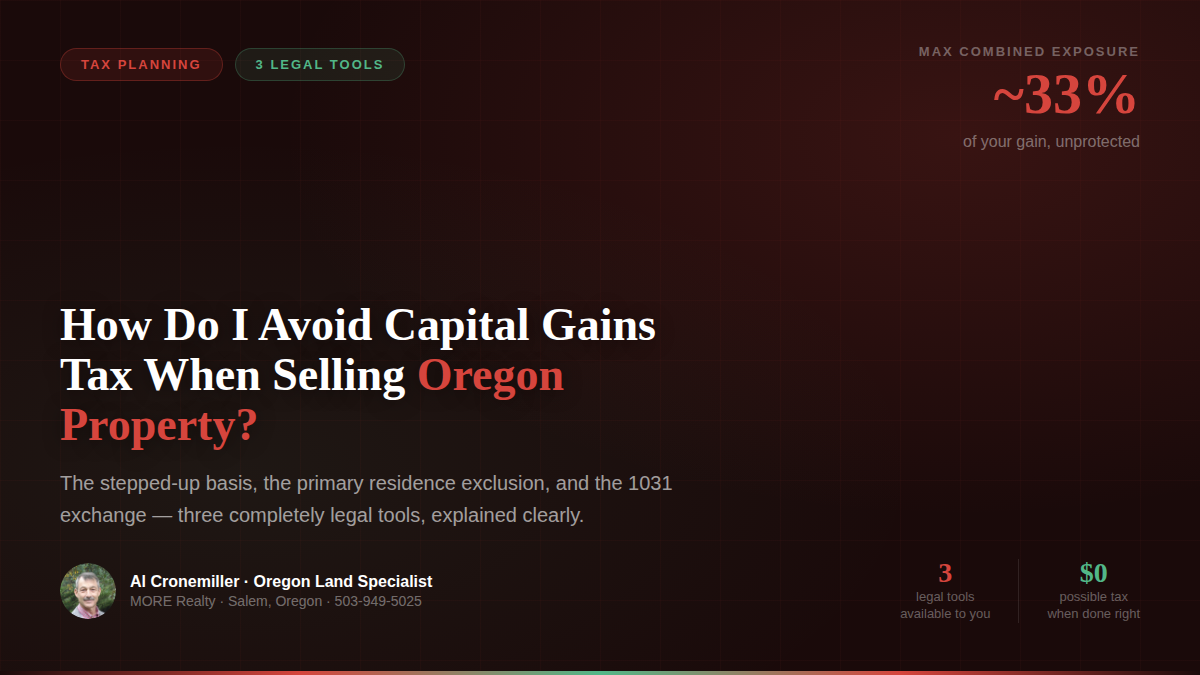
In Oregon, that question carries more weight than in most states. Oregon does not offer a reduced rate for long term capital gains the way the federal government does. Instead, Oregon taxes all capital gains as ordinary income, at rates that climb as high as 9.9%. Stack that on top of federal long term capital gains rates of up to 20%, plus a possible 3.8% Net Investment Income Tax for higher earners, and a land or property sale can trigger a tax bill that eats a third of your gain before you ever see it.
The good news: the tax code gives property owners several legal, well established tools to defer, reduce, or in some cases eliminate that bill entirely. Below are three that Oregon land and property owners use most often, along with how each one actually works.
Read more: Sell or Hold Oregon Bare Land? An Honest Financial Analysis (2026)
Why Oregon Property Sellers Face a Bigger Tax Bite Than Most States
Before getting into strategy, it helps to understand exactly what you are working with.
Oregon has no capital gains discount. Most states either exempt capital gains entirely or tax them at a reduced rate compared to ordinary income. Oregon does neither. Long term and short term gains are both taxed as regular income, using the same brackets that apply to your paycheck, up to a top marginal rate of 9.9%.
Federal long term capital gains still apply on top of that. For 2026, federal long term capital gains are taxed at 0%, 15%, or 20%, depending on your total taxable income. Most Oregon land sellers with a meaningful gain will land in the 15% or 20% federal bracket.
High earners may also owe the Net Investment Income Tax. This additional 3.8% federal tax applies to investment income, including capital gains, once modified adjusted gross income exceeds $200,000 for single filers or $250,000 for married couples filing jointly.
Put together, a Salem area land owner in a higher income bracket can realistically face a combined federal and state tax burden approaching a third of their total gain. On a $500,000 profit, that is well over $150,000 handed to tax authorities instead of reinvested into your next property or your retirement.
That is exactly why the following three strategies exist, and why so many Oregon land owners use them.
Read more: How Do I Find Out If My Oregon Land Has Water Rights? (Step-by-Step Verification Guide)
Tool One: The 1031 Exchange (Defer, Not Avoid)
What It Is
A 1031 exchange, named for Section 1031 of the Internal Revenue Code, allows an owner of investment or business property to sell that property and reinvest the full proceeds into a new, like kind property, while deferring both federal and Oregon capital gains tax on the transaction.
This is the single most powerful tool available to bare land owners, timberland owners, and agricultural property owners across the Willamette Valley, because it does not just reduce your tax bill. Done correctly, it defers the entire liability, allowing 100% of your equity to keep working for you.
How It Works
- You sell your bare land, timberland, or other qualifying investment property.
- Proceeds go directly to a qualified intermediary, not to you personally. This step is required. If the money touches your hands, the exchange is disqualified.
- You have 45 days from closing to formally identify replacement property.
- You have 180 days total from closing to complete the purchase of the replacement property.
- If every rule is followed, your capital gains tax is deferred and your full equity rolls into the new property.
Read more: How Do I Avoid Capital Gains Tax When Selling Oregon Property? (Three Legal Tools That Work)
Why Oregon Land Owners Use It
Bare land is often a poor performer as an investment. It generates no income, still carries property taxes and insurance costs, and typically appreciates more slowly than inflation erodes purchasing power. A 1031 exchange lets you move that same equity into an income producing property, such as a multi family building or commercial property, without losing a third of it to taxes along the way.
Important Limitation
A 1031 exchange only applies to investment or business use property. Your personal residence does not qualify. If the property you are selling is the home you live in, you need the next strategy instead.
Tool Two: The Section 121 Primary Residence Exclusion
What It Is
If the property you are selling is your primary home, not investment land, the tax code offers a separate and very generous benefit. Under Section 121, a single filer can exclude up to $250,000 of gain from the sale of a primary residence, and a married couple filing jointly can exclude up to $500,000, with no requirement to reinvest the proceeds into anything at all.
How to Qualify
You must meet two tests during the five years leading up to the sale:
- Ownership test: you owned the home for at least two of the last five years
- Use test: you lived in the home as your primary residence for at least two of the last five years
These two year periods do not need to be continuous, and you can generally use this exclusion again on a future home sale as long as you meet the tests each time.
Read more: What Is Oregon’s Urban Growth Boundary? How It Affects Your Land Value
The Catch for Long Time Owners
The exclusion amounts have not changed since 1997, despite significant home price appreciation across Oregon and the country. Long time owners in Salem, especially those who have owned for fifteen, twenty, or more years, may find their gain now exceeds the exclusion limit. Any gain above $250,000 or $500,000 is taxed at standard capital gains rates, both federal and Oregon state.
Partial Exclusions
If you sell before meeting the full two year requirement due to a job change, health issue, or other qualifying unforeseen circumstance, you may still claim a prorated partial exclusion rather than losing the benefit entirely.
Tool Three: The Installment Sale (Seller Carryback)
What It Is
An installment sale allows you to spread the recognition of your capital gain across multiple tax years instead of taking it all in the year of sale. Rather than receiving full payment at closing, you act as the lender, accepting payments from the buyer over time, typically with interest.
Why This Reduces Your Tax Burden
Because Oregon taxes capital gains as ordinary income, a large lump sum gain in a single year can push you into a much higher tax bracket, both federally and at the state level. By spreading the gain over several years through an installment sale, you may keep your taxable income in a lower bracket each year, reducing your overall effective tax rate on the sale.
Who This Works Well For
- Land owners who do not need the full sale proceeds immediately
- Owners looking for a steady income stream in retirement, secured by the property itself
- Sellers whose gain would otherwise push them into the 20% federal bracket or Oregon’s top 9.9% bracket in a single year
The Trade Off
You are extending your financial relationship with the buyer and taking on the risk of a defaulted payment. This strategy works best when structured carefully, with clear terms, adequate down payment, and appropriate legal documentation.
Which Strategy Fits Your Situation?
| Your Situation | Best Fit |
|---|---|
| Selling bare land, timberland, or agricultural property you do not live on | 1031 Exchange |
| Selling the home you currently live in | Section 121 Exclusion |
| Want to spread a large gain across multiple tax years | Installment Sale |
| Want to both defer tax and generate monthly income | 1031 Exchange into income producing property |
Many Oregon land owners actually combine strategies over time. A common path: use a 1031 exchange to move bare land into an income producing rental property, then years later use the Section 121 exclusion if that property ever becomes a primary residence, following the applicable holding period rules.
Frequently Asked Questions
Does Oregon have its own capital gains tax rate separate from the federal rate?
Yes. Oregon does not offer a reduced rate for long term gains. All capital gains are taxed as ordinary income under Oregon’s regular income tax brackets, up to 9.9%.
Can I use a 1031 exchange on my personal home in Salem?
No. A 1031 exchange applies only to investment or business property. Your primary residence is covered separately under Section 121.
How long do I have to complete a 1031 exchange in Oregon?
You have 45 days from closing to identify replacement property and 180 days total to complete the purchase.
Is a 1031 exchange the same as avoiding capital gains tax permanently?
Not exactly. A 1031 exchange defers the tax rather than eliminating it. Many owners continue exchanging property over their lifetime, and some heirs eventually receive a stepped up basis, which can significantly reduce or eliminate the deferred gain.
Do I need a tax professional or attorney for these strategies?
Yes. These strategies involve strict deadlines and IRS compliance requirements. This article is educational and general in nature and should not be treated as tax or legal advice for your specific situation.
Get a Free Evaluation Before You Sell
If you own bare land, timberland, or agricultural acreage in Salem, Marion County, Polk County, or anywhere across the Willamette Valley, the strategy you choose can mean a difference of tens or even hundreds of thousands of dollars in taxes. Before you list your property, find out what a 1031 exchange could do for your specific situation.
📞 503-949-5025 | ✉️ al@cronemiller.com | HomesForSaleSalemOregon.net
Al Cronemiller | Oregon Land Specialist | MORE Realty | Salem, Oregon
5 Responses