
If you own bare land, timberland, or agricultural acreage anywhere in Salem, Marion County, or the wider Willamette Valley, there is a decent chance someone has mentioned a “1031 exchange” to you at some point. Maybe your accountant brought it up. Maybe a neighbor used one, or maybe you have just heard the phrase and never gotten a straight answer about what it actually means.
What Is a 1031 Exchange?
A 1031 exchange, named after Section 1031 of the federal tax code, lets you sell an investment property and roll the proceeds into a new investment property without paying capital gains tax at the time of the sale. Instead of the tax bill hitting you immediately, it gets deferred and rolled forward into the new property.
For Oregon landowners specifically, this matters a lot. Bare land often sits there producing no income year after year while property taxes and inflation quietly chip away at its real value. A 1031 exchange is the legal mechanism that lets you convert that non-producing land into an income-generating property, like a rental, a small multi-family building, or a commercial property, without a tax event standing in the way.
Read more: How Do I Sell Timberland in Oregon? (What Buyers Want and How to Maximize Your Return)
The Two Deadlines That Control Everything
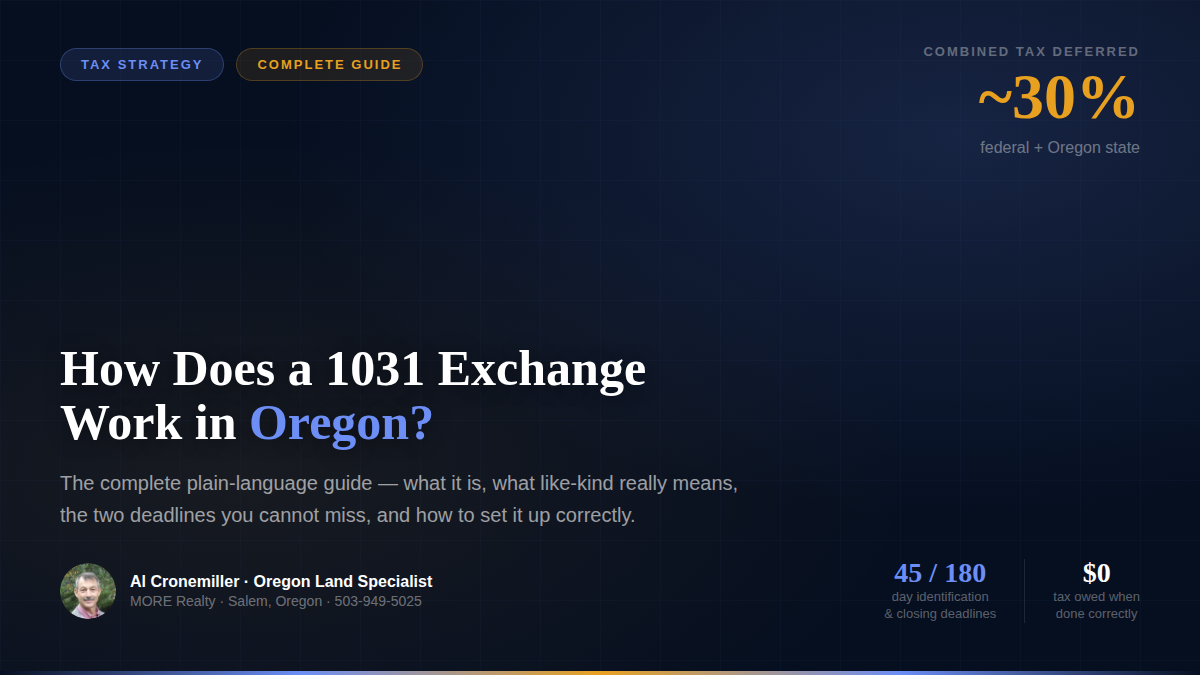
Every 1031 exchange runs on a strict 180-day clock that starts the moment you close the sale of your original property. Inside that 180-day window, there are two hard deadlines:
The 45-Day Identification Period: You have 45 calendar days from your closing date to formally identify, in writing, the replacement property or properties you intend to purchase. This is not a soft deadline. It does not move for weekends, holidays, or the fact that the property you liked just went under contract with someone else.
The 180-Day Exchange Period: You have 180 calendar days total, not 45 plus 180, to close on the replacement property. The 45-day identification window is part of the 180 days, not additional time on top of it. If your tax filing deadline falls before day 180, that earlier date can end your window unless you file a tax extension, which is common practice for exchanges closing late in the year.
There are no extensions for missed deadlines outside of a formal IRS disaster declaration. If you miss day 45 or day 180, the exchange is disqualified, and the capital gains tax becomes due.
Read more: What Is Oregon’s Urban Growth Boundary? How It Affects Your Land Value
The Qualified Intermediary Requirement
You cannot touch the sale proceeds yourself at any point during the exchange. If the money from your land sale lands in your bank account, even briefly, the IRS treats the exchange as disqualified.
Instead, the proceeds must go directly to a qualified intermediary, sometimes called a QI or exchange accommodator. This is an independent third party who holds your funds in escrow between the sale of your old property and the purchase of your new one. Choosing an experienced, properly bonded, qualified intermediary is one of the most important decisions in the entire process, and coordinating with one is a core part of what a good 1031 exchange specialist handles for you.
Read more: Sell or Hold Oregon Bare Land? An Honest Financial Analysis (2026)
What Counts as Like-Kind Property
You can exchange raw bare land for a rental duplex, timberland for a commercial building, and agricultural acreage for a multi family property. As long as you hold both properties for investment or business use, they generally qualify as like kind, regardless of their type, grade, or location within the United States.
This is exactly why a 1031 exchange is such a useful tool for Salem area landowners sitting on non-producing acreage. You are not restricted to buying more raw land. You can move directly into a property that generates monthly cash flow.
Understanding “Boot”: The Part Most People Miss
Boot is any part of your sale proceeds that does not get reinvested into the replacement property, and it is fully taxable even in an otherwise successful exchange.
For example, if you sell your Oregon land with $800,000 in equity and only deploy $650,000 into the replacement property, the remaining $150,000 is boot, and you will owe capital gains tax on that portion. The same principle applies to debt. If your replacement property carries a smaller mortgage than the property you sold, that reduction in debt can also count as boot.
The rule of thumb: to fully defer your tax, match or exceed both the sale price and the debt of the property you are giving up.
Read more: How Do I Find Out If My Oregon Land Has Water Rights? (Step-by-Step Verification Guide)
Oregon-Specific Rules You Need to Know
Section 1031 is federal law, so the 45-day and 180-day deadlines, the qualified intermediary requirement, and the like-kind standard are identical no matter what state you are in. What changes state to state is how your state taxes the deferred gain, and Oregon has a few specific wrinkles worth understanding before you start.
Oregon Taxes Capital Gains as Ordinary Income
Oregon does not have a separate, lower capital gains tax rate the way the federal government does. Instead, Oregon taxes capital gains as ordinary income, with rates ranging up to 9.9%, one of the highest state rates in the country. This is exactly why deferring the gain through a 1031 exchange is often even more valuable in Oregon than in lower-tax states. Skipping the sale-day tax hit means skipping both the federal long-term capital gains rate and Oregon’s 9.9% top rate on the same gain.
Oregon has a Clawback Rule for out-of-state exchanges
If you sell Oregon property and exchange into a replacement property located outside Oregon, the state requires you to file Form OR-24 with your Oregon tax return. This form reports the deferred gain and must be filed annually until the replacement property is eventually sold and the gain is finally recognized.
Oregon is one of a small handful of states, along with California, Montana, and Massachusetts, that track deferred gain this closely on property that originated within its borders. This does not stop you from exchanging into an out-of-state property, but it does mean you cannot simply forget about the deferred gain once the deal closes.
Oregon Does Not Charge a Real Estate Transfer Tax (With One Exception)
Oregon is one of only a handful of states that prohibits a general real estate transfer tax under state law, so most Salem and Willamette Valley landowners will not pay one on either side of a 1031 exchange transaction. The single exception is Washington County, which has a grandfathered transfer tax of $1 per $1,000 of sale price. If your land or replacement property falls outside Washington County, this is simply one less cost to factor into your exchange.
Depreciation Basis Carries Forward
If your replacement property is a depreciable asset like a rental or commercial building, your original adjusted basis carries forward from the property you sold rather than resetting. This affects your future depreciation deductions and is worth reviewing with a CPA as part of your exchange planning, especially if you are moving from raw, non-depreciable land into an improved income property for the first time.
Why Bare Land Owners in Salem and the Willamette Valley Use This Strategy
Bare land is a unique case within the 1031 exchange world because it typically generates no income at all while you own it. You are paying property taxes and, in many cases, carrying costs like weed abatement or fencing, on an asset that contributes nothing to your monthly cash flow. Meanwhile, land value appreciation in Oregon has historically trailed inflation for many years, meaning your real purchasing power can shrink even while the sale price on paper goes up.
A 1031 exchange lets you take that same equity and move it into an income-producing property, potentially generating consistent monthly cash flow, without a tax bill standing between you and the transition. For land that has been in a family for generations, inherited acreage nobody quite knew what to do with, or agricultural land leased for minimal return, this is often the single most effective wealth strategy available.
Frequently Asked Questions
Can I do a 1031 exchange on inherited land in Oregon?
In most cases, yes, as long as the land is held for investment purposes rather than personal use. Inherited timberland, agricultural acreage, and rural land in Marion County or elsewhere in Oregon commonly qualify.
Does a 1031 exchange eliminate my capital gains tax completely?
No. It defers the tax rather than eliminating it. The gain rolls forward into the replacement property’s basis and becomes taxable if and when you eventually sell without doing another exchange. Some investors continue exchanging for the rest of their lives and let the deferred gain pass to heirs, who generally receive a stepped-up basis.
What happens if I cannot find a replacement property within 45 days?
The exchange fails, and the sale becomes fully taxable. This is why identifying likely replacement properties, and in many cases beginning conversations with sellers, before your original property even closes is such a common strategy among experienced exchangers.
Do I need a 1031 exchange specialist, or can I do this myself?
You can technically manage the process yourself, but between the qualified intermediary requirement, the strict deadlines, Oregon’s Form OR-24 filing requirement, and the risk of accidentally triggering boot, most landowners benefit significantly from working with someone who has handled multiple Oregon exchanges and understands local land values in Salem and the Willamette Valley.
Talk to a Salem-Based 1031 Exchange Specialist
If you are sitting on bare land, timberland, or agricultural acreage anywhere in Salem, Marion County, Polk County, or the greater Willamette Valley, the first step is understanding what your land is actually worth today and what it could be earning as income property.
Get a Free, No-Obligation Land Evaluation
📞 503-949-5025 | ✉️ al@cronemiller.com | HomesForSaleSalemOregon.net
Al Cronemiller | Oregon Land Specialist | MORE Realty | Salem, Oregon
https://shorturl.fm/hNUTD
https://shorturl.fm/BA1bU
https://shorturl.fm/Ztasx