
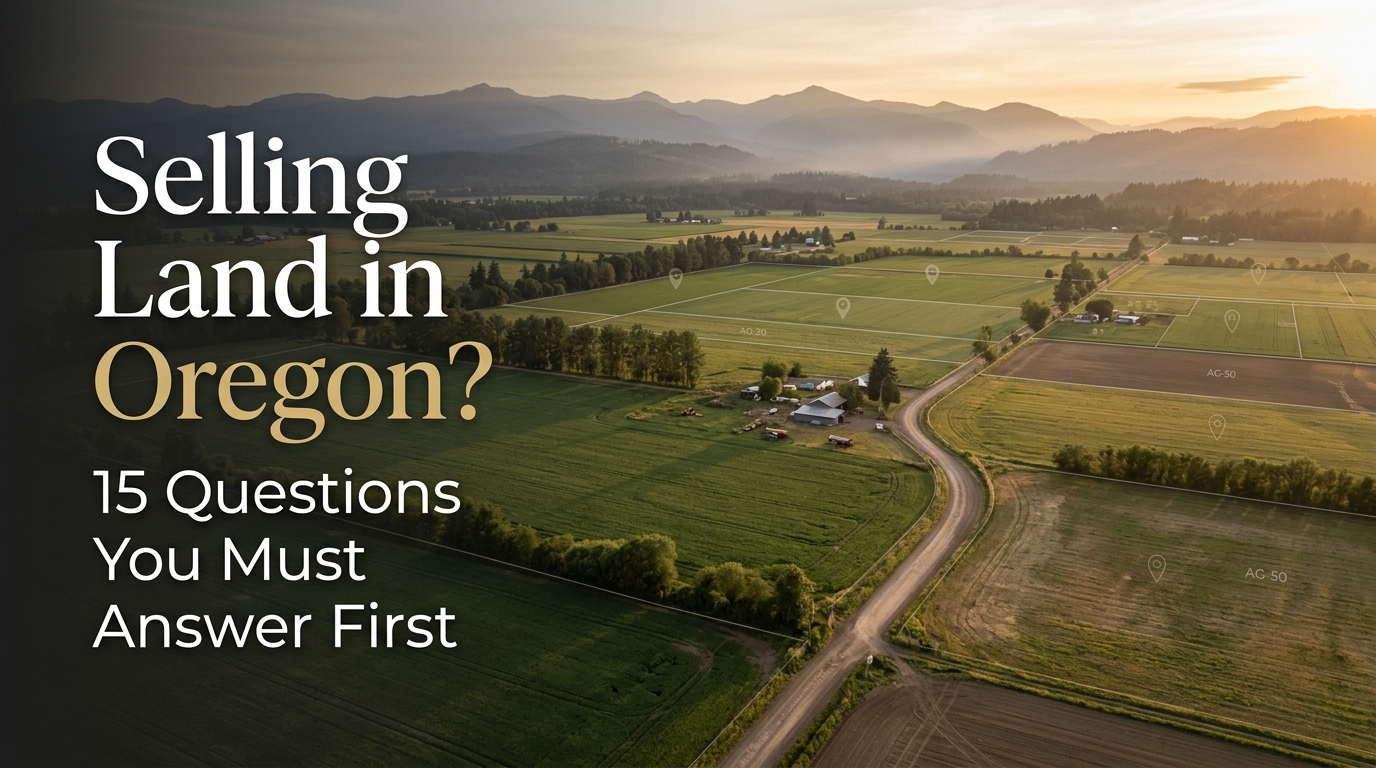
Selling raw land in Oregon is not the same transaction as selling a house, and treating it that way is where most land owners lose money. There is no staging, no open house, and often no agent who truly understands acreage, timber value, or the tax rules attached to rural property.
If you own bare land, timberland, or agricultural acreage in Salem, Marion County, Polk County, Yamhill County, or anywhere in the Willamette Valley, these are the 15 questions worth answering before you sign a listing agreement or accept an offer.
Read more: Land Specialist vs Real Estate Agent in Oregon: What Bare Land Owners Need to Know
1. Do You Actually Know What Your Land Is Worth Today?
Bare land does not price itself the way a house does. There is no simple square footage comparison. Value depends on soil type, timber stocking, access, zoning, water rights, and how close the parcel sits to Salem or another growth area.
Many Oregon land owners are working off a number they heard years ago, or an assessed value from their property tax statement, which is not the same as fair market value. Before you set a price or field an offer, get a current land specific evaluation, not a generic home value estimate.
Read more: Sell or Hold Oregon Bare Land? An Honest Financial Analysis (2026)
2. Is Your Land in a Farm or Forest Special Assessment Program?
This is the single most overlooked question, and it can cost sellers tens of thousands of dollars if they miss it.
Oregon allows farmland and forestland to be taxed at a reduced value through special assessment programs like Designated Forestland, Small Tract Forestland, and farm use assessment in an exclusive farm use zone. In exchange for that lower tax bill, the county tracks a potential additional tax liability behind the scenes.
If you sell, subdivide, or change the use of that land in a way that disqualifies it from the program, the deferred taxes from the past several years become due. Depending on the county and how long the land was in the program, that additional tax can run into the tens of thousands of dollars and it attaches to the land itself, not just the seller. Before listing, ask your county assessor’s office directly whether your parcel carries a potential additional tax liability, and get the estimated payoff amount in writing.
Read more: How Do I Find Out If My Oregon Land Has Water Rights? (Step-by-Step Verification Guide)
3. What Is Your Actual Zoning Designation, and What Does It Allow?
Exclusive Farm Use, Farm/Forest, Rural Residential, and Urban Growth Boundary zoning all carry very different rules for what a buyer can legally do with the land. A parcel zoned EFU in Marion County, for example, has strict limits on new dwellings and land division, while a similar sized parcel closer to Salem’s urban growth boundary may have meaningfully more development potential.
Buyers researching zoning restrictions on your parcel will find the answer regardless, so it is far better for you to know it, understand it, and be ready to explain it clearly than to be caught off guard mid negotiation.
4. Do You Have Legal, Recorded Access to a Public Road?
Landlocked parcels, or parcels that rely on an old handshake agreement to cross a neighbor’s driveway, are one of the most common deal killers in Oregon land sales. Access needs to be a recorded easement, not an assumption based on how things have worked for the last twenty years.
Pull your title report and confirm there is a recorded easement or public road frontage before you market the property. If access is unclear, resolving it before you list will save you from a collapsed sale later.
Read more: How Do I Avoid Capital Gains Tax When Selling Oregon Property? (Three Legal Tools That Work)
5. Are There Easements, Encroachments, or Boundary Issues You Should Know About?
Utility easements, shared driveways, a neighbor’s fence that sits a few feet over the property line, these are common on rural Oregon acreage and are not necessarily deal breakers, but they need to be disclosed and understood before a buyer’s attorney or title company finds them first.
6. What Is the Water Rights Situation on the Property?
Water rights matter enormously for agricultural and rural land in Oregon, and they do not automatically transfer the way people assume. Oregon’s standard vacant land purchase agreement actually requires the seller to represent that they have the authority to transfer any water rights tied to the property and that those rights have been put to beneficial use within the past several years.
If your land has an irrigation right, a well, or a pond, confirm the status of that water right with the Oregon Water Resources Department before you go to market. An unclear or lapsed water right can significantly reduce what a buyer is willing to pay.
Read more: Tax Deferred Real Estate Swap in Oregon: How to Use a 1031 Exchange to Build Wealth
7. Has the Land Been Surveyed, and Are the Boundaries Clearly Marked?
If your last survey is decades old, or does not exist at all, budget for a current one before listing. A clean, recent survey removes one of the biggest sources of buyer hesitation and gives you a document you can point to instead of relying on old fence lines or verbal descriptions from the previous owner.
8. Do You Know What a Straight Cash Sale Will Actually Cost You in Taxes?
This is where a lot of Oregon land owners get an unpleasant surprise. Oregon taxes capital gains as ordinary income, with no separate lower rate for long term gains the way the federal system offers. State rates run up to 9.9 percent, on top of federal capital gains tax, which can reach 20 percent for higher income sellers, plus a possible 3.8 percent net investment income tax.
Combined, a straightforward sale of appreciated land can push total tax exposure well above 30 percent of your gain for higher income sellers. That number changes the entire math of whether selling outright is actually your best option.
9. Would a 1031 Exchange Make More Sense Than a Straight Sale?
If your land has appreciated and you are not relying on the full proceeds for near term spending, a 1031 exchange lets you roll the sale proceeds into income producing replacement property and defer that capital gains tax rather than paying it at closing. Instead of a lump sum reduced by taxes, you move into a property generating monthly cash flow while your full equity keeps working for you.
This only works within specific IRS timelines, generally 45 days to identify replacement property and 180 days to close, so this is a question worth answering before you list, not after you already have an accepted offer.
Get a detailed answer: How Does a 1031 Exchange Work in Oregon? (Complete Plain-Language Guide)
10. Is a Disclosure Statement Required, and Should You Provide One Anyway?
Oregon law requires a specific seller’s disclosure statement for residential sales of one to four unit dwellings, but that statutory requirement does not automatically extend to vacant land. That said, Oregon is not a state where sellers can simply stay silent about known issues.
In practice, most Oregon land transactions use a vacant land specific disclosure addendum covering land usage history, mineral or oil rights, water rights, and known soil or environmental issues. Providing one voluntarily, even when not strictly required, protects you from disputes after closing and signals a well prepared seller to buyers and their agents.
11. If the Land Includes Timber, Do You Know Its Current Value?
Timber value changes with species, age, stocking density, and current market pricing, and it is a completely separate question from raw land value. A parcel with mature, marketable timber can be worth significantly more than the bare acreage alone, but only if that value is documented.
If you have never had a timber cruise done, or your last one is more than a few years old, get a current estimate before pricing your land. Selling timberland without knowing your timber value is one of the fastest ways to leave money on the table.
12. Are There Wetlands, Floodplain Areas, or Other Environmental Restrictions?
Wetlands, riparian buffers along streams, and floodplain designations can all limit what a buyer is able to build or develop, and they are increasingly easy for buyers to check themselves through state and federal mapping tools. Know these restrictions on your own property before a buyer brings them up, and be ready to explain how they affect usable acreage.
13. Is Your Land Inside or Outside an Urban Growth Boundary?
Proximity to Salem’s urban growth boundary, or that of a nearby city like Keizer, can meaningfully change your land’s development potential and therefore its value. Land inside or adjacent to a growth boundary tends to draw a different type of buyer, and often a different price per acre, than land firmly inside a rural or resource zone with no near term development prospects. Understanding where your parcel sits relative to these boundaries helps you set realistic expectations and market to the right buyer pool.
14. What Would It Take to Partition or Subdivide the Property?
Some buyers are specifically looking for land they can divide into smaller parcels. Whether that is realistic on your property depends on county minimum lot sizes, zoning, road access requirements, and septic or well feasibility for each new parcel. If subdivision potential is part of your land’s value story, get a preliminary answer from the county planning department before you market it as a selling point, since an unverified claim about future subdivision potential can create real liability if a buyer later finds out it is not feasible.
15. Who Is Your Ideal Buyer, and How Should You Position the Land?
Land buyers are not one uniform group. A developer, a timber investor, a farming operation, and a family looking for rural acreage are all evaluating the same property through completely different lenses. The way you market a parcel with strong timber value to a timber buyer should look very different from how you market that same parcel’s development potential to someone eyeing future subdivision.
Knowing your likely buyer before you list changes your pricing strategy, your marketing materials, and even which platforms and networks you use to find them.
The Bottom Line
Selling Oregon land well means answering these questions before you list, not scrambling to answer them after an offer is already on the table. Special assessment tax liability, water rights, access, and the capital gains exposure of a straight sale are the four areas that most often catch sellers off guard, and all four are avoidable with the right preparation.
If you own bare land, timberland, or agricultural acreage in Salem, Marion County, Polk County, Yamhill County, or anywhere in the Willamette Valley and want honest answers to these questions specific to your property, a free land evaluation is the fastest way to get clarity before you decide anything.
Get My Free Oregon Land Evaluation
503-949-5025 | al@cronemiller.com | HomesForSaleSalemOregon.net
Al Cronemiller | Oregon Land Specialist | MORE Realty | Salem, Oregon