If you own bare land anywhere in Salem, Marion County, or the wider Willamette Valley, you have probably asked yourself this question more than once: is holding onto raw acreage actually building my wealth, or would that same equity work harder for me as a rental property?
It is a fair question, and it deserves a real answer backed by real numbers, not just a gut feeling about “land always goes up.” Below is what the current data actually shows, and what it means for Oregon land owners deciding what to do next.
Read more: Sell or Hold Oregon Bare Land? An Honest Financial Analysis (2026)
What the Data Says About Oregon Land Appreciation
Oregon land has genuinely appreciated over the past decade, but the pace depends heavily on land type and location.
Rural land across the state has historically averaged a few percent in annual appreciation, with forestland, which makes up roughly 47% of Oregon’s total land area, appreciating around 5% a year over the last five years according to Oregon Department of Forestry data. Farm real estate values climbed 23% between 2017 and 2022 based on Oregon State University research, and rose another 6.3% from 2023 to 2024.
More recently, that growth has cooled. The most recent USDA and OSU Extension figures for 2025 show inflation adjusted farm real estate values in Oregon actually dipped slightly, the first real decline since 2013, even though nominal values have generally kept pace with or slightly outrun inflation over the longer term. Limited inventory rather than falling demand is the main driver keeping Oregon and Idaho land values from softening further, according to AgWest Farm Credit’s regional analysis.
What this means for you: Bare land in Oregon is not a bad asset. But its appreciation has been modest, uneven year to year, and entirely dependent on market timing since it produces zero income while you wait.
Read more: How Do I Find Out If My Oregon Land Has Water Rights? (Step-by-Step Verification Guide)
What Rental Property Returns Actually Look Like in Salem and the Willamette Valley
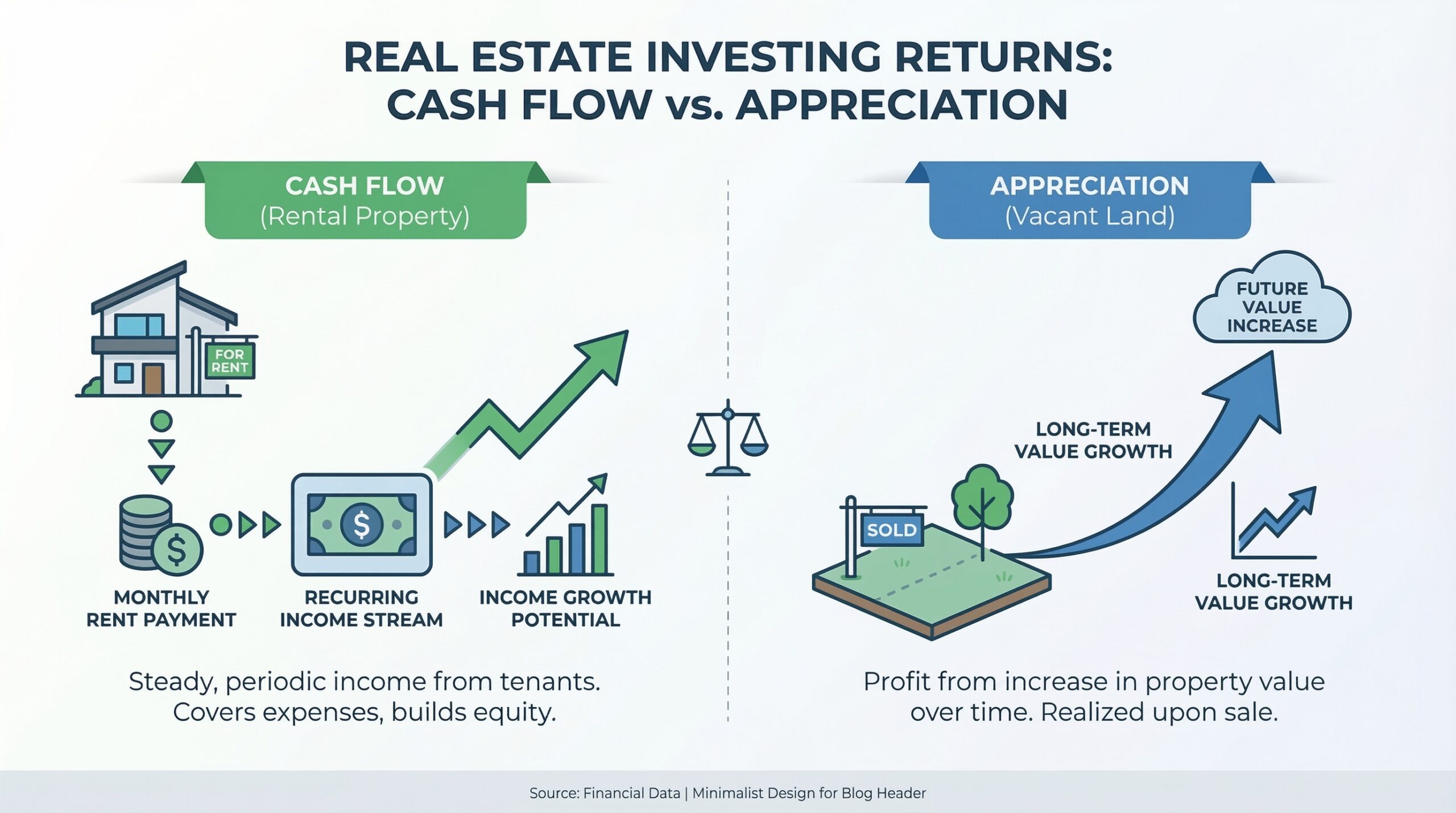
Rental property tells a different story, because it produces two forms of return at once: appreciation and monthly cash flow.
As of mid-2026, average rent across Salem sits between roughly $1,395 and $1,539 a month depending on the data source and property mix, with standalone houses renting closer to $2,100 a month on average. Multifamily cap rates across the Salem market are averaging around 5.6% as of the first quarter of 2026, according to apartment lending industry data, meaning a well positioned income property is generating real, collectible cash flow every single month, not theoretical appreciation you can only access by selling.
Oregon’s statewide rent stabilization law also caps annual rent increases, at 9.5% for 2026, which gives income property owners a level of predictable, compounding cash flow growth that bare land simply cannot offer, since bare land generates no rent at all.
The core difference: land value only becomes real money the day you sell it. Rental property pays you every month whether you sell or not.
The Hidden Costs of Holding Bare Land in Oregon
This is the part most land owners underestimate. Bare land is not free to hold.
Property taxes still apply. Marion County’s effective property tax rate runs roughly 0.87% to 1.1% depending on the specific taxing district, and vacant parcels carry their own minimum surcharge, $20 per vacant lot for the current tax year, on top of standard levies. Forested acreage is taxed separately under Oregon’s forestland program, currently assessed near $1.79 per acre for timberland in Marion County.
Insurance and maintenance add up. Fire mitigation, boundary maintenance, weed abatement, and liability insurance are ongoing costs with no offsetting income.
Liquidity is genuinely lower. Vacant land typically takes longer to sell than developed property, often months and sometimes over a year, especially for large rural parcels or land with access and zoning complications.
Wildfire risk is now a real underwriting factor. Research cited by Capital Press found Oregon wildfires have reduced farmland values by several hundred dollars per acre in affected areas, a risk that simply does not exist in the same way for a well insured rental property in an established neighborhood.
None of this means bare land is a poor investment. It means bare land is a patient, low cash flow asset that quietly costs you money every year you hold it without a clear plan.
Read more: How Do I Avoid Capital Gains Tax When Selling Oregon Property? (Three Legal Tools That Work)
Bare Land vs Rental Property: Side by Side
| Factor | Bare Land | Rental Property |
|---|---|---|
| Monthly income | None | Yes, typically $1,300 to $2,600+ in the Salem area depending on property type |
| Recent appreciation | Roughly 2% to 6% a year depending on land type, uneven year to year | Appreciation plus rent growth, rent capped at 9.5% annual increases under Oregon law |
| Property tax burden | Ongoing, plus vacant lot surcharges | Ongoing, but partially offset by rental income |
| Liquidity | Low, often months to a year or more to sell | Generally faster to sell or refinance |
| Management required | Minimal | Moderate, or manageable through property management |
| Wealth building mechanism | Appreciation only, realized on sale | Appreciation plus compounding monthly cash flow |
Tax Considerations Every Oregon Land Owner Should Understand
Selling bare land outright triggers capital gains tax, and Oregon does not offer a lower rate for long term gains the way the federal government does. Oregon taxes capital gains as ordinary income, with a top state rate of 9.9%. Combined with federal long term capital gains rates, high income sellers in Oregon can face a combined tax bill approaching a third of their total gain.
This is exactly the problem a 1031 exchange is built to solve. Instead of selling your bare land and paying capital gains tax immediately, a 1031 exchange allows you to reinvest the full proceeds into a qualifying replacement property, such as an income producing rental, while deferring that tax bill entirely. You have 45 days from closing to identify replacement property and 180 days total to complete the exchange, and the process must be coordinated through a qualified intermediary to remain IRS compliant.
In other words, you do not have to choose between “sell my land and pay a large tax bill” or “keep sitting on land that earns nothing.” A properly structured exchange lets you move from one to the other without losing a significant share of your equity to taxes along the way.
Read more: How Do I Sell Timberland in Oregon? (What Buyers Want and How to Maximize Your Return)
So Which Actually Builds Wealth Faster?
Based on the data, rental property generally outpaces bare land for wealth building in the Salem and Willamette Valley market, for one core reason: it combines appreciation with monthly income, while bare land offers appreciation alone, and often at a slower, less predictable pace once carrying costs are factored in.
That does not mean every land owner should sell immediately. If you have a clear long term development plan, land with above average appreciation potential, such as forestland or acreage near an expanding urban growth boundary, or a genuine emotional or legacy reason to hold, keeping the land can still make sense.
But if your bare land has sat unused for years with no clear plan, generating no income while quietly costing you in property taxes, insurance, and lost opportunity, the numbers make a strong case for converting that equity into income producing property, without the tax hit that would normally come with selling.
Read more: What Is Oregon’s Urban Growth Boundary? How It Affects Your Land Value
Frequently Asked Questions
Does bare land in Oregon actually lose value over time?
Bare land itself rarely loses nominal value in most Oregon markets, but its real, inflation adjusted value can decline in years when appreciation trails inflation, as recent 2025 farmland data has shown. Add in property taxes and carrying costs, and many parcels produce a negative real return even while the sale price technically holds steady.
Is rental property really more profitable than land in Salem, Oregon?
In most cases, yes, because rental property generates monthly income in addition to appreciation. A land parcel only pays you once, when you sell it.
Can I convert bare land into rental property without paying capital gains tax?
Yes, through a 1031 exchange. This allows Oregon land owners to reinvest sale proceeds into a qualifying income property while deferring capital gains tax, as long as IRS timelines and rules are followed correctly.
How much does it cost to hold bare land in Marion County each year?
Costs vary by parcel, but expect standard property tax at roughly 0.87% to 1.1% of assessed value, plus a minimum vacant lot surcharge, plus insurance and any maintenance or fire mitigation costs.
Is now a good time to exchange bare land for rental property in Oregon?
With farmland appreciation cooling in 2025 and Salem rental cap rates holding near 5.6%, many land owners are finding this an attractive window to move stagnant equity into cash flowing property. A free land evaluation is the fastest way to see what your specific parcel could generate.
Ready to See What Your Land Could Be Earning?
If your bare land in Salem, Marion County, Polk County, or anywhere in the Willamette Valley has been sitting without a clear plan, it may be time to see what it could generate as income property instead. I offer a free, no obligation land evaluation that shows you exactly what your parcel is worth today and what it could be earning through a 1031 exchange.
503-949-5025 | al@cronemiller.com | HomesForSaleSalemOregon.net
Al Cronemiller | Oregon Land Specialist | MORE Realty | Salem, Oregon