A Strategic, Financial, and Practical Analysis for Landowners
Introduction: The Truth About Bare Land in Oregon
Owning bare land in Oregon can feel simple.
There are no tenants.
No roofs to repair.
No plumbing to fix.
But simplicity does not automatically mean profitability.
Bare land is one of the most misunderstood asset types in real estate. Some parcels perform extremely well. Others quietly underperform for years.
The difference is not luck.
It is structure, income, zoning, and strategy.
This guide explains everything Oregon landowners need to understand about owning, evaluating, holding, selling, or repositioning vacant land.
- What Is Bare Land?
Bare land (also called vacant land) is property without improvements such as:
- Residential structures
- Commercial buildings
- Infrastructure installations
It may be:
- Agricultural land
- Timberland
- Rural acreage
- Urban infill lots
- Commercial or industrial parcels
In Oregon, land classification matters enormously because land use laws are highly structured.
Understanding the type of land you own is the first step.
- How Bare Land Actually Generates Return
Bare land produces return in only three ways:
- Appreciation
- Income
- Development
If none of these are present, land functions as a static asset.
Let’s break these down.
Appreciation
Land may increase in value due to:
- Population growth
- Infrastructure expansion
- Zoning changes
- Market cycles
However, appreciation is unpredictable and dependent on timing.
Without income, appreciation must exceed inflation and holding costs to create real gain.
Income
Land can produce income through:
- Agricultural leases
- Timber harvest
- Commercial ground lease
- Recreational use
Income fundamentally changes the risk profile.
Income stabilizes ownership.
Development
Land near expanding urban boundaries may gain value from:
- Partitioning
- Subdivision
- Construction
- Zoning modification
However, development is governed by Oregon’s land use laws, which are among the strictest in the country.
Assuming development without verifying zoning is a costly mistake.
- Oregon’s Land Use System: Why It Matters
Oregon operates under a statewide land use planning system.
This system affects:
- Urban Growth Boundaries (UGBs)
- Exclusive Farm Use (EFU) zoning
- Forest zoning
- Environmental overlays
- Development density
Two parcels of identical size can have radically different values depending on zoning classification.
Before evaluating land as an “investment,” you must understand what it is legally allowed to become.
- The Hidden Costs of Owning Bare Land
Vacant land feels inexpensive to hold.
But expenses continue.
Property Taxes
All land is subject to annual taxation.
Opportunity Cost
Capital tied up in non-producing land cannot be deployed elsewhere.
Liability Exposure
Vacant land can carry risk from trespassing, environmental issues, or fire exposure.
Maintenance
Brush clearing, access upkeep, fencing, road grading.
Inflation
If appreciation does not exceed inflation, purchasing power declines.
Over 10–20 years, these factors compound.
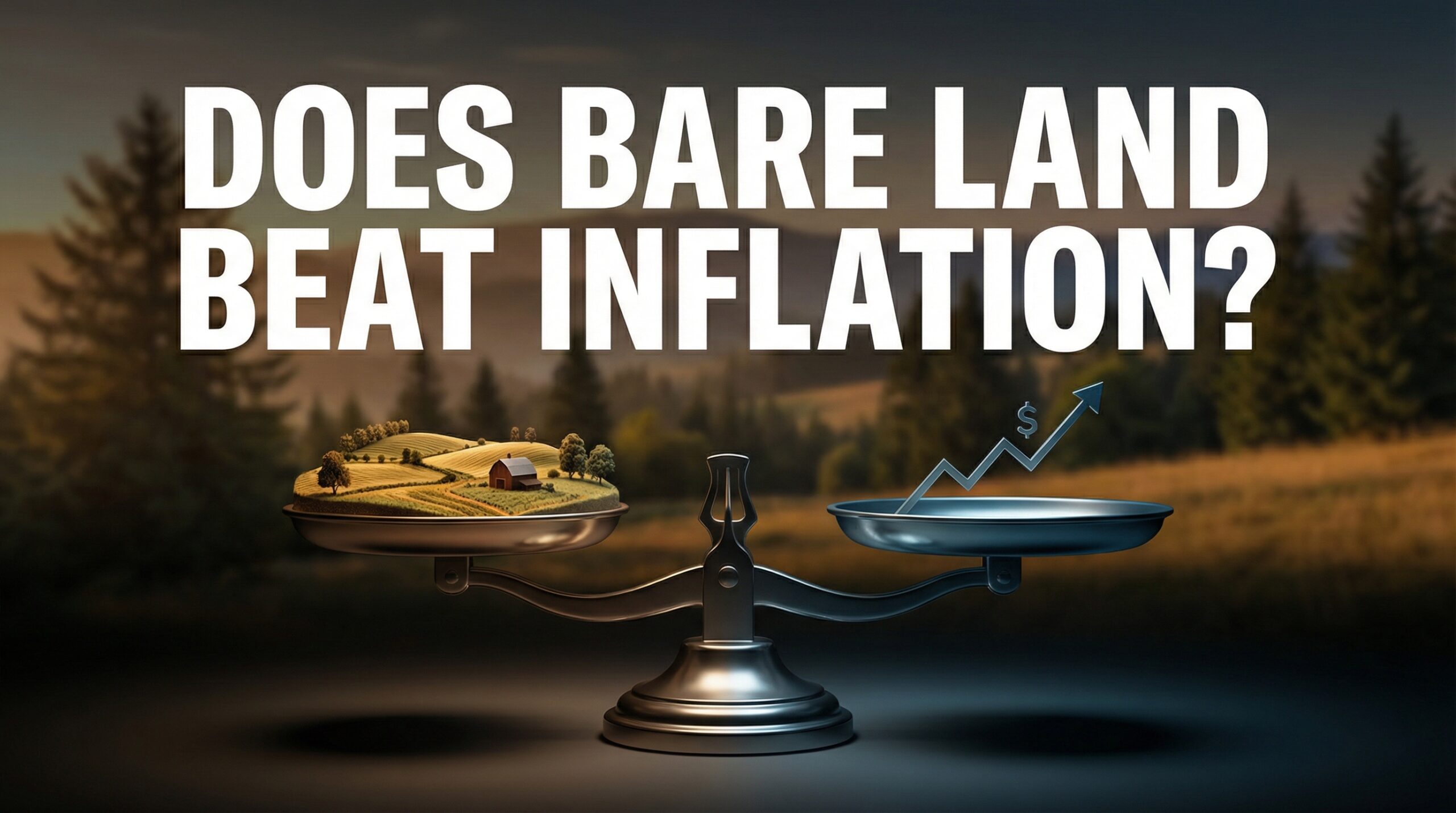
- Appreciation vs Inflation: The Quiet Erosion
A key question most landowners never ask:
Does land appreciation consistently beat inflation?
If land appreciates at 3% annually and inflation averages near that rate, real wealth may not increase meaningfully.
Without income, appreciation must carry the entire return.
Income-producing property, by contrast, provides inflation-adjusting revenue.
This distinction is critical.
- Bare Land vs Income-Producing Property
Let’s compare two equal-value investments:
Vacant Land
- No income
- Holding costs
- Appreciation only
Rental Property
- Monthly cash flow
- Rent increases
- Mortgage amortization
- Appreciation
Income reduces reliance on market timing.
Appreciation-only strategies require patience and favorable conditions.
Investors often prefer income because it provides control.
- When Bare Land Makes Financial Sense
Land can be strategic when:
- It generates agricultural or timber income
- It sits near expanding urban growth
- It has confirmed development feasibility
- It fits a defined long-term plan
- It is part of a structured 1031 exchange
Land without purpose often underperforms.
Land with structure can outperform.
- Inherited Land in Oregon
Inherited land introduces unique considerations.
One major advantage is the stepped-up basis.
Upon inheritance, tax basis resets to fair market value at date of death. This can significantly reduce capital gains exposure.
However, inherited land still carries:
- Holding costs
- Zoning limitations
- Opportunity cost
Many heirs hold land emotionally rather than strategically.
Clarity is essential.
- 1031 Exchanges and Repositioning
Vacant land held for investment may qualify for a 1031 exchange.
This allows:
- Sale of land
- Deferral of capital gains tax
- Reinvestment into income-producing property
Strict rules apply:
- 45-day identification window
- 180-day closing requirement
- Qualified intermediary required
A 1031 exchange is not just a tax tool — it is a portfolio restructuring strategy.
It can convert speculative land into income-producing assets.
- Valuing Bare Land Accurately
Land valuation depends on:
- Zoning
- Urban growth boundary placement
- Access
- Utilities
- Topography
- Comparable sales
- Development feasibility
Price per acre is not a reliable shortcut.
Usability and legal use matter more than raw size.
Professional evaluation reduces overestimation or undervaluation.
- Common Mistakes Landowners Make
- Assuming all land appreciates equally
- Ignoring zoning limitations
- Holding indefinitely without a plan
- Overestimating development potential
- Failing to consider opportunity cost
- Letting emotion override financial analysis
Land ownership without strategy often leads to stagnation.
- Questions Every Oregon Landowner Should Ask
- Does this land produce income?
- What are my annual holding costs?
- Does appreciation exceed inflation?
- What is the realistic development timeline?
- Could this capital perform better elsewhere?
- Is there a tax-efficient exit strategy?
Answers to these questions determine whether land is strategic or speculative.
- Liquidity and Market Cycles
Vacant land is less liquid than improved property.
During downturns:
- Buyers prioritize housing
- Financing tightens
- Marketing times increase
Liquidity matters in real-world decision making.
Having a defined exit plan reduces uncertainty.
- Emotional Ownership vs Strategic Ownership
Land often carries emotional weight.
Family property.
Long-held acreage.
Timber passed through generations.
Emotion is understandable.
But long-term wealth depends on objective evaluation.
Stewardship sometimes means repositioning rather than holding.
- Final Analysis: Is Bare Land a Good Investment in Oregon?
Bare land is not inherently good or bad.
It is neutral.
Its performance depends on:
- Income
- Zoning
- Location
- Development potential
- Time horizon
- Strategy
Without income or structure, land often underperforms compared to income-producing real estate.
With clarity and planning, land can be powerful.
The key difference is intention.
Owning land without strategy is speculation.
Owning land with structure is investment.
Conclusion
Oregon’s land market is unique. Regulations are structured. Growth patterns are defined. Zoning drives value.
Bare land ownership requires:
- Financial clarity
- Regulatory understanding
- Market awareness
- Defined objectives
The most successful landowners are not those who simply hold.
They are those who evaluate, adapt, and act strategically.
Land is a tool.
How it performs depends entirely on how it is used.