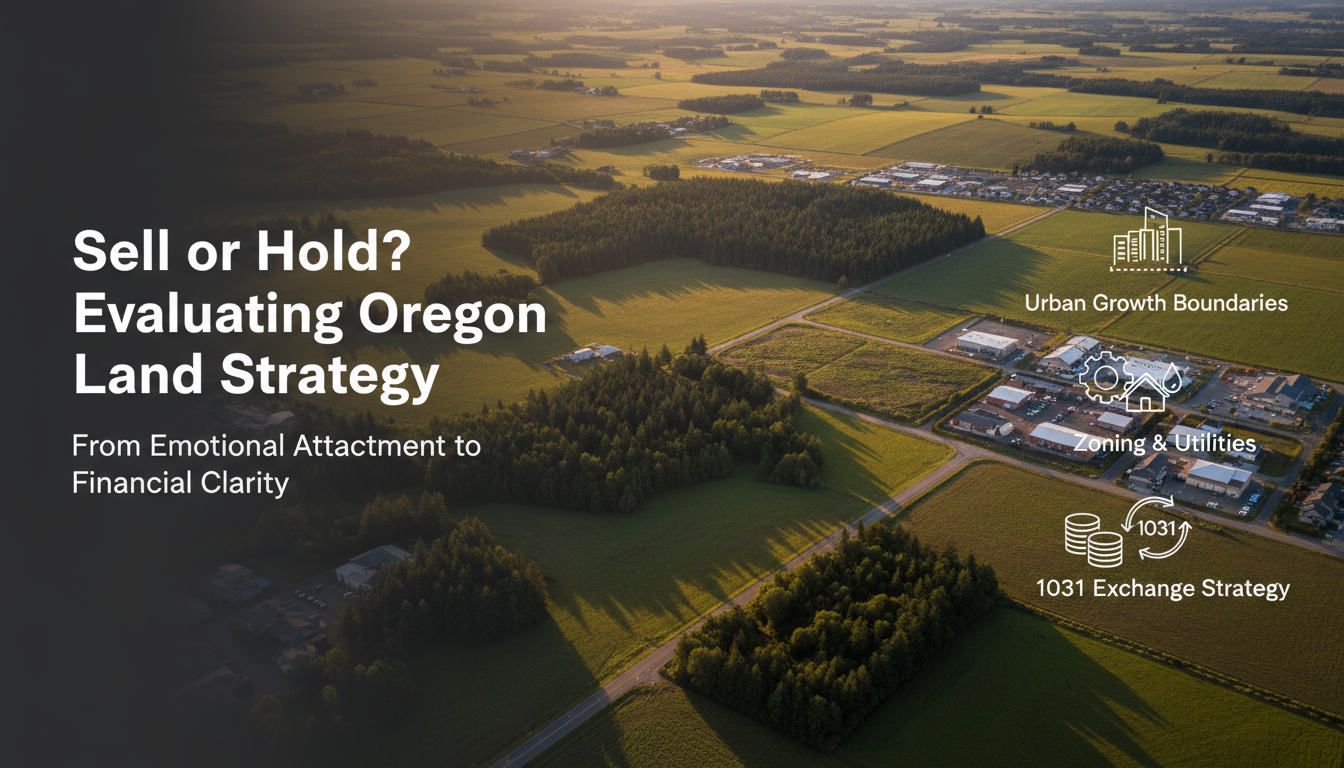
Should I Sell My Land in Oregon or Keep It Long Term?
Whether you should sell your land in Oregon or hold it long term depends on one central question:
Is the property producing income or tied to a clear strategic plan?
If the land generates no income and has no defined development timeline, holding it long term may result in underperformance compared to other real estate investments.
However, each situation is different. This guide walks through the financial and strategic factors Oregon landowners should consider before deciding.
Step One: Does the Land Produce Income?
The first and most important question is simple:
Does the land generate revenue?
Examples of income-producing land include:
- Agricultural lease property
- Timberland with active harvest cycles
- Commercial ground leases
- Recreational lease agreements
If your land produces consistent income, holding may make financial sense.
If it produces no income, appreciation becomes the only return driver.
That increases uncertainty.
Step Two: What Are the Ongoing Costs?
Even vacant land carries expenses.
Common holding costs in Oregon include:
- Property taxes
- Insurance (if applicable)
- Maintenance or clearing
- Road or access upkeep
- Opportunity cost
Over five to ten years, these costs accumulate.
Without income, these expenses reduce overall performance.
Understanding your annual carrying cost helps clarify the decision.
Step Three: Does Appreciation Justify Holding?
Many landowners assume:
“Land always goes up.”
While land may appreciate over time, growth rates vary depending on:
- Location
- Zoning
- Utility access
- Infrastructure expansion
- Market demand
Urban fringe land near Salem may perform differently than remote rural acreage.
Appreciation must meaningfully exceed inflation and holding costs to justify long-term retention.
Otherwise, purchasing power may stagnate.
Step Four: What Is the Development Potential?
Land often holds more value when tied to development potential.
Questions to consider:
- Is the property inside or near an urban growth boundary?
- Can it be partitioned or subdivided?
- Are utilities available?
- Does zoning allow residential or commercial construction?
If development is realistic within a defined timeframe, holding may be strategic.
If zoning restrictions limit use indefinitely, resale growth may be constrained.
Oregon’s structured land use system makes zoning clarity essential before deciding to hold long term.
Step Five: Opportunity Cost
Opportunity cost is frequently overlooked.
Capital tied up in vacant land cannot be used elsewhere.
If you sold the property, could you:
- Purchase income-producing rental property?
- Reinvest in commercial real estate?
- Reduce debt?
- Diversify investments?
Income-producing property generates:
- Monthly revenue
- Tax advantages
- Mortgage amortization
- Appreciation
Comparing potential alternatives helps clarify whether holding is optimal.
When Holding Land Makes Sense
Keeping land long term may be appropriate when:
- It Produces Income
Agricultural or timber revenue offsets holding costs.
- Development Is Imminent
Infrastructure expansion or zoning change is reasonably expected.
- It Fits a Broader Portfolio Strategy
Land may serve diversification or long-term planning goals.
- There Are Significant Tax Implications
Capital gains exposure may influence timing decisions.
Holding without one of these reasons increases risk of underperformance.
When Selling May Be the Smarter Move
Selling may make sense when:
- The land produces no income
- Appreciation has stalled
- Holding costs continue rising
- Capital could be repositioned more productively
- You lack a defined long-term plan
In many cases, repositioning capital into income-producing property improves financial stability.
Selling is not failure. It can be strategic reallocation.
Using a 1031 Exchange as a Strategy
For investment property owners, a 1031 exchange offers an alternative to outright sale with immediate taxation.
A properly structured 1031 exchange allows:
- Sale of investment land
- Deferral of capital gains tax
- Reinvestment into income-producing property
This shifts the asset from appreciation-only to income-based performance.
Strict timelines apply, including:
- 45-day identification period
- 180-day closing window
A qualified intermediary is required.
Each exchange requires careful planning.
Special Considerations for Salem and the Willamette Valley
In Salem and surrounding counties, land value depends heavily on:
- Urban growth boundaries
- Zoning classification
- Utility access
- Road frontage
- Timber valuation
- Agricultural designation
Urban fringe parcels may carry greater upside potential than isolated acreage.
However, land inside regulated zones may have development limitations.
Professional evaluation helps clarify realistic outcomes.
Emotional Factors vs Financial Factors
Land ownership often carries emotional attachment.
Family property, inherited acreage, or long-held parcels may feel difficult to sell.
However, financial decisions benefit from objective analysis.
Ask:
- What is the land doing financially today?
- What is it likely to do in the next five to ten years?
- Does it align with long-term goals?
Emotional attachment should not override strategic planning.
Frequently Asked Questions
Should I hold land for appreciation in Oregon?
Holding may make sense if appreciation significantly exceeds inflation and holding costs, or if development potential exists.
Is land a safe long-term investment?
Land may feel safe, but without income, it carries financial uncertainty.
When is selling land smart?
When capital can be repositioned into income-producing assets or when holding costs outweigh benefits.
Can I avoid capital gains taxes when selling land?
A properly structured 1031 exchange may allow tax deferral for investment property.
How do I evaluate my specific property?
Evaluation should include zoning, development potential, holding costs, tax implications, and alternative investment opportunities.
Final Analysis
The decision to sell or keep land in Oregon depends on income, appreciation potential, holding costs, and long-term strategy.
Land without income or development potential often underperforms compared to income-producing real estate.
Holding makes sense when part of a defined plan.
Selling can be strategic repositioning — not surrender.
Clear evaluation allows landowners to move from speculation to informed decision-making.