Why Bare Land Often Underperforms in Oregon Real Estate
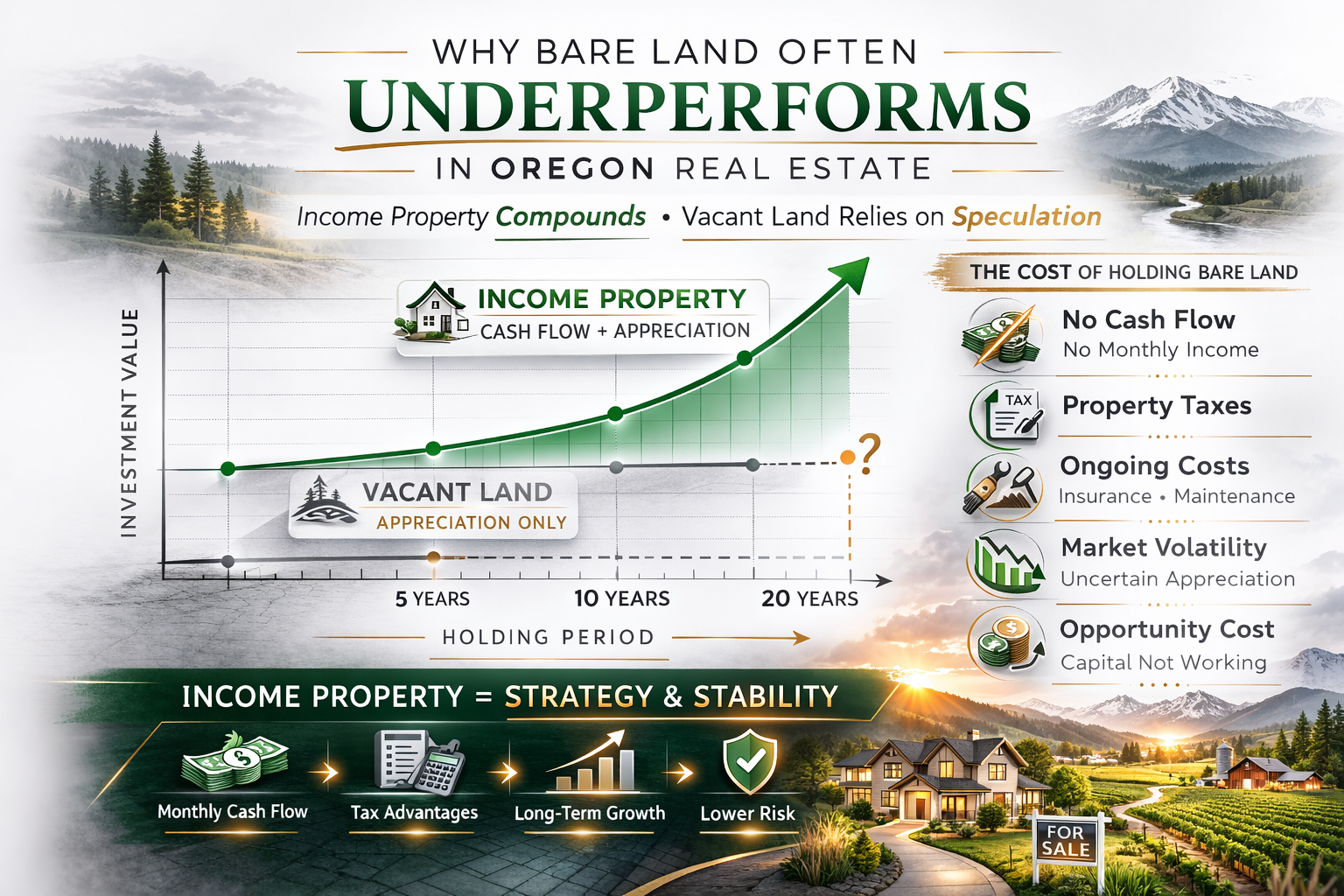
Bare land in Oregon often underperforms compared to income-producing real estate because it generates no cash flow and relies almost entirely on appreciation.
While land can increase in value, appreciation alone does not guarantee meaningful financial growth. Without income, land ownership becomes dependent on timing, market cycles, and long-term speculation.
Understanding why vacant land frequently underperforms helps landowners make more strategic decisions.
The Core Issue: No Income
The primary reason bare land underperforms is simple:
It does not produce income.
Rental property produces:
- Monthly cash flow
- Inflation-adjusted rent increases
- Tax advantages
- Reinvestment opportunities
Vacant land produces none of those unless it is leased for agriculture, timber, or commercial use.
Without income, landowners must rely on appreciation to justify holding costs.
Appreciation Alone Is Unpredictable
Land appreciation in Oregon varies widely depending on:
- Location
- Zoning
- Infrastructure access
- Market demand
- Development potential
Urban fringe parcels near Salem or growing parts of the Willamette Valley may appreciate more steadily than isolated rural acreage.
However, appreciation is not consistent or guaranteed.
Unlike rental property, which generates return while held, land depends on resale timing.
Market downturns affect vacant land disproportionately because it is not essential housing inventory.
Inflation and Opportunity Cost
Another major factor in land underperformance is opportunity cost.
If inflation averages 3% annually and land appreciation averages near that rate, real purchasing power does not significantly increase.
Meanwhile, capital tied up in land could potentially earn income elsewhere.
Opportunity cost includes:
- Lost rental income
- Missed reinvestment growth
- Reduced leverage capacity
Over 10–20 years, these differences compound.
Ongoing Holding Costs in Oregon
Even without income, vacant land carries expenses.
Common costs include:
- Property taxes
- Liability insurance (if applicable)
- Maintenance or clearing
- Survey or boundary clarification
- Access improvements
In Oregon, additional considerations may include:
- Land use compliance
- Forest management requirements
- Environmental restrictions
These expenses reduce net performance over time.
Regulatory and Zoning Limitations
Oregon has some of the most structured land use regulations in the country.
Statewide land use planning can restrict:
- Subdivision
- Development
- Dwelling placement
- Timber harvest
- Agricultural conversion
Many landowners purchase property assuming flexibility that does not exist.
If zoning does not support intended use, appreciation potential declines.
Understanding local zoning in Salem, Marion County, Polk County, and surrounding areas is critical to evaluating performance potential.
Market Volatility and Liquidity
Vacant land is less liquid than improved property.
During market slowdowns:
- Buyers prioritize housing
- Financing becomes more restrictive
- Demand for raw land declines
Land often takes longer to sell.
Longer marketing time increases holding cost exposure.
This reduced liquidity contributes to underperformance compared to rental housing or commercial assets.
Psychological Holding Patterns
Another reason land underperforms is emotional decision-making.
Common beliefs include:
“Land is always safe.”
“I’ll just wait until prices go up.”
“It doesn’t cost much to hold.”
While land may feel passive, passive does not mean profitable.
Holding without a defined exit strategy often leads to stagnation rather than growth.
Comparing Bare Land to Income-Producing Property
Consider two $300,000 investments:
Vacant land
Rental property
Rental property may generate:
- $1,500–$2,000 per month in gross rent
- Tax deductions
- Principal reduction through amortization
- Appreciation
Vacant land generates:
- No income
- Property taxes
- Speculative appreciation
Even moderate cash flow can significantly outperform appreciation-only growth over time.
This is why many experienced investors prioritize income first.
When Bare Land Performs Well in Oregon
Bare land can outperform under specific conditions:
- Clear Development Upside
Land near expanding urban boundaries or infrastructure growth.
- Income-Producing Agricultural or Timber Use
Properties generating lease or harvest revenue.
- Strategic 1031 Exchange Positioning
Holding land temporarily before reinvesting into higher-yield assets.
- Long-Term Portfolio Diversification
As part of a broader investment strategy.
Without one of these elements, land frequently lags income-based investments.
1031 Exchanges as a Performance Strategy
Some Oregon landowners use 1031 exchanges to reposition underperforming land.
A 1031 exchange allows investors to:
- Defer capital gains taxes
- Sell investment land
- Reinvest in income-producing property
For landowners seeking stronger performance, this strategy can shift the investment profile from speculative to productive.
Each case requires careful evaluation of timelines, replacement property options, and tax considerations.
Evaluating Land in Salem and the Willamette Valley
In Salem and surrounding areas, performance depends on:
- Proximity to city growth
- Utility access
- Road frontage
- Timber value
- Zoning flexibility
Urban infill parcels may carry more appreciation potential than isolated acreage.
However, accurate valuation requires understanding planning regulations, infrastructure limitations, and development feasibility.
Professional evaluation reduces performance assumptions.
Frequently Asked Questions
Why does vacant land underperform?
Because it typically produces no income and relies entirely on appreciation.
Is land safer than rental property?
Land may require less management but often carries greater financial uncertainty.
Does land appreciate in Oregon?
Yes, but appreciation varies widely and is not guaranteed to exceed inflation consistently.
Can I improve land performance?
Yes, through development, leasing, timber management, or strategic 1031 exchange repositioning.
Should I sell underperforming land?
That depends on long-term goals, tax position, and alternative opportunities.
Final Analysis
Bare land in Oregon often underperforms because it lacks income.
Appreciation alone does not create stable financial growth.
Holding costs, inflation, opportunity cost, and regulatory constraints all influence performance outcomes.
Land can be strategic when part of a defined plan.
Without a clear plan, however, it frequently becomes a speculative asset rather than a productive investment.
Understanding these factors allows Oregon landowners to make informed, strategic decisions about whether to hold, develop, or reposition their property.