
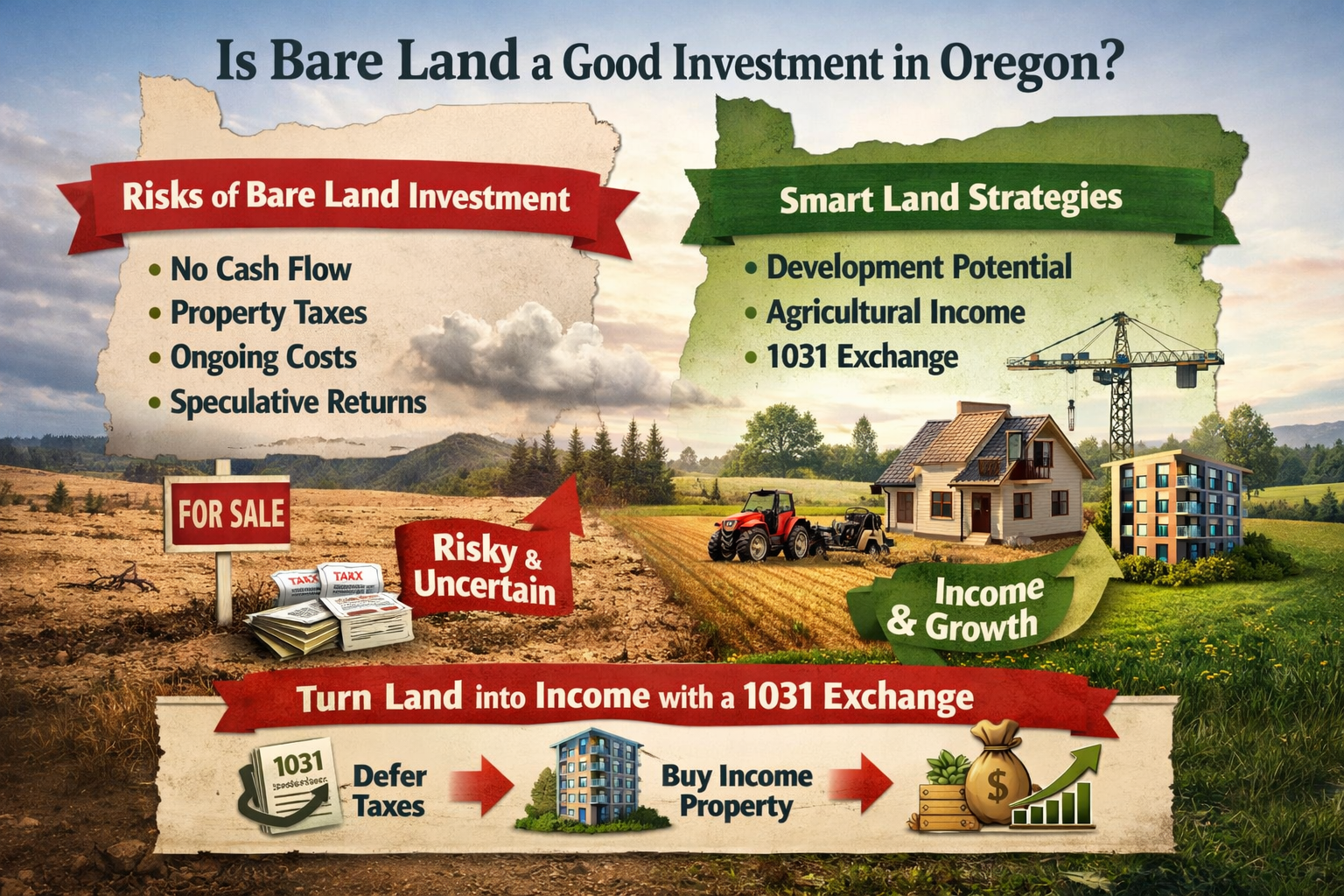
Is Bare Land a Good Investment in Oregon?
In most cases, bare land in Oregon is not a strong investment unless it produces income or has a clearly defined development strategy.
Bare land typically:
- Produces no monthly income
- Requires ongoing property tax payments
- Carries liability exposure
- Relies entirely on appreciation
Without income, land ownership becomes speculative rather than strategic.
That does not mean land is always a bad purchase. It means land must be evaluated differently than income-producing real estate.
This article breaks down the financial realities of owning vacant land in Oregon.
How Bare Land Generates Returns
There are only three primary ways bare land creates financial return:
- Appreciation
- Income (agriculture, timber, lease)
- Development or subdivision
If none of those exist, the land functions as a holding asset — not an investment.
Many landowners assume appreciation alone will justify ownership. That assumption deserves closer examination.
Does Bare Land Appreciate in Oregon?
Yes — land can appreciate.
However, appreciation rates vary widely depending on:
- Location (Salem vs rural counties)
- Zoning and development potential
- Access to utilities
- Infrastructure improvements
- Market cycles
Historically, vacant land appreciation is often slower and more volatile than improved property.
Unlike rental property, land does not generate income while waiting for value growth. That delay creates opportunity cost.
Appreciation vs Inflation
A critical question many landowners overlook is:
Does appreciation consistently outpace inflation?
If land appreciates at 2–3% annually but inflation averages near or above that rate, the real purchasing power of that asset may not increase meaningfully over time.
Without income, appreciation must do all the work.
That is a significant risk factor.
The Hidden Costs of Owning Vacant Land in Oregon
Even when land produces no income, expenses continue.
Common holding costs include:
- Property taxes
- Liability insurance (if applicable)
- Maintenance or clearing
- Access road upkeep
- Survey or legal clarification costs
Over five to ten years, these costs accumulate.
Additionally, capital tied up in non-producing land cannot be deployed into income-producing assets.
That opportunity cost often becomes the largest invisible expense.
Risk Factors Unique to Oregon Land
Oregon land carries additional considerations:
- Zoning restrictions
- Forest and environmental regulations
- Access limitations
- Utility availability
- Wetland or land use constraints
For example, timberland requires careful valuation and regulatory understanding. Agricultural land must meet income and use standards. Urban infill land depends heavily on local planning requirements.
Without professional evaluation, buyers may overestimate land potential.
Bare Land vs Income-Producing Property
A useful comparison is between:
Vacant land
and
Rental or commercial property
Income-producing property offers:
- Monthly cash flow
- Inflation hedge
- Tax advantages
- Greater leverage potential
Bare land offers:
- Appreciation potential
- Lower management involvement
- Development upside (if applicable)
However, income dramatically changes the risk profile.
Investors often prioritize cash flow because it stabilizes returns.
When Bare Land Does Make Sense in Oregon
Bare land can be strategic under certain conditions:
- Clear Development Plan
If zoning allows subdivision, partitioning, or construction within a defined timeframe.
- Income-Producing Use
Agricultural lease, timber harvest cycle, or commercial ground lease.
- 1031 Exchange Strategy
Land may serve as transitional property in a larger reinvestment plan.
- Long-Term Strategic Hold
When part of a broader portfolio with diversification goals.
Without one of these, land often underperforms compared to income assets.
The Role of 1031 Exchanges for Landowners
Many Oregon landowners consider repositioning non-producing land through a 1031 exchange.
A properly structured 1031 exchange allows:
- Deferral of capital gains tax
- Reinvestment into income-producing property
- Portfolio restructuring
Vacant land qualifies for 1031 exchange treatment if held for investment purposes.