Does Land Appreciation Beat Inflation in Oregon?
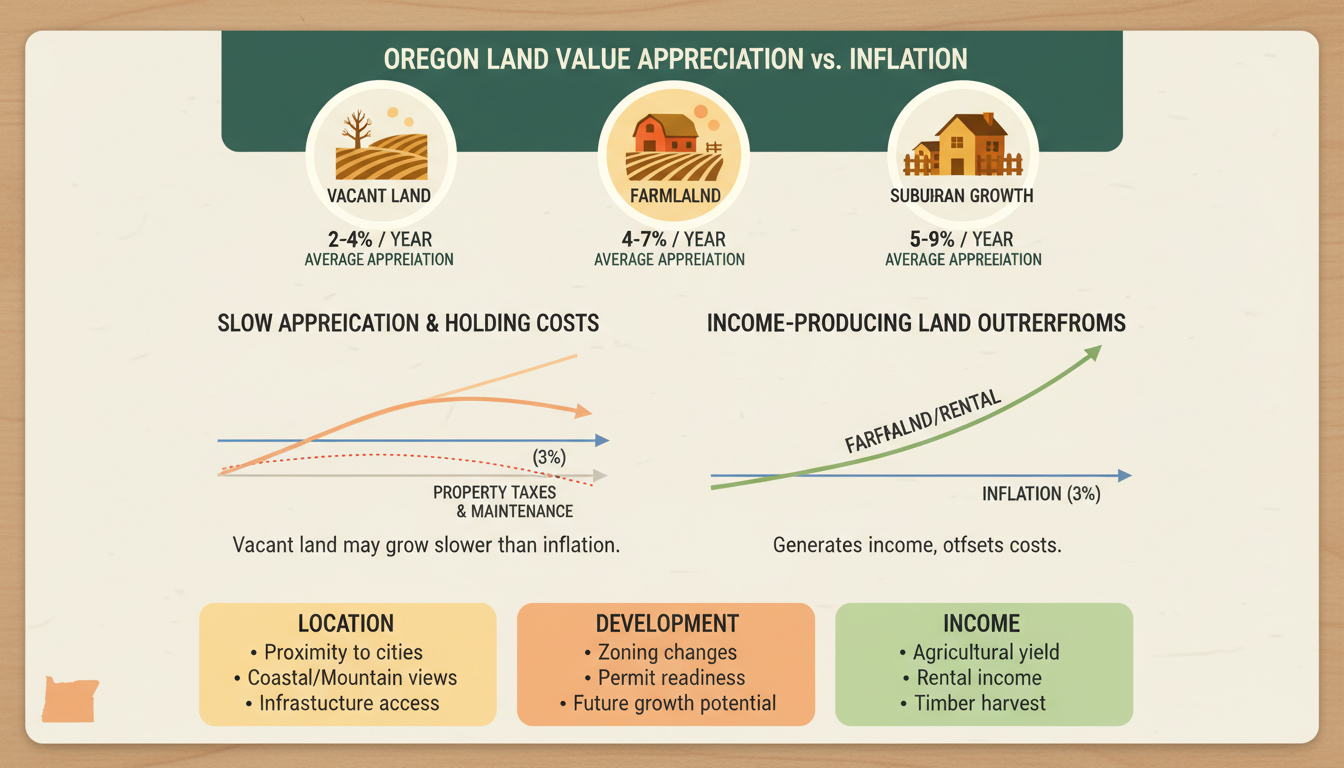
In many cases, land appreciation in Oregon does not consistently beat inflation unless the property has income, development potential, or a clear strategic catalyst.
Land can increase in price over time.
But price increases alone are not the same as real financial returns.
To understand whether land truly builds wealth, appreciation must be measured after inflation and holding costs.
This article explains how inflation affects land value, why appreciation often falls short, and when land can outperform.
What Appreciation Really Means
Appreciation is the increase in a property’s market value over time.
For vacant land, appreciation is usually driven by:
- Population growth
- Infrastructure expansion
- Zoning or land-use changes
- Scarcity in desirable locations
Unlike income-producing real estate, land has no built-in return mechanism while it is held.
That means appreciation must do all the work.
What Inflation Does to Real Returns
Inflation reduces purchasing power.
If inflation averages 3% per year, an asset must appreciate more than 3% annually just to maintain real value.
If land appreciates at 2–3% per year:
- Nominal value may increase
- Real purchasing power may stagnate or decline
This distinction is often overlooked.
Rising prices feel like progress, but without exceeding inflation, real wealth does not grow.
Historical Context: Land Appreciation vs Inflation
While exact appreciation varies by parcel and time period, vacant land historically:
- Appreciates more slowly than improved property
- Shows greater volatility
- Underperforms during market slowdowns
Improved property benefits from:
- Rental income
- Replacement cost increases
- Demand for housing or commercial use
Vacant land depends almost entirely on future demand — which may take years to materialize.
During inflationary periods, income-producing assets often adjust faster than land.
The Problem With “Land Always Goes Up”
Many landowners rely on a simple belief:
“Land always goes up.”
Land may rise in price over long periods, but:
- Growth is not steady
- Timing matters
- Liquidity is limited
- Costs continue during holding
If land appreciates unevenly and inflation rises steadily, the net result may be underperformance.
Price movement without income creates uncertainty.
Holding Costs Reduce Real Performance
Inflation is not the only drag on returns.
Vacant land in Oregon typically incurs:
- Property taxes
- Maintenance or clearing
- Access road upkeep
- Insurance or liability exposure
- Opportunity cost of idle capital
When these costs are combined with inflation, appreciation must exceed a higher threshold to generate real return.
Without income, landowners absorb these costs directly.
Opportunity Cost During Inflationary Periods
Opportunity cost becomes more significant when inflation rises.
Capital tied up in non-producing land cannot be deployed into assets that:
- Increase rents
- Adjust pricing with inflation
- Produce monthly cash flow
Income-producing property often provides:
- Inflation-adjusting revenue
- Tax advantages
- Debt amortization
When inflation accelerates, income matters more.
Land without income becomes relatively weaker.
When Land Can Beat Inflation in Oregon
Land can outperform inflation under specific conditions:
- Development Catalyst Exists
Zoning changes, urban growth boundary expansion, or infrastructure investment.
- Strong Location
Urban fringe land near Salem or expanding employment centers.
- Income Component
Agricultural lease, timber harvest, or commercial ground lease.
- Strategic Timing
Acquired before demand increases or regulatory changes occur.
Without one of these factors, appreciation alone may not exceed inflation consistently.
Timberland and Agricultural Land Considerations
Some Oregon land generates income through:
- Timber harvest cycles
- Agricultural leases
Income changes the equation.
Even modest revenue can:
- Offset holding costs
- Reduce inflation erosion
- Improve long-term performance
However, income must be consistent and well-managed.
Timberland valuation, harvest timing, and regulatory compliance all affect results.
Comparing Land to Income-Producing Property
Vacant Land:
- Appreciation dependent
- Inflation sensitive
- No income offset
- Speculative timing
Income-Producing Property:
- Monthly cash flow
- Inflation-adjusting rents
- Principal reduction
- Appreciation
During inflationary periods, income property often provides better protection.
This is why many investors prioritize income first.
Using a 1031 Exchange to Improve Performance
Some Oregon landowners choose to reposition land through a 1031 exchange.
A properly structured 1031 exchange allows:
- Sale of investment land
- Deferral of capital gains taxes
- Reinvestment into income-producing property
This strategy converts appreciation-only exposure into income-supported performance.
Timing, replacement property selection, and compliance are critical.
Each situation requires analysis.
Special Considerations in Salem and the Willamette Valley
In Salem and surrounding areas, appreciation potential depends on:
- Urban growth boundaries
- Zoning flexibility
- Infrastructure expansion
- Proximity to services
- Development feasibility
Land near expanding city limits may outperform inflation.
Remote acreage without income may not.
Local evaluation is essential.
Common Misunderstandings About Inflation and Land
“Any appreciation is good”
Appreciation must exceed inflation and costs to create real value.
“Land is inflation-proof”
Without income, land does not automatically hedge inflation.
“Time fixes everything”
Time without income compounds opportunity cost.
Understanding these distinctions improves decision-making.
Frequently Asked Questions
Does land appreciation usually beat inflation?
Not consistently, unless income or development potential exists.
Is land a hedge against inflation?
Land without income is a weak inflation hedge compared to income-producing property.
Can agricultural land beat inflation?
It can if income offsets costs and demand remains strong.
Does location matter?
Yes. Location is one of the strongest drivers of real appreciation.
How can landowners reduce inflation risk?
Through income, development, or repositioning strategies such as a 1031 exchange.
Final Analysis
Land appreciation in Oregon does not automatically beat inflation.
Without income, holding costs and opportunity cost reduce real returns.
Land can outperform when tied to development, income, or strategic timing.
Without those elements, appreciation alone often fails to create meaningful wealth growth.
Understanding inflation’s impact allows landowners to move from assumption-based decisions to strategy-based planning.