
How to Sell Land Through Probate in Oregon: A Step-by-Step Guide

From an Oregon Land Specialist Who Works Directly With Executors, Heirs, and Estate Attorneys Selling land through probate is one of the more stressful real estate situations there is — you’re usually grieving, dealing with a court process you’ve never navigated before, sometimes coordinating with siblings or other heirs who don’t all agree, and trying to figure out what the land is even worth. Here’s a clear walkthrough of how an Oregon probate land sale actually works, so you at least know what to expect. Read more: Stepped-Up Basis on Inherited Oregon Property: How It Lowers Your Tax Bill First: do you need formal probate at all? Not every Oregon estate requires the full probate process. Oregon offers a simplified affidavit procedure for smaller estates — generally those valued under roughly $275,000, with additional limits on how much of that can be real property. If the estate qualifies, this route is dramatically faster and cheaper than formal probate. This is worth checking with an estate attorney before assuming you’re in for the long process, because a lot of families default into formal probate without confirming they actually need it. The formal probate timeline If the estate does require formal probate, plan for it to take four months or more from start to finish — often longer when real property is involved, multiple heirs need to be notified, or there are any disputes. For comparison, a typical Oregon home sale outside of probate closes in a matter of weeks; probate roughly quadruples that timeline at minimum, and land sales inside probate follow the same extended court-driven process as home sales do. Read more: Capital Gains Tax on Oregon Land Sales: What You’ll Actually Owe in 2026 The step-by-step process Step 1: Appoint a Personal Representative This is the person with legal authority to act on behalf of the estate, including selling real property. Nothing moves until this appointment is finalized. Step 2: Appraise the Oregon Property The court typically requires a formal appraisal to establish the property’s value as part of the estate. This appraisal also matters for the stepped-up basis calculation heirs will need later — I cover that connection in a separate article on stepped-up basis for inherited Oregon property. Step 3: Hire a Land Specialist and List the Property This is where working with someone who specifically understands both land and the probate process pays off — land valuation (especially for farmland, timberland, or bare acreage) is a different skill set than pricing a house, and probate sales carry extra procedural requirements a generalist agent may not be used to. Step 4: Review and Accept Buyer Offers This is notably higher than the deposit on a typical residential purchase, and it signals that offers on probate property are expected to be serious. Step 5: Obtain Court Approval Even after you’ve accepted an offer, it isn’t final — the court has to approve it. Step 6: Attend the Probate Confirmation Hearing This is the part that surprises most people: at the hearing, other potential buyers can actually show up and outbid the accepted offer in an open auction format, right there in the courtroom. The original buyer typically has a chance to match or beat any overbid. Step 7: Complete the Sale and Closing Probate sales are sold as-is, with no repair contingencies, and the estate generally cannot fund repairs before closing. Read more: Why Your Oregon Bare Land Isn’t Selling (And What to Do About It) Costs specific to probate sales Beyond normal closing costs, sellers in a probate sale typically also cover probate-specific expenses — executor fees, court filing fees, appraisal costs, and sometimes a probate bond. Altogether, these additional costs average around 2.4% of the purchase price on top of standard closing costs, according to industry data on Oregon probate sales. Factor this into what the estate will actually net. Read more: Willamette Valley Farmland For Sale: What Buyers Need to Know Before You Buy in 2026 Why land makes probate sales even more complicated A house is a house — most buyers can evaluate it quickly. Farmland and timberland inside probate add extra layers: EFU zoning restrictions on who can even buy or use the land a certain way, farm deferral tax status that may need to be addressed at or before closing, water rights that need to be confirmed and disclosed, and sometimes boundary or access issues that have never been resolved because the land sat in the same family for generations without a survey. Every one of these needs to be sorted out before the court confirmation hearing, not discovered during it. What multiple heirs need to know When land passes to several heirs jointly through probate, everyone with an ownership interest generally needs to be kept informed and, in many cases, consent to the sale terms. I’ve found the estates that move through this smoothly are the ones where one person — often the personal representative — coordinates all communication with a single land specialist, rather than each heir fielding separate conversations. It keeps the process moving and avoids the confusion that stalls a lot of probate sales for months. How to make this go faster, not slower Working alongside your estate attorney, not around them I want to be clear about my role in a probate sale: I handle the land — valuation, marketing, buyer qualification, and coordinating the offer and confirmation process — while your estate attorney handles the legal administration of the estate itself. The two need to move in sync, especially around the appraisal and the confirmation hearing timeline. In every probate sale I’ve worked, the smoothest ones had the real estate side and the legal side talking to each other directly and early, rather than the personal representative relaying messages back and forth between two professionals who’d never spoken. Read more: How Do I Sell Timberland in Oregon? (What Buyers Want and How to Maximize Your Return) Frequently asked questions Do all heirs have to agree to sell
Stepped-Up Basis on Inherited Oregon Property: How It Lowers Your Tax Bill
From an Oregon Land Specialist Who Has Guided Multiple Heirs Through Selling Inherited Oregon Acreage If you inherited Oregon land, such as a family farm, timber ground, or acreage passed down for a generation or more, one of the most valuable things you can understand before selling is the stepped up basis. It’s the single biggest reason heirs often owe far less capital gains tax than they assume when they sell inherited property, and a lot of people list their land without ever finding out how much it actually helps them. Read more: Capital Gains Tax on Oregon Land Sales: What You’ll Actually Owe in 2026 What “basis” means, and why it matters Your basis in a property represents what the IRS considers your cost in it. You use this amount to calculate your taxable gain when you sell the property. If you bought land for $100,000 and sold it for $400,000, your gain is roughly $300,000, and that’s what capital gains tax applies to. Basis is the foundation the whole tax calculation sits on. Why inherited land gets a different basis than purchased land When you inherit property instead of buying it, the tax code generally lets your basis “step up” to the property’s fair market value on the date the person you inherited it from passed away — not what they originally paid for it decades earlier. This matters enormously for Oregon land, because a huge amount of Oregon farmland and timberland has been in families for 40, 50, even 100+ years, often purchased for a tiny fraction of today’s value. A simplified example: Say your grandfather bought 80 acres of Willamette Valley farmland in 1975 for $20,000. If he still owned it when he passed and you inherited it, your basis isn’t $20,000 — it’s roughly what that land was worth on his date of death, which today might be $600,000 or more. If you sell it for $650,000, you calculate your taxable gain using the stepped up $600,000 basis rather than the original $20,000 basis. You would owe capital gains tax on roughly $50,000 of gain instead of $630,000. This difference can turn a potentially devastating tax bill into a much more manageable one. Read more: Why Your Oregon Bare Land Isn’t Selling (And What to Do About It) This is why the “just sell it, taxes will eat it anyway” assumption is often wrong I regularly talk to heirs who assume that selling inherited land will trigger a massive tax bill because the property has appreciated so much since the original purchase. They often feel genuinely surprised when they learn how much stepped up basis can protect them. This doesn’t mean there’s zero tax; appreciation since the date of death is still taxable gain. But it usually means the number is far smaller than people fear, and that fear alone shouldn’t drive a rushed decision to sell below value or accept a lowball cash offer just to “get it over with.” How to actually establish your stepped-up basis This is the part that trips people up, because it requires documentation, not guesswork: Get a date of death appraisal, or obtain a retrospective appraisal if you did not get one at the time. This document establishes your new basis. Without it, you may have a much weaker position with the IRS if it questions your return. Check whether the estate went through probate, and if so, whether an appraisal was already filed as part of that process — it may already exist in the court file. Document any capital improvements made to the property since you inherited it (a new well, road work, structures), since those add to your basis going forward. Confirm how the property was titled — jointly owned property, property in a trust, and property owned solely by the decedent can each be treated differently for basis purposes. How this connects to selling through probate If the land is still working its way through the probate process rather than already being in your name, the sale and the basis question often move together. I’ve written a separate, detailed article on how the Oregon probate sale process actually works, timeline and all, if that’s where you’re at. Read more: Willamette Valley Farmland For Sale: What Buyers Need to Know Before You Buy in 2026 What if multiple heirs inherited the land together? This is extremely common with Oregon farmland and timberland — three, four, sometimes eight or more siblings and cousins inheriting a share of the same parcel. Each heir generally gets their own proportional stepped-up basis, but decision-making gets complicated fast when that many people need to agree on price, timing, and whether to sell at all versus keep it in the family. In my experience, the parcels that sit unsold longest — and the ones that generate the most family friction — are almost always the ones with multiple heirs and no single point person coordinating the sale. Having one specialist manage communication, valuation, and offers for the whole group tends to be the difference between a smooth close and a year of stalled phone calls. What to do if you’re not ready to sell yet Understanding your stepped-up basis matters even if you’re not planning to sell right away. If you decide to keep the land for now, document everything — the date-of-death appraisal, any improvements, and how the property is titled — while the information is still easy to gather. I regularly hear from heirs years later trying to reconstruct records that would have taken one phone call to get right at the time. Getting this documentation in order early also means that whenever you do decide to sell, whether that’s next year or in twenty years, you’re not scrambling to prove your basis under time pressure. Read more: What Is Oregon’s Urban Growth Boundary? How It Affects Your Land Value Don’t skip the CPA conversation I want to be direct about this: I’m a land specialist, not a tax professional, and
Capital Gains Tax on Oregon Land Sales: What You’ll Actually Owe in 2026
From an Oregon Land Specialist Who’s Helped Clients Structure Multi-Million-Dollar Land Sales, Including a $4M 1031 Exchange “How much am I going to lose to taxes?” is usually the very first question I get from a landowner thinking about selling — and it should be. Before you accept an offer, list a parcel, or start a 1031 exchange, you need a realistic picture of what capital gains tax on an Oregon land sale actually looks like. Here’s the straight version, in plain English, with the caveat up front that I am a land specialist, not a CPA — the numbers below are general education, and you should run your specific situation past a tax professional before you sell. Read more: Willamette Valley Farmland For Sale: What Buyers Need to Know Before You Buy in 2026 The two-layer tax you’re actually paying When you sell Oregon land for more than your cost basis, you owe tax at two levels: Federal long-term capital gains tax — if you’ve owned the land more than a year, your federal rate is 0%, 15%, or 20%, depending on your total taxable income for the year. Most landowners selling appreciated Oregon acreage land in the 15% or 20% bracket. Oregon state tax — this is the part that surprises a lot of sellers. Oregon does not have a separate, lower capital gains rate the way some states do. Plus, Oregon taxes capital gains as ordinary income, at Oregon’s regular income tax brackets, up to a maximum rate of 9.9%. Stack those together and a higher-income seller can be looking at combined federal-plus-state tax approaching 30% of the gain — meaningfully more than sellers expect if they’ve only thought about the federal number. Read more: Why Your Oregon Bare Land Isn’t Selling (And What to Do About It) A simple example (illustrative only) Say you bought 40 acres of Oregon bare land years ago for $120,000, and today it’s worth $420,000. Your gain is roughly $300,000. If you’re in a high federal bracket (20% long-term rate) and Oregon’s top rate applies to the gain, you could owe somewhere in the range of $85,000-$90,000 in combined federal and state tax on that sale — before any selling costs are factored in. Every number in that example changes based on your actual basis, your income, deductions, and whether any of the gain qualifies for special treatment, so treat it as illustrative, not a quote for your parcel. Read more: Willamette Valley Farmland For Sale: What Buyers Need to Know Before You Buy in 2026 What actually reduces the tax bill There are a handful of legitimate ways landowners lower what they owe on an Oregon land sale — this is where a good CPA earns their fee: Timing matters more than people think Whether you close in December or January can shift which tax year the gain lands in, which matters if your income is unusually high or low in one of those years. Whether you’ve owned the land more than 12 months determines if you get long-term rates at all — selling short-term land gets taxed as ordinary income with no preferential rate. None of this is something to figure out after you’ve already accepted an offer; it needs to be part of the conversation before you set a closing date. Why this matters for how you price and negotiate Understanding your real, after-tax number changes how you think about offers. A seller who only thinks in gross sale price can turn down a perfectly good offer chasing a higher number that, after taxes, actually nets them less than a 1031 exchange into replacement property would have. This is exactly why I walk every seller through the tax and exchange picture before we ever talk about listing price — the goal isn’t the biggest sale number, it’s the biggest number that actually lands in your account. Read more: What Is Oregon’s Urban Growth Boundary? How It Affects Your Land Value Selling costs also reduce your taxable gain It’s worth remembering that your taxable gain isn’t simply sale price minus purchase price. Selling costs — real estate commissions, title and escrow fees, and certain closing costs — generally reduce the amount subject to capital gains tax, the same way capitalized improvements to your basis do. Sellers who forget to account for this sometimes overestimate their tax bill and undervalue what a professionally marketed sale actually nets them versus a quick cash offer with a lower gross price but fewer costs offsetting the gain. Your CPA can walk through exactly which costs on your closing statement count toward this. Why sellers sometimes rush — and regret it I’ve seen sellers accept a fast cash offer specifically to “avoid the tax hit,” without realizing the tax calculation is largely the same regardless of who buys the land or how quickly it closes. The tax is driven by your gain, your income, and your holding period — not by whether you sold through a traditional listing or a quick cash buyer. Rushing a sale to dodge taxes that apply either way usually just means leaving money on the table from a lower sale price, without actually reducing what you owe. Frequently asked questions Does Oregon have a separate capital gains tax rate? No. Oregon taxes capital gains as ordinary income under the state’s regular income tax brackets, topping out at 9.9%. Do I owe capital gains tax if I inherited the land? Possibly much less than you’d think, because of stepped-up basis. See my separate article on inherited Oregon property for the full explanation. Can I avoid capital gains tax entirely? A properly structured 1031 exchange defers (not eliminates) the tax by rolling proceeds into replacement property. Full elimination generally only happens through specific circumstances like certain inherited-property situations or if the gain falls within the 0% federal bracket. Should I talk to a CPA before or after I list my land? Before. The tax and exchange strategy can affect your asking price,
Why Your Oregon Bare Land Isn’t Selling (And What to Do About It)
From a Land Specialist and 30-Year Licensed General Contractor Who’s Sold Oregon Land for 20+ Years If you’ve had a parcel of Oregon bare land sitting on the market for months — or you’ve tried to sell it before and gave up — you’re not doing anything unusual. Bare land is a fundamentally different sale than a house. It moves slower, it attracts a smaller buyer pool, and it gets marketed wrong far more often than homes do. In my 20+ years selling Oregon bare land, EFU farmland, and timberland, I’ve walked into almost every version of “why isn’t this selling,” and it almost always comes down to one of six things. More About Me Why Your Oregon Bare Land Isn’t Selling 1. It’s priced off the wrong comparables The biggest reason bare land sits on the market is that sellers price it using home sale logic or a generic per acre figure from a national land website instead of using comparable local land sales. Land value depends on factors that home appraisals often overlook, including zoning, soil class, water rights, access, and buildability. Two ten acre parcels located half a mile apart can have very different values if one has EFU restrictions and no legal access while the other has road frontage and a septic approved building site. If you set your listing price using a Zillow style algorithm or a quick comparable search, you may have identified the first major problem. Learn more: How Do I Find Out If My Oregon Land Has Water Rights? (Step-by-Step Verification Guide) 2. Buildability was never confirmed — or never disclosed This is the one that kills deals late, after months of “interest” that never turns into offers. Buyers who are seriously looking at bare land almost always want to know: can I build here? That means: If your listing doesn’t answer these questions up front, serious buyers move on to a parcel that does — and you never even hear from them. 3. The marketing treated it like a house Land buyers search differently than home buyers, and they need different information. A listing with one blurry photo of a field and a description that says “beautiful acreage, great potential” tells a buyer nothing they can act on. What sells bare land is an aerial or drone shot showing the actual boundary and terrain, a soil map, a clear statement of zoning and permitted uses, water rights status, and — critically — distribution to land-specific buyer pools, not just the general residential MLS feed most agents rely on by default. 4. It’s carrying farm deferral and nobody explained what that means to a buyer If your land qualifies for Oregon’s farm use special assessment, which reduces property taxes for qualifying farmland or forestland, that status can add real value. However, it can also scare off buyers who do not understand the program. Worse, a sale can disqualify the land and leave the buyer with a back tax bill after closing. I cover exactly how that back-tax calculation works in a separate article, but the short version for sellers is: get ahead of this in your listing instead of letting a buyer’s attorney discover it during due diligence. Read more: Sell or Hold Oregon Bare Land? An Honest Financial Analysis (2026) 5. Title or boundary issues are sitting quietly in the background Rural Oregon parcels, especially those that families have owned for decades, often contain old mineral reservations, easements that owners never formally released, or fence lines that do not match the recorded legal description. These issues rarely stop a sale when sellers identify and address them early. They absolutely are deal-killers when a buyer’s title company flags them three weeks into escrow and the buyer walks. Having spent five years in the City of Salem survey department and growing up in a land surveying family, this is the first place I look on any listing I take. 6. The pool of buyers who’d actually want this specific parcel was never reached Land buyers are a niche audience: hunters, hobby farmers, timber investors, builders, 1031 exchange buyers, and people planning to build a homestead. They don’t all search the same places, and they respond to different things — a builder cares about buildable acreage and utilities, a timber buyer cares about board-foot volume and access for equipment, a 1031 buyer cares about like-kind qualification and closing timeline. A generalist listing approach reaches none of them well. A land-specific approach — the right photos, the right facts, the right distribution — reaches all of them. Read more: Willamette Valley Farmland For Sale: What Buyers Need to Know Before You Buy in 2026 What Actually Fixes a Stale Bare Land Listing If your parcel has been sitting, here’s the order I work through with a seller: Re-verify the comps with actual recent land sales — not home sales, not national averages. Run buildability and access down to a documented answer, so it can be stated as fact in the listing, not left as a question mark. Check farm deferral, tax-lot, and title status so nothing surprises a buyer’s attorney later. Rebuild the marketing around what land buyers actually need to see — boundary maps, zoning, water rights, access, and honest photos of the actual terrain. Get it in front of the specific buyer type this parcel fits — timber buyer, farm buyer, builder, or 1031 exchange buyer — instead of a generic listing feed. Most of the time, land that’s “not selling” isn’t actually unsellable. A quick gut-check before you assume the worst If you’re wondering whether your land is simply unsellable, it helps to separate the parcel from the process. A landlocked, unbuildable, badly zoned parcel is genuinely a harder sell — but that’s rare. Far more often, I find perfectly good land that’s simply never had its buildability confirmed, never been shown to the right buyer pool, or never had its price checked against real land comps. Before you assume there’s something fundamentally wrong with
What Is Oregon’s Urban Growth Boundary? How It Affects Your Land Value

Urban Growth Boundary: What Oregon’s Urban Growth Boundary is, how it affects land value near expanding cities, and the farm deferral tax difference on either side of it.
What Disclosures Are Required When Selling Land in Oregon? (Everything Sellers Must Know)

Disclosures: Everything Oregon land sellers are legally required to disclose under ORS Chapter 105 — and what happens when they don’t.
Sell or Hold Oregon Bare Land? An Honest Financial Analysis (2026)
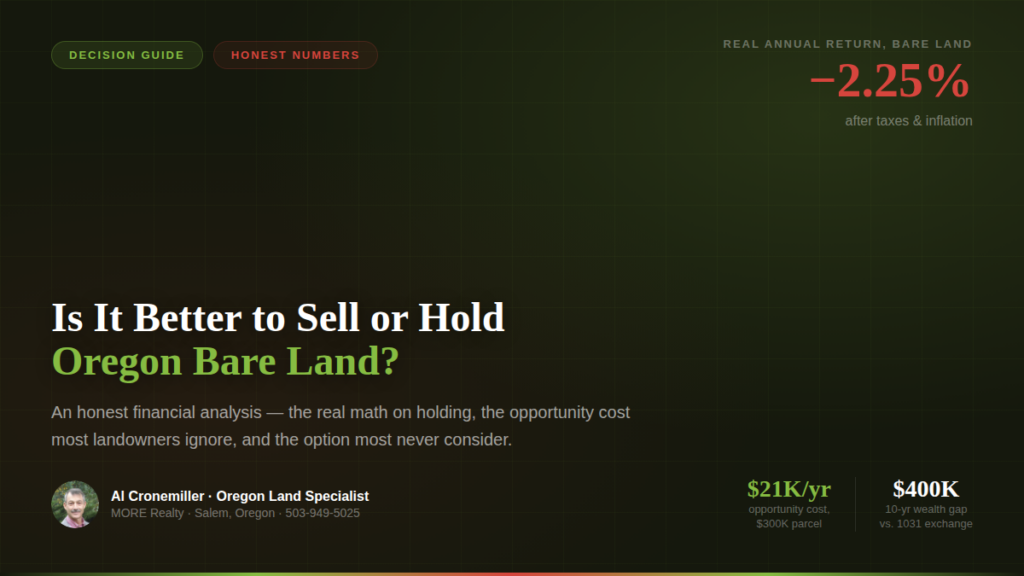
Sell or Hold: An honest financial analysis of holding vs. selling Oregon bare land, including the real math most landowners have never run.
How Do I Find Out If My Oregon Land Has Water Rights? (Step-by-Step Verification Guide)

Water Rights: A step-by-step guide to checking whether your Oregon land has water rights, using OWRD’s free public database — before you buy, sell, or price anything.
How Do I Avoid Capital Gains Tax When Selling Oregon Property? (Three Legal Tools That Work)
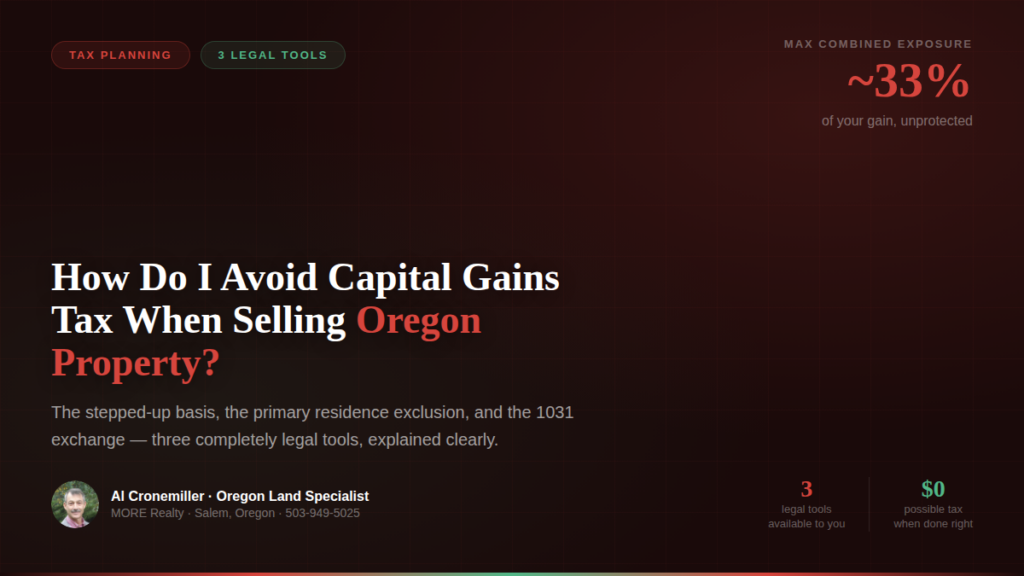
Capital Gains Tax: Three completely legal tools — the stepped-up basis, the primary residence exclusion, and the 1031 exchange — to reduce or eliminate capital gains tax on Oregon property.
Land Specialist vs Real Estate Agent in Oregon: What Bare Land Owners Need to Know

Specialist vs Agent: Why the difference between a land specialist and a residential agent can mean $30,000–$60,000 on a single Oregon land sale — and three questions to ask before you list.