
How to Value Bare Land in Salem Oregon Accurately

Valuing bare land in Salem, Oregon requires far more than comparing price per acre. Unlike residential property, land value depends on zoning, urban growth boundary placement, access, utilities, buildability, and realistic development potential. Two similar parcels can carry dramatically different values based on legal use and infrastructure availability. Accurate valuation begins with understanding what the land can actually become not simply what nearby listings are asking.
The Ultimate Guide to Owning Bare Land in Oregon

Owning bare land in Oregon may feel simple — but simplicity does not equal profitability. While vacant land avoids tenants and maintenance, it often produces no income and quietly absorbs capital through taxes, inflation, and opportunity cost. The real performance of land depends on zoning, income potential, development feasibility, and long-term strategy. Before you continue holding, it’s worth asking: Is your land functioning as an investment or simply sitting idle?
The Complete Guide To 1031 Exchanges For Oregon Landowners

If you own bare land in Oregon that isn’t generating income, you may be sitting on idle capital. While property taxes, insurance, and inflation continue to erode returns, your equity remains locked in a non-performing asset. A properly structured 1031 exchange allows you to defer capital gains taxes and reinvest 100% of your proceeds into income-producing real estate — transforming underperforming land into long-term cash flow and portfolio growth. Here’s how Oregon landowners are using this strategy to reposition for stronger financial outcomes.
Does Land Appreciation Beat Inflation in Oregon?
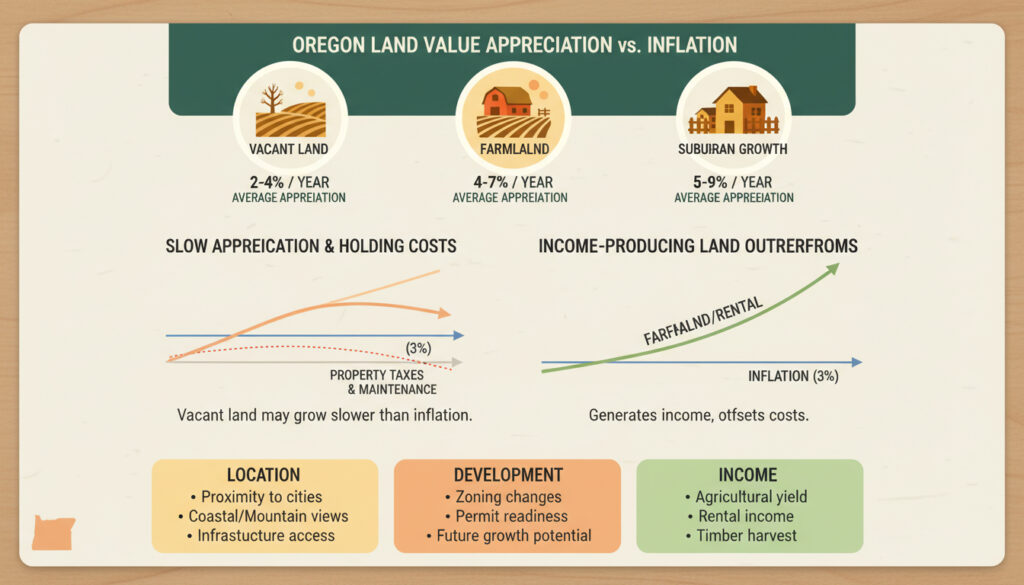
Land can rise in value, but without income or development potential, it often fails to outpace inflation. Strategic location, income, or timing are key for real wealth growth.
Should I Sell My Land in Oregon or Keep It Long Term?

In Salem and across the Willamette Valley, land value isn’t just about acreage it’s about zoning, urban growth boundaries, utility access, and long-term development potential. While emotional attachment often influences decisions, smart landowners evaluate holding costs, appreciation potential, and tax strategy before choosing to keep or sell. The right move isn’t about sentiment it’s about strategy, timing, and financial alignment.
What Are the Hidden Costs of Owning Vacant Land in Oregon?

Owning vacant land in Oregon may seem simple but the real costs often go unnoticed. From property taxes and opportunity cost to liability risk and regulatory limits, holding land without income can quietly erode long-term performance.
Why Bare Land Often Underperforms in Oregon Real Estate
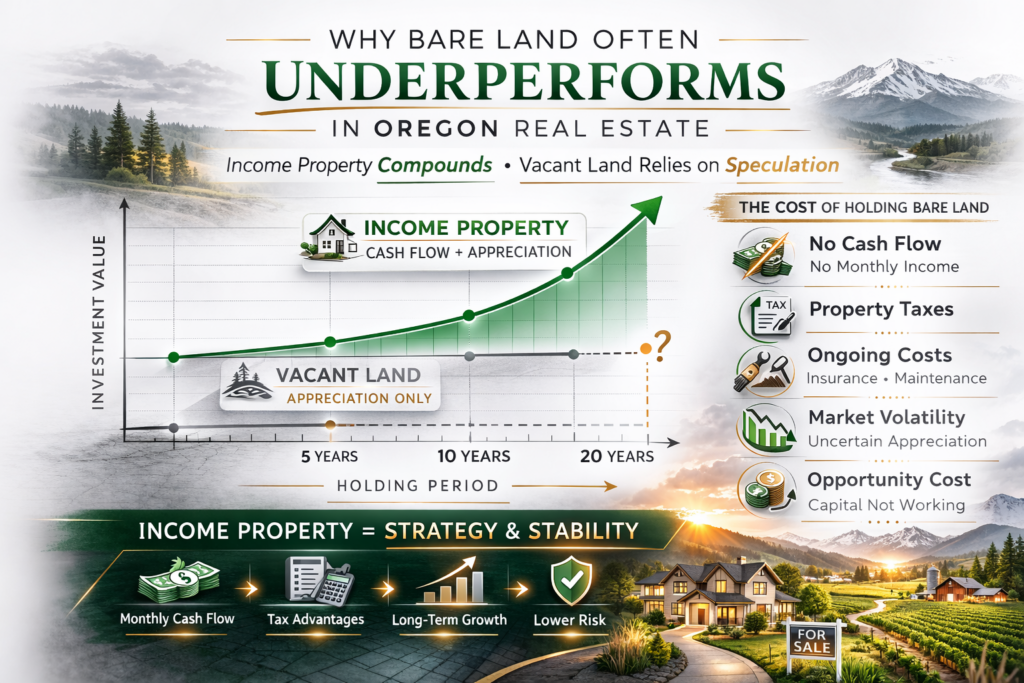
Not all land is created equal. Before you sell or hold inherited property, understand its true potential. The right strategy could turn idle land into a powerful investment opportunity.
Is Bare Land a Good Investment in Oregon?

Is bare land in Oregon truly an investment or is it speculation? While many assume land naturally appreciates over time, vacant property produces no income, requires ongoing holding costs, and relies entirely on future demand. Without a clear development plan or income strategy, bare land often underperforms compared to income-producing real estate. Before you hold or sell, it’s important to understand the numbers behind the narrative.
Identifying A Qualified Intermediary For A 1031 Exchange

1031 exchanges are an important tool for real estate investors and property owners. They allow for the deferment of capital gains taxes when a property is sold and a new one purchased. It is crucial to ensure that the process is done correctly and that the right qualified intermediary is chosen. In this blog post, we will discuss the important factors to consider when selecting a qualified intermediary for a 1031 exchange. What Is A 1031 Exchange? A 1031 exchange, also known as a like-kind exchange, is a type of tax deferment in which an investor sells a property and then purchases another, while deferring capital gains tax on the sale. It must be done in accordance with the Internal Revenue Service (IRS) rules. Why Is A Qualified Intermediary Necessary? A 1031 exchange is an IRS-recognized tax deferral program that allows an investor to exchange an investment property for another property of like-kind. This exchange allows an investor to defer the capital gains tax on an investment property by reinvesting the proceeds from the sale into a new property. To facilitate this exchange, an investor is required to hire a Qualified Intermediary (QI). A QI is a neutral third party who holds the proceeds from the sale of the relinquished property and facilitates the exchange. They are experienced in the 1031 exchange process and will handle the required paperwork, provide guidance, and ensure that the exchange meets the IRS requirements. The QI is critical to the 1031 exchange process as they are responsible for holding the proceeds from the sale of the relinquished property in a trust or escrow account. They will then use the proceeds to purchase the replacement property. Without the QI, the investor would be in possession of the proceeds, which would disqualify the exchange for tax deferral. The QI also provides additional safeguards for the investor. They will ensure the paperwork is filled out properly, the exchange meets the IRS requirements, and the exchange is completed within the specified timeline. If the exchange is not completed within the specified period, the investor would be liable for the capital gains tax on the relinquished property. In short, a Qualified Intermediary is necessary for a 1031 exchange as they are responsible for handling the paperwork, providing guidance, and ensuring the exchange meets the IRS requirements. They provide additional safeguards to the investor by holding the proceeds from the sale of the relinquished property and ensuring the exchange is completed within the specified timeline. Without a QI, the 1031 exchange would not be eligible for tax deferral. What Factors Should You Consider When Choosing A Qualified Intermediary? 1. Experience: When selecting a qualified intermediary for a 1031 exchange, it is important to consider their experience in the field. An experienced professional will be able to provide advice on the most tax-efficient strategies and ensure that the process is completed within the allotted time frame. They should also be familiar with the local and state regulations that apply to 1031 exchange transactions. Additionally, an experienced intermediary will be able to provide guidance on structuring the exchange to reduce the tax liabilities associated with the transaction. They should also be able to provide assistance in obtaining financing and helping to identify suitable replacement properties. Having an intermediary with extensive experience in the 1031 exchange field can be invaluable in ensuring a successful transaction. 2. Reputation: A qualified intermediary is responsible for facilitating the 1031 exchange properties and must have a solid understanding of all applicable laws. They must also have a proven track record of successful transactions. To ensure you are working with a qualified intermediary who will provide the highest quality of service, it is important to research the company’s reputation. Ask for references from past clients, look for online reviews, and read industry publications to get an understanding of the company’s reputation and the services they provide. You should also look for a qualified intermediary who is a member of a professional organization and keeps up to date on the changing regulations and laws. Working with a qualified intermediary who has a good reputation will give you the confidence and peace of mind needed to make a successful 1031 exchange. 3. Fees: The fees charged by the qualified intermediary should be reasonable and in line with the industry standard. It is important to make sure that the fees are transparent and that there are no hidden costs. 4. Availability: The qualified intermediary should be available to answer questions and provide advice throughout the exchange process. It is important to have a good working relationship with your intermediary and to feel comfortable that they are knowledgeable and reliable. 5. Insurance: The qualified intermediary should have the necessary insurance to protect your funds in the event of any unforeseen circumstances. 6. Communication: It is important that the qualified intermediary is able to communicate effectively with the investor and other parties involved in the exchange. They should be able to provide updates and answer questions in a timely manner. 7. Documentation: The qualified intermediary should provide all of the necessary documentation in a timely manner and should be able to explain the process in detail. 8. Technology: Many qualified intermediaries offer online services that allow investors to track the progress of their exchange. It is important to choose an intermediary that has the necessary technology to make the process more efficient. 9. Financial Strength: The qualified intermediary should have the financial strength to handle large transactions. They should also be able to provide the necessary escrow services to secure the funds from the sale of the relinquished property. 10. Network: The qualified intermediary should have a network of contacts that can help with the 1031 exchange process. This could include real estate agents, accountants, and lawyers. 11. Compliance: The qualified intermediary should be up to date with the latest regulations and ensure that the exchange is done in accordance with the IRS rules. Conclusion Choosing the right qualified intermediary for
How To Leverage The Oregon Property Exchange For Maximum Profits

Introduction The Oregon Property Exchange (OPE) is a popular real estate tool that allows investors to buy and sell properties without paying taxes on the profits. With the OPE, investors can take advantage of many of the benefits that come with 1031 exchange properties, such as deferring capital gains taxes and exchanging like-kind properties. In this blog post, we will explore how to leverage the Oregon Property Exchange for maximum profits. What is the Oregon Property Exchange? The Oregon Property Exchange is a tax-deferral program designed to help Oregon residents and businesses maximize the value of their real estate investments. It allows property owners to exchange one property for another, while deferring taxation on any gain realized. In essence, you can trade “like-kind” properties of equal or greater value and defer paying taxes on any gain realized until you sell the new property. This can be a great way to diversify your portfolio, acquire more property, or upgrade to a better property. The Oregon Property Exchange allows you to defer capital gains taxes on the sale of a property while reinvesting the proceeds into a new property. In order to qualify, the properties must be of “like-kind”, meaning that they must be comparable in value and use. This could mean exchanging a rental home for a commercial building, or exchanging multiple residential properties for a single larger property. The exchange must also be completed within 180 days of the sale of the original property. The Oregon Property Exchange is a great way for Oregon property owners to benefit from tax deferral and reinvest their proceeds without facing a large tax burden. It can be an excellent way to diversify an investment portfolio, upgrade to a better property, or acquire more property. With careful planning, this type of exchange can help Oregon residents and businesses maximize their real estate investments. How Does the Oregon Property Exchange Work? The Oregon Property Exchange is a process that allows investors to acquire real estate and defer capital gains taxes. Through this process, an investor exchanges one property for another of equal or greater value. This exchange process is also called a “1031 exchange,” named after the section of the Internal Revenue Code that outlines the tax deferment rules. The Oregon Property Exchange process involves three main steps. First, the seller identifies a “like-kind” replacement property of equal or greater value within 45 days of the sale of their original property. This replacement property must be identified in writing and submitted to the IRS by the end of the 45-day period. Second, the seller must close on the replacement property within 180 days of the sale of the original property. The replacement property must be of equal or greater value, and all of the proceeds from the sale of the original property must be used to purchase the replacement property. Third, the seller must file Form 8824 with the IRS within 45 days of the closing of the replacement property. This form details the exchange and provides the necessary documentation to the IRS to show that the exchange was valid. The Oregon Property Exchange is a valuable tool for investors looking to defer capital gains taxes on their real estate investments. By following the three main steps outlined above, investors can benefit from deferring their capital gains taxes and reinvesting their proceeds into a new real estate investment. What Are the Benefits of Using the Oregon Property Exchange? There are several benefits to using the Oregon Property Exchange for real estate investments. Here are a few of the top benefits: Tax Deferment: The most obvious benefit of using the OPE is the ability to defer capital gains taxes on the sale of a property. This can be a huge benefit to investors, as it can help them save money and maximize their profits. Exchange Like-Kind Properties: The OPE also allows investors to exchange like-kind properties. This means that investors can trade one type of property for another, such as a house for a commercial building, without incurring any taxes. Cost Savings: Another benefit of using the OPE is the potential for cost savings. Because the OPE is an online marketplace, investors can save money by avoiding the high costs associated with traditional real estate transactions. Speed and Convenience: The OPE also makes it easy for investors to quickly and conveniently search for and purchase properties. With the OPE, investors can locate and purchase properties in a matter of minutes. Professional Guidance: The OPE also provides professional guidance for investors. The OPE’s experienced team of experts can help investors find the best deals and maximize their profits. How To Leverage The Oregon Property Exchange For Maximum Profits Now that we’ve discussed the benefits of the Oregon Property Exchange, let’s take a look at how investors can leverage the OPE to maximize their profits. Research the Market: The first step to leveraging the OPE for maximum profits is to research the real estate market. This means researching local markets, current trends, and properties that are available for purchase. This will help investors identify the best deals and maximize their profits. Create a Comprehensive Plan: Once investors have identified potential properties, they should create a comprehensive plan for their investments. This plan should include the budget, timeline, and goals for the investment. This will help investors stay on track and ensure that their investments are profitable. Utilize the OPE’s Services: The OPE offers several services that can help investors maximize their profits. For example, the OPE’s team of experts can help investors find the best deals and provide advice on how to maximize their profits. Network with Other Investors: Networking with other investors is another great way to leverage the OPE for maximum profits. By networking, investors can learn from the experiences of other investors and gain valuable insight into the real estate market. Stay Up-to-Date: It’s also important for investors to stay up-to-date on the latest news and trends in the real estate market. This will